
Security deposit when renting a campervan: how it works, when it's refunded and what can be deducted
Understand how the security deposit works when renting a campervan, when it's refunded, what damages can be deducted and why it's not the same as the excess.
The security deposit on a campervan rental is a financial guarantee tied to the contract. It covers damage, breaches of the agreement or costs attributable to the rental that are found when the vehicle is returned. If you hand back the campervan in the agreed condition and there's no outstanding issue, the deposit must be released or refunded according to the method and timeframe set out in the contract.
Before booking, check four things: the exact amount, how the deposit is taken, which situations allow deductions, and how long it takes to be released. Don't confuse this guarantee with the insurance excess: the two can be related when there's a claim, but they're not the same thing.
Quick answer: the amount and the terms that apply are the ones shown during your booking process and in beWinkle's current contract. Check these before paying. A figure you've seen in an old article, a review or an external comparison doesn't override the terms of your rental.
What is the security deposit when renting a campervan?
The security deposit is an amount the company holds as a guarantee during the rental. It's not a surcharge for using the campervan, nor a cost you automatically lose. Its purpose is to cover, within the limits of the contract and applicable law, any obligations left outstanding at the end of the trip.
These obligations may relate to new damage, missing items, fuel, extra cleaning, fines, tolls or other breaches set out in the terms. So you can weigh up the risk before booking, these items should be explained in the booking documentation.
The deposit also doesn't replace looking after the vehicle. Even though its amount sets the money withheld at the outset, damage excluded from the insurance or caused by use that breaches the contract can create a different kind of liability. That's why it's worth reading both the deposit terms and the insurance cover and exclusions.
Security deposit, excess and damage charge: they don't mean the same thing
| Term | What it means | When it applies |
|---|---|---|
| Security deposit | Financial guarantee tied to fulfilling the contract | Taken before the rental starts and reviewed at the end |
| Excess | The portion of an insured claim the customer bears under the policy | When a covered claim subject to an excess occurs |
| Damage or cost charge | A specific amount charged for a proven incident | After assessing the damage, cost or breach |
An example helps make this clear. If you return the campervan with no issues, there's no reason to apply the insurance excess and the deposit follows the normal release process. If a covered claim occurs, the relevant excess may apply. And if a cost arises that isn't linked to a claim — for example, a missing inventory item — how it's handled will depend on the contract.
beWinkle publishes a fully comprehensive insurance policy with a €600 excess per claim. For bookings of at least a week, it offers an extended cover option at €12 a day that reduces this excess to €200. These figures describe the insurance excess; on their own, they don't tell you what the deposit for your booking will be.
Before booking, check the cover and terms in beWinkle's help section and confirm which damage is covered, what's excluded and how each incident is handled.
How much is the security deposit on a campervan rental?
There's no universal amount across all companies, vehicles and dates. The figure can depend on current commercial terms, the model, the cover you've chosen or other features of your booking.
To find out how much you'll need to provide with beWinkle, use only these sources:
- the amount shown during the booking process;
- the confirmation you receive before pick-up;
- the contract and terms that apply to your dates;
- a written reply from the beWinkle team if you need to clarify a discrepancy.
Check the figure before paying for the rental and check it again before picking up the campervan. That way you'll have enough available balance and avoid a declined transaction delaying your departure.
Don't budget for the deposit as an ordinary trip expense, but do treat it as money that's temporarily unavailable. While it's held or awaiting refund, it can reduce the usable balance on your card or account.
How is the deposit taken or held?
A deposit can be managed through a card pre-authorisation, a temporary charge or another method set out by the company. The difference matters:
- Pre-authorisation: the bank sets aside part of your available limit, though the transaction doesn't work like an ordinary purchase.
- Charge: the amount leaves your account or appears as a recorded transaction, and must then be refunded.
- Other accepted deposit method: governed by the specific terms communicated to the customer.
Don't assume which system beWinkle will use in your case. Confirm the accepted method, the type of card, who needs to present it, and when the guarantee is formalised.
What to check if a card is used
- that it's valid for the whole rental period;
- that the cardholder will be present at pick-up if the terms require this;
- that it has sufficient balance or limit;
- that it allows pre-authorisations or charges for vehicle rental;
- that you know the PIN in case it's needed;
- that your bank won't block the transaction as a security measure.
A card with a high overall limit may not have enough available limit if it's already carrying other purchases or deposits. Check the usable balance, not just the nominal limit.
When is the security deposit refunded?
The refund process begins once the condition of the campervan is checked and it's confirmed there's nothing outstanding. How long it takes before the money is available to you again can also depend on the method used and your bank's processing times.
The usual process follows these stages:
- Returning the vehicle: you hand back the campervan at the agreed place, date and time.
- Inspection: its condition is compared with the pick-up record, and the equipment, fuel and handover condition are checked.
- Closing or investigation: if there's no issue, release begins; if there is one, it may need to be documented and assessed.
- Payment handling: the company releases the pre-authorisation or issues the refund according to the method used.
- Bank processing: the bank updates the available balance or records the credit.
Ask before booking which contractual timeframe applies and from what point it starts counting. It's also worth knowing whether you'll get confirmation when beWinkle orders the release. That date lets you tell the difference between something still pending on the company's side and something already being processed by the bank.
Why can a deposit take longer?
Closing the deposit can be delayed if damage is found, documentation about an incident is missing, the cost of a repair is still pending, or later charges linked to the trip are still to arrive. For example, some fines or tolls aren't notified at the time the vehicle is returned.
If no incident has been reported and the contractual timeframe has already passed, ask in writing for the release or refund date and reference so you can check it with your bank.
In which cases can money be deducted from the deposit?
The specific scenarios depend on the contract. Items commonly covered in a campervan rental can include:
- new damage to the vehicle, furnishings or equipment;
- missing or broken inventory items;
- damage caused by unauthorised use;
- fuel or consumables handed back below the agreed level;
- extra cleaning when the terms haven't been followed;
- late return of the vehicle;
- lost keys or documents;
- fines, tolls or admin costs attributable to the rental period;
- costs arising from failing to properly report an accident or breakdown.
This list is a guide to what you should check, but it doesn't extend beWinkle's actual terms. Only the items set out in the contract, and duly justified, can be applied.
Damage that's covered and damage that's excluded
Having fully comprehensive insurance on the campervan doesn't mean every situation is covered without limits. Policies usually include excesses, exclusions and reporting obligations. An unauthorised driver, negligent use, ignoring the vehicle's dimensions or carrying on driving after a warning can all change how damage is treated.
If something happens, stop somewhere safe, document what occurred and contact beWinkle before arranging any repairs. The guide on what to do if a rented campervan breaks down explains the procedure step by step.
What to check at pick-up to protect your deposit
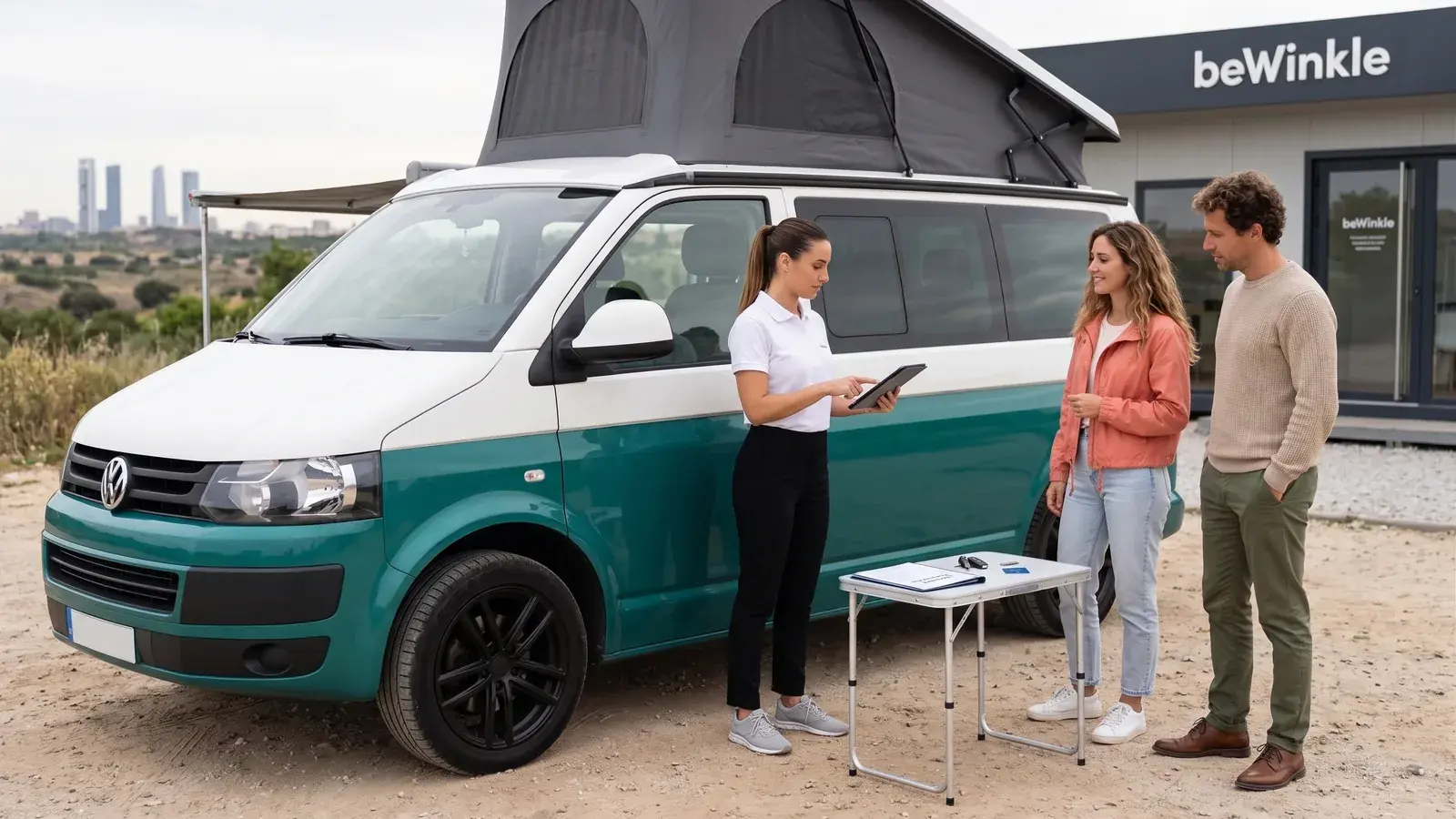
The best prevention is spending time on the handover. At beWinkle, the check is carried out together with the customer, and the vehicle's prior condition is documented with photographs and an attached record. Make sure the record reflects any mark or defect that already existed before you set off.
Use this checklist:
- check the bodywork, windows, wheels, tyres and mirrors;
- check the roof, awning and any accessible exterior parts;
- test the doors, windows, locks and blackout blinds;
- check the furniture, bed, kitchen, bathroom and tanks depending on the model;
- confirm the inventory and the condition of every accessory;
- note the fuel level and mileage;
- make sure the photos are clear and attached to the handover record;
- ask for any discrepancy to be added to the record before you sign.
This isn't about distrust — it's about setting a shared reference point. A clear record protects both parties and makes it easier to tell a pre-existing issue apart from something that happened during the rental.
How to return the campervan and avoid unexpected deductions
Set aside enough time to prepare the return. Rushing increases the risk of forgetting something or handing the campervan back outside the agreed terms.
- Check the exact drop-off time and location.
- Refuel to the level set out in the contract and keep the receipt.
- Empty any tanks that need to be handed back empty and follow the cleaning instructions.
- Take your belongings with you without taking any inventory accessories.
- Put everything back in its place and check nothing's missing.
- Take dated photos of the exterior, interior, dashboard, fuel gauge and mileage.
- Do the check together with the beWinkle team whenever possible.
- Ask for written confirmation of the handover and of any issue found.
If you've caused or found a defect during the trip, report it. Hiding it can make the insurance process harder and delay the resolution. Explain what happened, when, where and what you did about it.
What to do if you disagree with a deduction
Ask for a written explanation and gather the documentation before disputing the amount. Request:
- the exact item being charged;
- the relevant clause in the contract;
- the pick-up and drop-off photographs;
- the damage report, if there is one;
- the invoice, quote or valuation method used;
- how the charge relates to the insurance cover;
- the calculation of the remaining deposit balance.
Compare this information with your own photos, the handover record, your correspondence and your trip receipts. If part of the deposit isn't affected by the issue, ask how and when the undisputed balance will be released.
Book knowing what you'll pay and what money will be held
Before choosing your dates, add up the rental cost, the mileage package, any extras and the temporary balance you'll need for the deposit. Then check the insurance excess and exclusions separately.
Check the available campervans and review the terms that apply to your booking. If any amount or timeframe isn't clear, get it sorted in writing before you pick up your Winkle.
Content reviewed in July 2026. The contractual terms in force at the time of booking take precedence over this guide.
Frequently asked questions
Is the security deposit part of the rental price?
No. The deposit works as a temporary guarantee. The price pays for use of the vehicle and any services booked; the deposit is released or refunded once the rental is closed with nothing outstanding.
Are the deposit and the excess the same thing?
No. The deposit guarantees obligations under the contract. The excess is the portion of an insured claim that falls to the customer under the policy. A rental can involve both, and their amounts don't have to match.
Does extended cover remove the deposit?
Don't assume this. The extended cover published by beWinkle reduces the insurance excess from €600 to €200 on bookings that meet its conditions. Check separately whether — and how — this affects the deposit on your booking.
Can the whole deposit be withheld for minor damage?
During the assessment, the full amount set out in the terms may be held, but the final charge must correspond to items covered by the contract and must be justified. Ask for the breakdown, the damage documentation and the balance that should be refunded.
When does a pre-authorisation become available again?
It depends on the contractual timeframe, the date the company releases it, and your bank's processing. Ask for the release reference if the rental has already been closed and the balance still isn't showing as available.
What happens if I get a fine after getting my deposit back?
Fines and some tolls can be notified after the rental ends. How they're handled is set out in the contract, and this doesn't necessarily go away just because the deposit has already been released. Check whether any admin costs apply.
Can I book if I don't have enough balance for the deposit?
Pick-up may not go ahead if you can't provide the guarantee via the accepted method. Confirm the amount, the accepted card and the available balance in advance.