
What to do if a rented campervan breaks down: 9 steps to sort it safely
Has your rented campervan broken down? Learn how to signal it, activate assistance, send your location and document the incident step by step.
If a rented campervan breaks down, the order matters: protect the people first, then signal the vehicle, and only then activate assistance. Trying to diagnose the problem on the hard shoulder, carrying on driving with a critical warning light on, or calling a garage on your own can turn a manageable incident into a risk or an unauthorised expense.
With a Winkle you get 24/7 roadside assistance during authorised trips. Even so, it helps to know what information to provide, what not to touch, and how to document the incident so help arrives with less friction.
If anyone is injured, there's fire, immediate danger or the vehicle is blocking traffic: call 112. For a mechanical breakdown that isn't an emergency, use the assistance phone number shown on your contract first.
What to do if a rented campervan breaks down: 9-step summary
- Slow down and stop in the safest possible place.
- Turn on the hazard lights and protect the occupants.
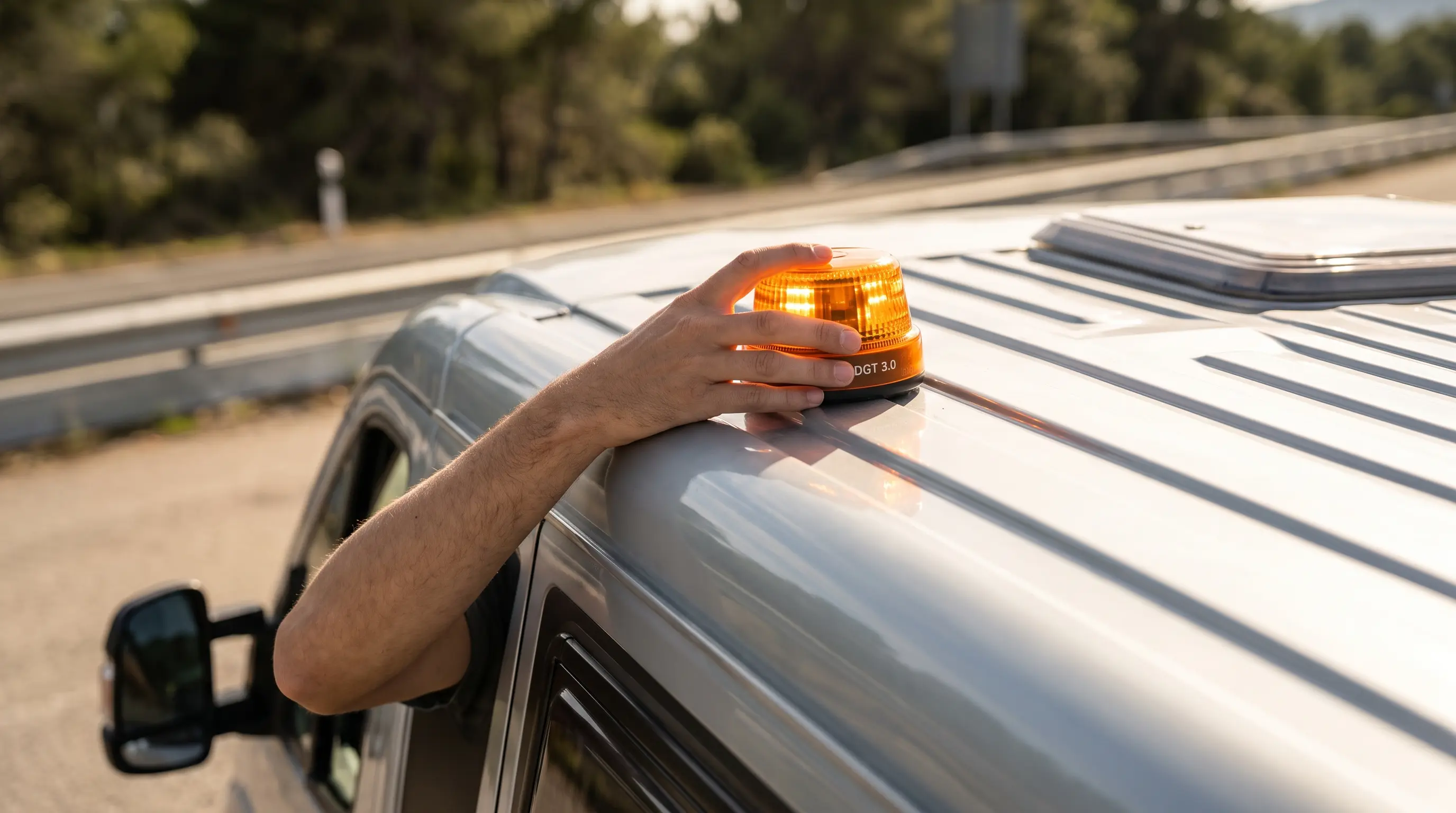
- Activate and place the connected V16 beacon without exposing yourself to traffic.
- Don't carry on driving or attempt an unauthorised repair.
- Call the assistance number shown on the contract.
- Share your location, number plate, symptoms and booking reference.
- Take photos and keep messages, reports, invoices and receipts.
- Wait in a protected spot, following the instructions given.
- If the campervan can't continue, arrange a tow and next steps with assistance.
Save this procedure on your phone before setting off. In an area with poor signal, an accessible screenshot will be more useful than a page open in your browser.
1. Stop without increasing the risk
If a warning light comes on, or you notice loss of power, smoke, a burning smell, an abnormal temperature or a loud noise, don't wait for the vehicle to stop on its own. Slow down gradually, turn on the hazard lights and look for a spot away from traffic.
Whenever the vehicle allows it, prioritise in this order:
- an exit or service area;
- a car park;
- a secondary road or wide area away from the lanes;
- the hard shoulder, if there's no safer alternative.
Don't brake sharply or cross several lanes to reach an exit. If the campervan ends up stuck in a lane or somewhere with poor visibility, call 112 to report the hazard as well as activating assistance.
Can you move the campervan a few metres?
Only if doing so won't make the breakdown worse or put anyone at risk. A puncture, a red warning light, overheating or low oil pressure can require stopping the engine immediately. If you're not sure, don't carry on: describe the warning light or symptom to the assistance service.
2. Protect the occupants before thinking about the campervan
The priority isn't checking the engine. It's avoiding being hit by another vehicle or a secondary collision.
As a general rule, if the campervan is stuck and there's a safe spot away from the road, the occupants should get out on the side away from traffic and stand behind a barrier or other protection. They shouldn't walk or stay in the lanes or on the hard shoulder.
If getting out means a bigger risk — for example, because there's no protected area — stay inside with your seatbelt on and follow instructions from emergency services or assistance. Always weigh up the real conditions: a bend, a tunnel, traffic, darkness, rain and whether children are present.
If you're travelling with children
Don't let them get out on their own or wait behind the campervan. An adult should manage getting out on the protected side and keep the group away from the road. Reflective vests should be within reach from inside the cabin, not buried under luggage.
3. Signal the breakdown with the connected V16 beacon
Since 1 January 2026, the connected V16 beacon has been the only legal device for pre-signalling immobilised vehicles in Spain. It replaces warning triangles and lets you flag the danger without walking on the road.
Activate it and place it as high as possible on the vehicle, making sure it's visible. It should be kept somewhere accessible — ideally the glovebox — and with enough charge.
The connected V16 sends the vehicle's location to the DGT 3.0 (Spanish traffic authority) platform when activated. You don't need to install an app or register personal data for it to work.
Don't get out to place warning triangles in Spain. As of 2026, they're no longer the legal means of signalling for a vehicle registered in Spain. The whole point of the V16 is to avoid exposure to traffic.
4. Don't attempt unauthorised repairs
Don't remove parts, tamper with the electrical system, add fluids without instruction, or hire a garage on your own. Don't accept a repair offered by a third party without confirmation from assistance or beWinkle.
There are visual checks you can describe without intervening: a warning light being on, the position of a wheel, a visible leak or a dashboard message. Do this from a safe spot and only when you don't need to expose yourself to traffic.
Prior authorisation matters for three reasons:
- it avoids making the damage worse;
- it lets the insurer assign a provider;
- it reduces the risk of an expense falling outside the reimbursement process.
5. Call the assistance number on your contract
Your booking confirmation and contract include the details for activating assistance. Save them on your phone and, if possible, also as a screenshot available offline.
The recommended order is:
- 112, only if there are injuries or immediate danger;
- the roadside assistance phone number;
- beWinkle's contact details, to keep the team informed and coordinate next steps.
Don't call a tow truck found online first unless emergency services or assistance tell you to. The provider needs to be linked to the case file for cover to apply correctly.
6. Share your location and the necessary details
The more precise the information, the less time is wasted trying to find you or deciding which assistance vehicle to send.
Have ready:
- the name of the person the booking is under;
- the contract or booking number;
- the Winkle's number plate and model;
- your location or coordinates;
- road, direction of travel, kilometre marker or nearby exit;
- number of occupants and whether any are children;
- a description of the problem;
- any warning lights or messages showing on the dashboard;
- whether the vehicle is blocking traffic;
- whether there's a safe place to wait.
How to send a useful location
Share your location from your phone's map, but add a written reference. A set of coordinates can put you on the wrong road or heading the wrong way. Always state the road name, direction of travel and the last recognisable point.
7. Document the incident and keep the proof
When it's safe to do so, record:
- general photos of the location and the vehicle's position;
- photos of the dashboard and warning lights;
- images of any visible damage;
- the approximate time of the incident;
- the name or reference of the assistance operator;
- the case reference number;
- related messages and emails;
- the tow truck or garage report;
- authorised invoices and receipts.
Documenting doesn't mean putting yourself at risk to get a photo. If the vehicle is in a dangerous spot, wait for the tow truck to move it.
Don't assume every expense will be reimbursed
Before paying for transport, accommodation, a repair or any other service, ask for authorisation and find out what proof you need. Keep the original of every invoice. Cover depends on the cause, the policy, the contract terms and the procedure followed.
8. Wait somewhere safe and keep your phone available
Assistance may need to call you to confirm access, the number plate or a change of provider. Keep enough battery, sound turned on, and signal whenever possible.
Don't go back to the vehicle to fetch belongings if it means crossing the road or leaving a protected area. If it's cold, raining or children are travelling with you, let the operator know so they can take it into account.
9. What happens if the campervan can't continue
Assistance will assess whether the campervan can be repaired on the spot, needs to go to a garage, or requires a tow truck. Not every incident automatically leads to the same solution.
According to beWinkle's published information, 24/7 assistance covers towing and, where appropriate depending on the incident and the terms, accommodation and a replacement vehicle. The help centre states that the team aims to resolve the situation within four hours depending on severity. This timeframe shouldn't be read as a universal guarantee: traffic, location, local availability, diagnosis and country can all affect the response.
Explicitly ask:
- where the campervan will be taken;
- whether the repair can be done during the trip;
- what solution applies to the occupants;
- what expenses are authorised;
- how to get your luggage back;
- how continuing the trip or returning home will be arranged;
- what documentation needs to be handed over afterwards.
What to do if the campervan breaks down outside Spain
The essential procedure is the same: protect, signal, ask for help and don't repair without authorisation. A Winkle registered in Spain can use the connected V16 beacon when driving internationally in countries covered by the applicable traffic conventions, according to the DGT.
In addition:
- use the international assistance number shown on the policy or contract;
- state the country, road, direction of travel and coordinates;
- if it's an emergency, call 112 anywhere in the European Union;
- don't accept a repair or a private tow truck without authorisation;
- ask for full invoices and keep all documents;
- ask whether the garage, accommodation or transport needs to be assigned by the insurer.
beWinkle allows travel within the European Union, the United Kingdom, Switzerland and Norway according to the published terms. Morocco requires prior notice and specific insurance. Always check that the country on your route is among the authorised destinations before setting off.
What beWinkle's assistance covers and what may be excluded
beWinkle's help centre publishes comprehensive cover with 24/7 roadside assistance within the permitted zones.
| Situation | Published handling | What the traveller should do |
|---|---|---|
| Mechanical breakdown | Assistance, towing and follow-up solutions where applicable | Stop, signal and activate assistance |
| Damage caused by an identified third party | The third party's insurance takes over according to the case file | Gather details and fill in the accident report when it's safe |
| Damage with no identified third party, a fixed object, theft or break-in | Comprehensive cover subject to the published excess | Report it immediately and file a report or complaint where applicable |
| Improper use or breach of contract | May fall outside cover | Check the contract and cover any resulting costs |
The specific cover depends on the policy, the contract and the cause of the incident. The definitive information is the documentation provided with your booking, not a blog summary.
What to prepare before setting off so a breakdown doesn't catch you unawares
- save the contract and policy on your phone;
- take a screenshot of the assistance number;
- locate the connected V16 beacon and check it's accessible;
- find the reflective vests;
- confirm the authorised countries;
- bring a phone charger;
- don't block access to the safety kit with luggage;
- ask during pick-up which warning lights mean you must stop;
- note the correct fuel and fluids, but don't add any without instruction if a breakdown occurs.
It's also worth reviewing the essential kit for a campervan trip and the basics of driving a campervan for the first few kilometres.
Travel knowing who to call
Before booking, check the cover, authorised destinations and assistance terms. If something happens on the road, you'll have a procedure and a team on the other end of the phone.
Check cover and terms · Check availability
Frequently asked questions
Who do I call if a rented campervan breaks down?
If there are injuries or immediate danger, call 112. For a mechanical breakdown that isn't an emergency, use the assistance number shown on the contract and keep beWinkle informed.
Do I need to place warning triangles if the breakdown happens in Spain?
No. Since 1 January 2026, the connected V16 beacon has been the only legal device for signalling an immobilised vehicle in Spain. Activate it and place it as high as possible without exposing yourself to traffic.
Can I take the campervan straight to a garage?
Not without authorisation. Call assistance first so they can assess the problem and assign a provider. A repair arranged on your own could fall outside the cover procedure.
Does assistance include towing, a hotel and a replacement vehicle?
beWinkle's published information covers 24/7 assistance with towing and, where appropriate depending on the incident and terms, accommodation and a replacement vehicle. The specific solution depends on the policy, the diagnosis, the location and availability.
What happens to my luggage if the campervan is towed away?
Ask the operator whether you can safely remove it before the vehicle is taken away, or how you'll get it back afterwards. Don't get into the vehicle or stay by the road if doing so is risky.
What documents should I keep after a breakdown?
Keep the case reference number, the assistance report, the garage report, photographs, messages, and authorised invoices and receipts. If a third party is involved or there's a theft, also keep the accident report or police complaint.