
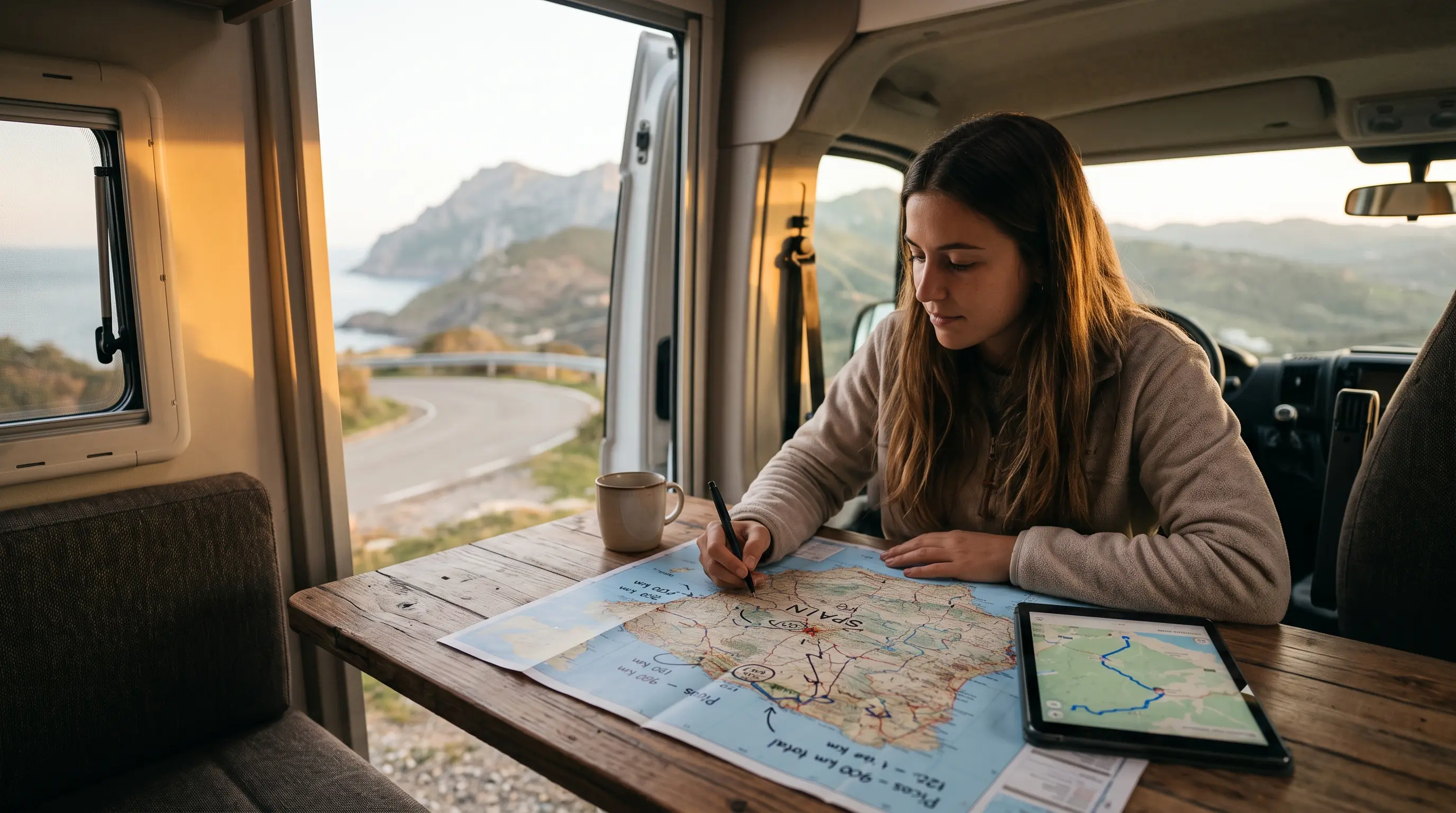
How many kilometres do you need when renting a campervan? Work out your package without overpaying
Work out the mileage for your campervan rental and discover when to choose 100 km/day, 200 km/day or unlimited mileage without overpaying.
The mistake isn't booking too few kilometres. The mistake is calculating only the distance to your destination and forgetting the way back, the day trips, and all those detours that turn a straight line into an actual journey. If you do the sums properly, you can choose the mileage for your campervan rental without paying for a package you don't need or facing an excess charge when you drop it off.
At beWinkle you can travel with 100 km per day included, upgrade to 200 km per day for €10 a day, or book unlimited mileage for €20 a day. If you go over your chosen package, the excess costs €0.50 per kilometre. In this guide, we'll work out which option suits each type of route.
The quick answer: which mileage package to choose
Divide your total expected mileage by the number of rental days. The result lets you make a first decision:
| Expected average | Option that usually works | Type of trip |
|---|---|---|
| Up to 120 km/day | 100 km/day included | Nearby getaways and routes with few stops |
| Over 120 and up to 220 km/day | 200 km/day | Medium-distance national routes |
| Over 220 km/day | Unlimited mileage | Long trips, international routes, or ones with lots of detours |
These thresholds aren't arbitrary. They come from comparing the cost of upgrading your package against the price of extra kilometres. You'll find the full calculation further down.
Rule of thumb: if your estimate falls right on a threshold, choose the option that gives you some breathing room. In a campervan, driving an extra ten kilometres to switch service areas, find fuel, or visit a viewpoint isn't the exception — it's part of the route.
How mileage works when renting a campervan
Not every company calculates mileage the same way. Some offer a daily allowance; others set a total limit for the whole booking, and some advertise unlimited mileage with specific conditions attached. Before comparing prices, always check these five points:
- how many kilometres the base rate includes;
- whether they're calculated per day or for the whole booking;
- how much it costs to upgrade the package;
- how much you're charged per kilometre over the limit;
- whether unlimited mileage has any territorial or contractual restrictions.
At beWinkle, kilometres build up across the whole booking. If you rent for five days with the 100 km/day package, you have 500 kilometres for the entire trip. You don't need to drive exactly 100 each day: you could cover 250 on the first day, leave the campervan parked on the second, and split the rest however you like.
| beWinkle package | Includes | Extra cost |
|---|---|---|
| Base | 100 km per day | Included in the price |
| Extended | 200 km per day | €10 per day |
| Unlimited | No mileage limit | €20 per day |
| Excess | Kilometres over the package | €0.50 per km |
These are the conditions published by beWinkle at the time this guide was last updated. Check them again when you book, as prices and packages can change.
How to calculate the mileage for your campervan trip
You need more than just typing your destination into the sat nav. A useful calculation adds up five components:
- Outbound leg: from the pick-up base to the first area on your route.
- Internal journeys: kilometres between towns, beaches, viewpoints, service areas, and activities.
- Return leg: from your last stop back to the base.
- Predictable detours: fuel, supermarkets, water, changes of overnight spot, or closed roads.
- Safety margin: between 10% and 15% on top of the calculated distance.
The formula is simple:
Kilometres to book = (outbound + internal route + return) × 1.10
If your base itinerary adds up to 900 kilometres, a sensible estimate would be:
900 × 1.10 = 990 kilometres.
Then divide the result by the number of days. For a five-day booking:
990 ÷ 5 = 198 kilometres per day.
In that case, the 200 km/day package fits far better than the basic one.
Don't calculate using the shortest route if you won't be taking it
Sat navs tend to show the fastest option between two points, but your trip might include scenic roads, towns along the way, or a different route back. Add each leg to the map in the actual order you'll drive it. If you don't yet know where you'll be spending the night, use the centre of the area as a reference point and keep a larger margin.
Count the pick-up and drop-off
The counter doesn't start at your destination. It starts when you collect your Winkle and ends when you return it in Madrid. A route that looks like 400 kilometres within Asturias can easily top 1,000 once you add the journey there and back.
When it's worth upgrading to 200 km/day or unlimited
Here's the part that stops you overpaying. Under beWinkle's current terms, every kilometre over your limit costs €0.50.
From 100 to 200 km/day: the threshold is 120
Upgrading from 100 to 200 km costs €10 a day. That €10 is equivalent to 20 kilometres of excess:
€10 ÷ €0.50/km = 20 km.
So if you're planning to average more than 120 kilometres a day, the 200 package starts to work out cheaper than sticking with the basic one and paying the excess.
From 200 km/day to unlimited: the threshold is 220
Unlimited mileage costs €10 a day more than the 200 package. Again, that €10 is equivalent to 20 extra kilometres. If your estimate goes over 220 km/day, unlimited starts to be the cheaper option.
The comparison looks like this:
- Up to 120 km/day: stick with the 100 included.
- Between 121 and 220 km/day: it usually pays to book 200.
- Over 220 km/day: it usually pays to go unlimited.
This calculation assumes you'll actually cover the estimated distance. If your route is flexible, also weigh up the value of travelling without watching the counter. Sometimes unlimited isn't just a maths decision — it buys you peace of mind to improvise.
How many kilometres to book for 3, 5, 7, and 12 days
| Duration | Base package | 200 package | Unlimited | Suggested use |
|---|---|---|---|---|
| 3 days | 300 km | 600 km for €30 | €60 | Nearby getaway or long weekend |
| 5 days | 500 km | 1,000 km for €50 | €100 | One region or a national destination |
| 7 days | 700 km | 1,400 km for €70 | €140 | A broad national route or neighbouring country |
| 12 days | 1,200 km | 2,400 km for €120 | €240 | A long or international trip |
A 3-day getaway
For a nearby trip of around 300 kilometres, such as a getaway around the Sierra de Madrid, the included package may well be enough. If your itinerary comes closer to 400 or 500 kilometres, the 200 km/day package gives you room to breathe for just an extra €30.
A 5-day trip
The 500 included kilometres work well if you reach one area and stay there. For a round trip from Madrid, the calculation usually comes closer to 1,000 kilometres; in that case, the 200 package tends to be the best balance.
A 7-day route
Over a week, 1,400 kilometres let you cover a good chunk of Portugal, northern Spain, or the south of France, provided the itinerary is fairly concentrated. When your estimate goes over 1,540 kilometres — 220 per day — compare it directly against unlimited.
A 12-day trip
Over twelve days, the 200 package gives you 2,400 kilometres. That can cover a long trip around Spain, but an international route of more than 2,640 kilometres falls into the range where unlimited works out cheaper.
Three examples: Picos de Europa, Portugal, and the south of France
The following calculations are indicative. The actual distance depends on your stops, where you sleep, and the roads you choose. Use them as a method, not a substitute for your final map.
Madrid–Picos de Europa in 5 days
Let's assume a route of around 1,050 kilometres, including the outbound journey, driving around Picos de Europa, and the return to Madrid.
- 100 km/day: includes 500 km. That would leave 550 km of excess, equivalent to €275.
- 200 km/day: includes 1,000 km for €50. The remaining 50 km would cost €25. Total extra cost: €75.
- Unlimited: €100.
Suggested choice: 200 km/day. If you add the Asturian coast or other detours and go over roughly 1,100 kilometres, compare again against unlimited.
You can use this as a starting point: five-day campervan route through Picos de Europa.
Madrid–Portugal in 7 days
For a route of around 1,400 kilometres through central Portugal:
- 100 km/day: includes 700 km. The other 700 would come to €350.
- 200 km/day: includes 1,400 km for €70.
- Unlimited: €140.
Suggested choice: 200 km/day. If you head down to the Algarve, follow the coast, or go over 1,540 kilometres, unlimited may start to pay off.
Madrid–south of France in 7 days
Picture a circuit of 1,600 kilometres between Madrid, the Pyrenees, Toulouse or Carcassonne, and back:
- 100 km/day: includes 700 km. The excess of 900 km would cost €450.
- 200 km/day: includes 1,400 km for €70. The remaining 200 km would cost €100. Total extra cost: €170.
- Unlimited: €140.
Suggested choice: unlimited mileage. Besides being cheaper in this example, it lets you adapt your route if the weather, an overnight stop, or road access changes.
Seven mistakes when calculating campervan mileage
- Counting only the outbound leg. Returning to Madrid is also part of the rental.
- Forgetting the internal legs. Visiting five towns can add up to more kilometres than the main journey.
- Not leaving a margin. An extra 10% stops every detour turning into a worry.
- Choosing unlimited out of habit. On a nearby getaway, you might end up paying for kilometres you'll never use.
- Choosing the basic package to save money. If you'll be averaging over 120 km/day, paying for the excess can end up costing more than upgrading.
- Comparing companies without reading the terms. "Mileage included" can mean very different amounts and restrictions.
- Planning too much driving. Just because your package allows 300 kilometres a day doesn't mean that's the best way to enjoy a campervan trip.
How to choose your package when booking
Before booking, put together your full itinerary, apply the margin, and divide the result by the number of days. Then follow these three steps:
- Up to 120 km/day on average: start with the included package.
- Between 121 and 220 km/day: compare with the 200 package.
- Over 220 km/day: compare with unlimited.
If you're still torn between two options, check our campervan routes and itineraries to estimate your distance more accurately, and look at the rental terms in our help centre.
Work out the route. We'll sort the Winkle.
Choose your dates, compare the four campervans, and pick the mileage package that fits your trip.
Keep reading: How much does a campervan trip cost
Frequently asked questions
How many kilometres are included when renting a campervan with beWinkle?
The base rate includes 100 kilometres for each day of the rental. During booking, you can upgrade to 200 km/day for €10 a day or choose unlimited mileage for €20 a day.
Do the kilometres need to be split evenly across days?
No. It's calculated as a total pool for the whole booking. For example, five days at 100 km/day comes to 500 total kilometres, which you can spread across the days however you like.
What happens if I go over my booked mileage?
Under beWinkle's current terms, the excess is charged at €0.50 per kilometre when you drop off the campervan.
When is it worth booking unlimited mileage?
At current rates, it starts to work out cheaper than the 200 package once you expect to average more than around 220 kilometres a day. It can also be worth it if you want to change your route without keeping an eye on the counter.
How many extra kilometres should I add for the unexpected?
Add between 10% and 15% to your base distance. Use the larger margin if you haven't decided where you'll sleep, you're driving through mountains, or you're travelling to another country.
Is fuel included in the rental?
No. The mileage package defines the distance you can cover, but fuel used during the trip is paid separately.