
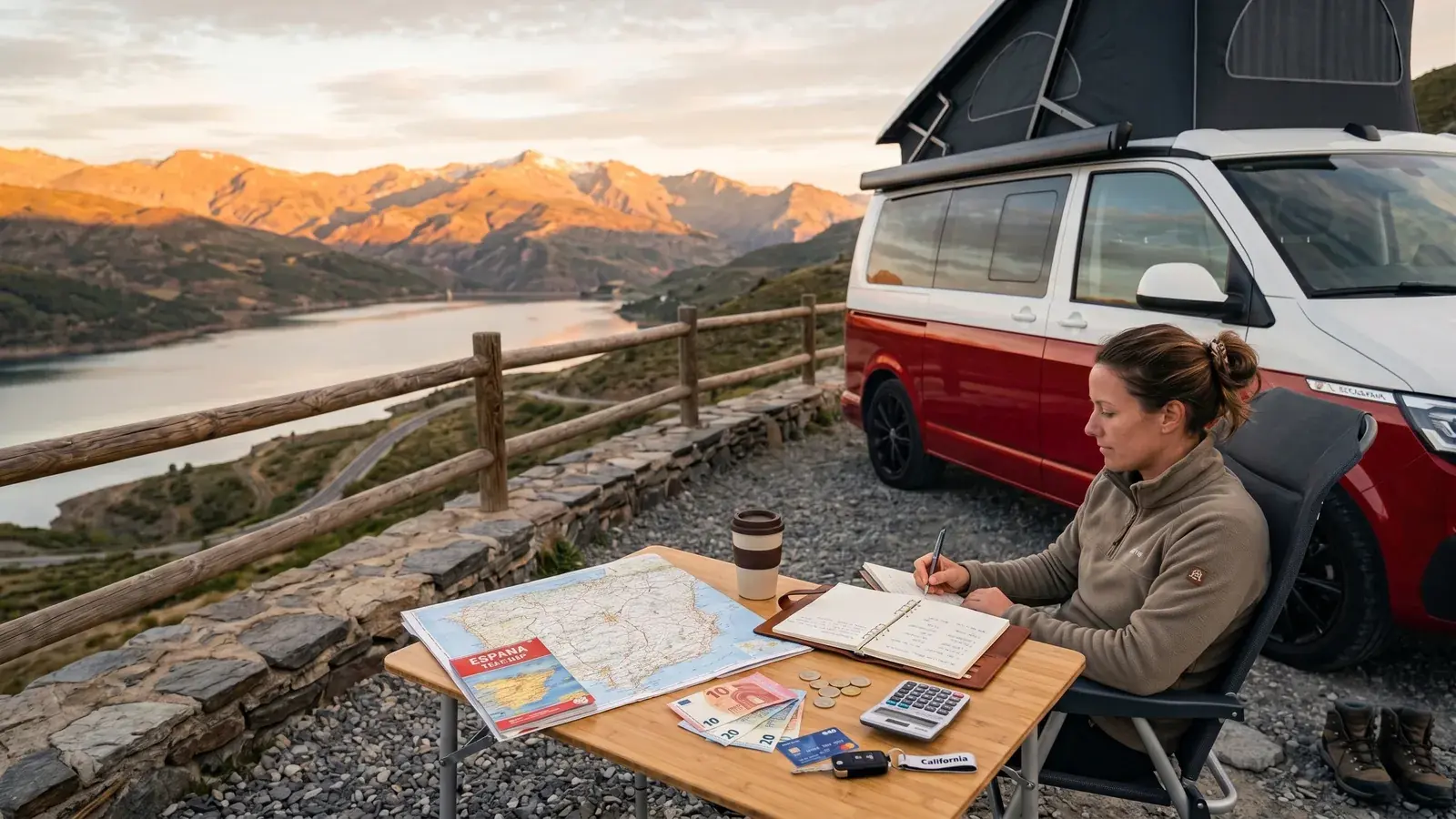
How much does it cost to travel by campervan: real budget for 3, 7 and 12 days from Madrid
Work out how much it costs to travel by campervan by adding up rental, mileage, fuel, tolls, food and overnight stays, with examples for 3, 7 and 12 days.
Travelling by campervan doesn't just cost the vehicle's daily rate. The real budget adds up rental, mileage, fuel, tolls, places to spend the night, food and extras. For a couple, a short getaway can start from a few hundred euros; a long route for four people easily tops two thousand. The figure that actually matters isn't a national average — it's the one that comes out of your route.
This guide includes a formula and three reproducible examples for 3, 7 and 12 days from Madrid. The calculations use prices published by beWinkle and clearly identified assumptions. Swap in the fuel, campsites, tolls and food costs that apply to you to get your own budget.
Quick formula: rental + mileage package + fuel + tolls + overnight stays + food + extras + a margin for the unexpected. Only divide the result by the number of travellers at the very end.
So, how much does it actually cost to travel by campervan?
There's no single rate, because two seven-day trips can end up with completely opposite budgets. A couple who covers 700 kilometres, cooks their own meals and alternates free rest areas with a campsite pays far less than four people who drive 2,000 kilometres, use toll motorways and always sleep at campsites.
To give you a starting point, here are the three scenarios worked out in this guide:
| Example trip | Travellers | Duration | Estimated budget | Cost per person |
|---|---|---|---|---|
| Short getaway | 2 | 3 days | €437 | €219 |
| National route | 2 | 7 days | €1,186 | €593 |
| Long route | 4 | 12 days | €2,823 | €706 |
These figures aren't commercial quotes or guaranteed prices. They use a starting rate for the model, diesel at €1.55/l, and food and overnight costs defined in each example. Their purpose is to show the full calculation, not to promise that any given trip will cost exactly that.
1. Campervan rental price
The vehicle is usually the biggest item. beWinkle publishes four starting rates:
- Adriático: from €70/day;
- Caribe: from €80/day;
- Índico: from €90/day;
- Báltico: from €100/day.
The rate that applies depends on the dates, availability, model and final setup. Multiplying the starting rate by the number of days gives you a rough first estimate, but you should check the booking engine before finalising your budget.
beWinkle's base rental includes 100 km per day, fully comprehensive insurance with an excess, 24/7 assistance across Europe, a cooker, a fridge and the equipment specific to the model. Check exactly what's included in a campervan rental to separate the base rate from the extras.
If you just want to know daily prices and payment terms, read the guide on how much it costs to rent a campervan in Spain. The rest of this article works out what happens after you pick it up.
2. Mileage package
Mileage can change your budget before you've even bought any fuel. beWinkle publishes:
- 100 km/day: included in the base rate;
- 200 km/day: an extra €10 per day;
- unlimited mileage: an extra €20 per day;
- excess mileage: €0.50 per kilometre over the package you booked.
Example: a five-day trip covering 850 km includes 500 km with the base package. The excess would be 350 km, equivalent to €175. Upgrading to 200 km a day costs €50 and covers up to 1,000 km. In that scenario, upgrading is €125 cheaper than paying for the excess.
Don't automatically pick unlimited mileage. Work out your route first, add a margin of 10–15% for detours, and compare all three options. The guide on mileage in campervan rental sets out the method in full.
3. How much you'll spend on fuel
beWinkle publishes an approximate consumption of 7.5–8.5 litres of diesel per 100 kilometres under the driving conditions specified by the company. Actual consumption changes with speed, load, gradient, wind, traffic, air conditioning and driving style.
Use this formula:
Cost = kilometres × consumption ÷ 100 × diesel price.
Example for 1,000 km, a consumption of 8 l/100 km and diesel at €1.55/l:
1,000 × 8 ÷ 100 × 1.55 = €124.
If the price rises to €1.70/l, the same trip costs €136. That's why an evergreen guide should give you the formula rather than treat one particular date's price as universal.
How to reduce fuel consumption without faking the route
- keep a steady, appropriate speed;
- avoid unnecessary acceleration and braking;
- don't carry luggage you won't use;
- group nearby stops together;
- don't cross a city several times because of poor planning;
- check tyre pressure and condition with whoever's responsible for the vehicle;
- accept that a shorter route usually saves more than any driving technique.
4. Tolls, ferries, vignettes and parking
This category can be zero on a route along free roads, or it can turn into a significant item if you're travelling through France, Portugal, Spanish toll motorways or routes involving ferries.
Include:
- tolls for the outward and return journey;
- electronic motorways linked to the number plate;
- compulsory vignettes or stickers;
- ferries for the vehicle and passengers;
- urban parking;
- public transport from the site into the centre;
- possible admin fees for charges billed later.
Work this item out using the final itinerary and official sources. Don't use a car's rate if the fee depends on the vehicle's height or class.
5. Sites and campsites
Sleeping inside the campervan doesn't make every night free. You can alternate between permitted parking spots, public sites, private motorhome service areas and campsites, depending on the rules and the services you need.
To budget properly, classify each night:
- permitted parking with no services: may have no charge, but you should confirm the rules and signage;
- service area: may charge for the stay, water, electricity or waste disposal;
- campsite: usually charges per pitch, per person, by season and for electricity;
- special booking: coastal destinations, festivals or peak season may require advance booking and different prices.
Don't build your budget assuming every night is free. Include at least some paid stays where you can shower, recharge, empty the tanks and rest with proper facilities.
Check the difference between parking, spending the night and camping before deciding where to stay.
6. Food: shopping, cooking and eating out
A campervan lets you cook, but that doesn't mean food disappears from the budget. Break it down into:
- initial shop;
- topping up water and fresh food;
- gas or consumables if not included;
- coffees and meals on the road;
- planned restaurant meals;
- emergency food for one day.
If you're comparing a campervan with a hotel, don't attribute the whole supermarket shop to the vehicle — you'd be eating anyway if you travelled another way. The relevant difference is how much you save by cooking instead of eating out.
The examples in this guide use €15 per person per day as an editorial assumption for shopping and simple meals. Replace it with your own real budget. A food-focused trip or a group with specific needs can spend much more.
7. Extras and costs people often forget
beWinkle's published extras include, among others:
- final cleaning: €45;
- portable toilet: €15;
- bedding for two: €20;
- portable two-ring cooker: €10;
- cleaning products: €8;
- extended cover on eligible bookings: €12/day;
- pack for two bikes: €8;
- additional driver: published as free.
Check availability and price when you book. Also factor in:
- tickets and activities;
- laundry;
- urban transport;
- showers or site services charged separately;
- equipment you buy for the trip;
- a 10% margin for ordinary unforeseen costs.
The security deposit isn't a final cost if you return the campervan as agreed, but it does temporarily tie up some of your money. Read how the rental security deposit works.
Example 1: how much a 3-day getaway costs
Scenario: two people, Adriático, a 420 km route from Madrid, one night at a campsite and two nights in permitted spots, simple cooking, and bedding.
| Item | Calculation | Amount |
|---|---|---|
| Rental | 3 × €70 | €210 |
| Mileage | 200 km/day package: 3 × €10 | €30 |
| Fuel | 420 km × 8 l/100 × €1.55 | €52 |
| Tolls and parking | Route with no tolls | €0 |
| Overnight stay | 1 night × €35 | €35 |
| Food | 2 people × 3 days × €15 | €90 |
| Bedding | Pack for 2 | €20 |
| Total | €437 |
Result: around €219 per person. Doesn't include activities or a margin for the unexpected.
Example 2: how much a week by campervan costs
Scenario: two people, Índico, a 1,100 km national route, three nights at a campsite or paid service area, occasional tolls, shopping and bedding.
| Item | Calculation | Amount |
|---|---|---|
| Rental | 7 × €90 | €630 |
| Mileage | 200 km/day package: 7 × €10 | €70 |
| Fuel | 1,100 km × 8 l/100 × €1.55 | €136 |
| Tolls and parking | Route assumption | €30 |
| Overnight stay | 3 nights × €30 | €90 |
| Food | 2 × 7 × €15 | €210 |
| Bedding | Pack for 2 | €20 |
| Total | €1,186 |
Result: €593 per person. Adding extended cover, more restaurant meals or a campsite every single night would push the total up.
Example 3: a 12-day route for four people
Scenario: four people, Báltico, 2,400 km, unlimited mileage, six nights at a campsite, tolls, shopping, two bedding packs and a portable toilet.
| Item | Calculation | Amount |
|---|---|---|
| Rental | 12 × €100 | €1,200 |
| Mileage | Unlimited: 12 × €20 | €240 |
| Fuel | 2,400 km × 8 l/100 × €1.55 | €298 |
| Tolls and parking | Route assumption | €100 |
| Overnight stay | 6 nights × €35 | €210 |
| Food | 4 × 12 × €15 | €720 |
| Bedding | 2 packs × €20 | €40 |
| Portable toilet | 1 unit | €15 |
| Total | €2,823 |
Result: around €706 per person. The overall cost is higher, but rental, fuel and tolls are shared between four people.
Important: all three examples use "from" rates, an assumed average consumption and variable prices. They don't replace a quote for specific dates.
How to save on a campervan trip without ruining it
- Cut kilometres, not experiences. Pick one region and explore it properly.
- Book the right package. Paying for excess mileage because you didn't calculate it usually works out expensive.
- Combine overnight options. Alternate permitted spots with campsites when you need facilities.
- Cook some of your meals. Save restaurants for specific experiences.
- Travel outside peak dates. You'll have more availability and less pressure on rest areas.
- Choose the campervan based on your needs. Two people don't always need the biggest model.
- Avoid duplicate extras. Don't rent bedding or kitchenware if you'd rather bring your own and the terms allow it.
- Plan for tolls. Weigh up the saving against the extra time on the alternative road.
- Leave a margin. A budget with no allowance for the unexpected isn't a complete budget.
Don't try to save money by driving tired, spending the night somewhere it's forbidden, or dropping cover you actually need. A fine, damage or an unsafe day costs more than a night at a service area.
Template for working out your own budget
| Item | Your calculation | Amount |
|---|---|---|
| Rental | Days × actual rate | _____ € |
| Mileage | Package chosen or excess | _____ € |
| Fuel | Km × consumption ÷ 100 × price/l | _____ € |
| Tolls and ferries | Final route | _____ € |
| Overnight stays | Paid nights × rate | _____ € |
| Food | People × days × daily spend | _____ € |
| Extras | Packs selected | _____ € |
| Activities | Tickets and bookings | _____ € |
| Margin | 10% of subtotal | _____ € |
| Total trip cost | _____ € | |
| Total per person | _____ € |
Work out your route before choosing the lowest price
The daily rate is only the starting point of the budget. Mileage and fuel determine how much it costs to move around; overnight stays and food determine how much it costs to live during the trip. Do the full sum and compare the total per person.
Check the campervan price for your dates and start working out your trip.
beWinkle rates and terms reviewed in July 2026. The examples are editorial scenarios, not binding quotes.
Frequently asked questions
How much does a week by campervan cost for two people?
In this guide's example, a week for two costs €1,186, around €593 per person. The figure changes with dates, model, mileage, fuel, campsites, food and extras.
Is it cheaper to travel by campervan than to stay in hotels?
It depends on the route and the group. A campervan combines transport, a bed and a kitchen in one, but adds fuel, overnight costs and mileage. The right comparison weighs up the full cost of both options for the same dates and the same number of people.
What expense do people usually forget?
The mileage package, excess mileage, urban parking, service area charges and the money temporarily tied up in the security deposit. Detours and eating out also tend to be underestimated.
How much fuel does a Winkle use?
beWinkle publishes an approximate consumption of 7.5–8.5 l/100 km under certain conditions. Calculate using a range and add a margin for load, wind, mountains and traffic.
How many nights should you pay for at a campsite?
There's no set number. It depends on your range, local rules and the services you need. On longer routes, it's worth including several nights with proper facilities rather than assuming every night will be free.
Does the security deposit count towards the trip's cost?
Not as a final cost, if the rental ends with nothing outstanding. But you do need to have that money available while it's held, and you should factor that into your cash flow.