
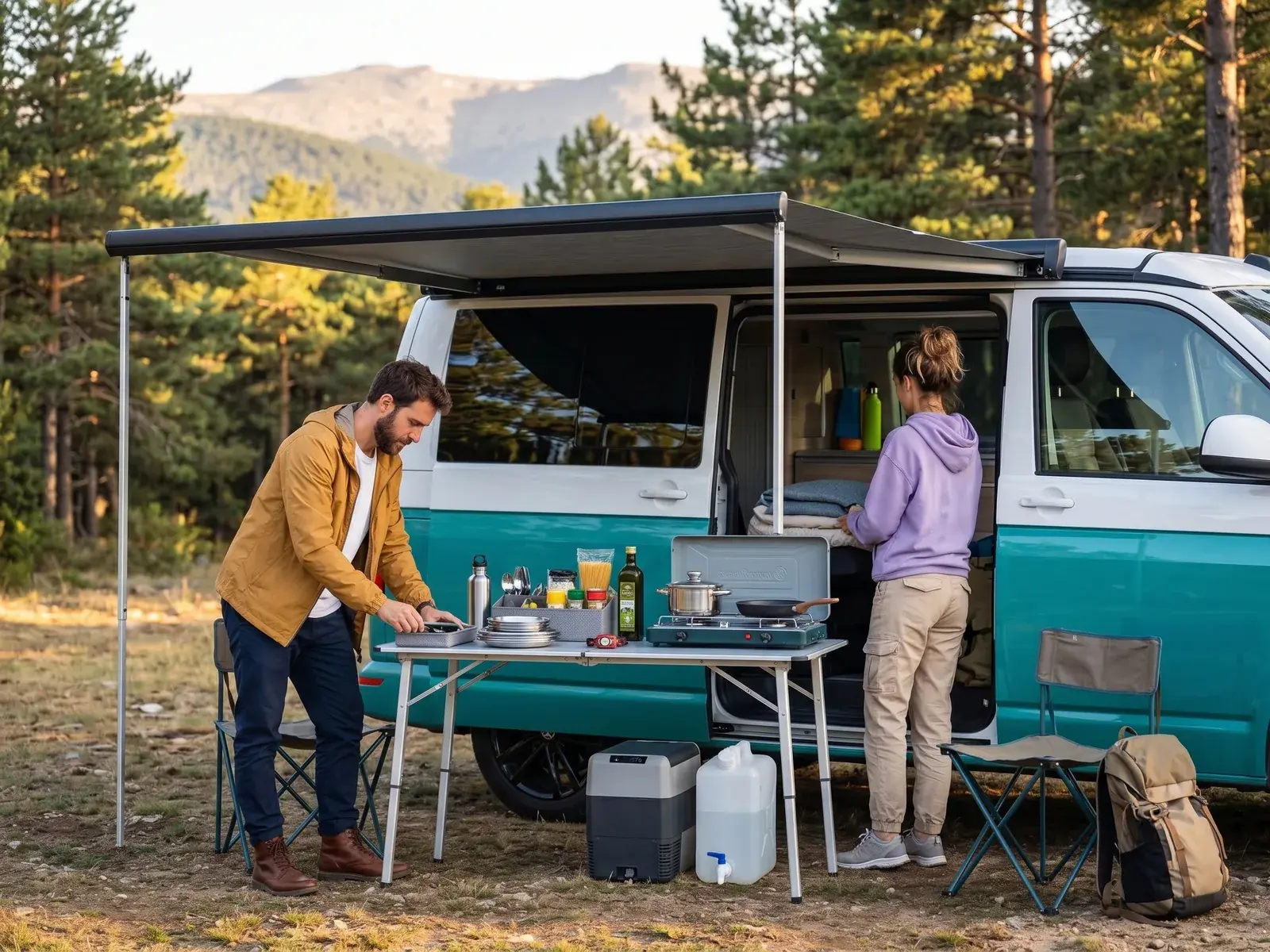
Kit for a campervan trip: the complete guide
Before a first campervan trip, the question that always comes up isn't where to go, but what's actually inside the van and what you need to bring yourself. This guide settles it once and for all: what the Winkles come with as standard, what's worth packing in your bag, and how each system works depending on the time of year, how many days you're travelling and who you're travelling with.
What to pack for your campervan trip
The first thing to clear up: a campervan isn't an empty van. The Winkles come with the bed, bedding, kitchen, fridge, water and electrical system already built in. You only need to bring what you'd pack for a weekend away, plus the kitchen basics.
Worth bringing:
- Clothes (layered, not in a bulky suitcase — see the Clothing section)
- Comfortable walking shoes + one pair for the beach or mud, depending on the route
- Toiletries bag
- Towels (Winkles don't include towels)
- Food for the first few days (see the Food section)
- Regular medication + basic first aid kit (plasters, paracetamol, ibuprofen)
- ID: driving licence, ID card/passport, credit/debit card
What's unnecessary and just takes up space:
- Hard suitcases (a flexible travel bag or medium rucksack works better)
- Too many clothes — in the van you live in a few square metres, not a wardrobe
- Gadgets you never use at home
Full list of what you actually need and what you don't: What to pack (and what not to) for your first campervan trip.
Basic checklist for a campervan trip
Print this list or save it on your phone. It's organised by category so nothing gets left behind.
Documents
- Valid driving licence (minimum 2 years held, age ≥ 25)
- ID card or passport
- Insurance policy (beWinkle emails it when you confirm your booking)
- Van pick-up document
Sleeping
- Bedding ✓ included in all Winkles
- Pillow ✓ included
- Extra blanket if travelling in winter or mountain areas
Kitchen and food
- Gas ✓ fitted and charged in all Winkles
- Basic utensils ✓ included (pot, pan, cutlery, plates)
- Coffee, spices and seasoning (first few days)
- Non-perishable backup food
Hygiene
- Towels (not included — bring at least 2 per person)
- Shower gel, shampoo, deodorant
- Extra toilet paper
- Water purification tablets (if heading to rural areas)
Clothing
- Base layers, T-shirts, fleece
- Waterproof windbreaker
- Hiking or water shoes depending on the route
Electronics
- Phone chargers and your own portable battery pack
- Plug adaptor (for campsites with mains hook-up)
- Headphones
Useful extras
- Day pack for hikes
- Physical map or paper guide of the area
- Sun cream + insect repellent
- Head torch
Kit for summer
Summer is the busiest season, and it's also where the kit makes the biggest difference.
Interior temperature: campervans don't have air conditioning, but they cope well with cross-ventilation: the open roof hatch and the sliding door create a draught that drops the temperature by several degrees. Where you park matters as much as which van you choose.
Fridge: in summer the fridge works harder. The Báltico and Índico have a larger compressor fridge, which keeps a constant temperature even when it's 38°C outside. On very hot days, it's best not to open the fridge more than necessary and to keep the van in the shade.
Water: summer sends consumption up. Each shower uses between 5 and 8 litres; with two people, the tank empties fast. The Báltico and Índico have 57 litres of hot water — enough for both of you to shower daily and cook. The Adriático only has 20 litres; for intense summer trips, it's best to plan stops at campsites to refill.
Worth packing in summer:
- Light, quick-drying clothes
- Sandals and swimwear you can grab quickly
- Sun cream (also for your neck when driving with the sun ahead)
- Reusable personal water bottle
- Microfibre towel (dries faster in small spaces)
- Compact beach bag
Kit for winter
Travelling by campervan in winter has something summer doesn't: stillness. Empty beaches, villages with no queues, national parks all to yourself. But it does mean thinking the kit through more carefully.
Heating: here the difference between Winkles is decisive. The Báltico is the only one of the four with a stationary heater, a system that keeps the interior at whatever temperature you choose without needing the engine running. You can sleep with -5°C outside and be perfectly warm inside. The Índico, the Caribe and the Adriático don't have a stationary heater — for winter trips with cold nights, the Báltico is the clear choice.
Insulation and condensation: on cold nights, condensation is the quiet enemy. Breath and cooking vapour condense on the windows and metal walls. The basic tricks: air the van for 10 minutes before sleeping, leave the roof hatch slightly ajar and dry the surfaces in the morning.
Electrics in winter: the Báltico's solar panels generate less with fewer daylight hours, but the battery has enough capacity to keep lights, fridge and device charging going for several days. Plugging into a campsite hook-up every 2-3 days is good practice in winter under overcast skies.
All the tricks for sleeping warm: Winter in a campervan: how to sleep warm with a stationary heater.
Worth packing in winter:
- Sub-zero rated sleeping bag (to go with the included bedding)
- Thick fleece or down jacket for indoors
- Thermal socks and indoor slippers
- Extra blanket
- Hot water bottle
The kitchen
Every Winkle has an integrated 2-burner gas hob. The gas comes fitted and charged from base — there's no bottle to bring and nothing to connect. When it runs out, you can refill it at any petrol station or roadside hardware shop.
What you can actually cook in a campervan:
- Pasta, rice, pulses (two burners mean you can boil and fry at once)
- Eggs any way you like
- Pan-fried meat and fish
- Sautéed vegetables
- Spanish tortilla
- Soups and creamy stews (welcome in winter)
- Coffee from a stovetop moka pot
The utensils included in the Winkles: medium pot, non-stick pan, cutlery for all occupants, plates, glasses, bottle opener and knife.
Worth adding: small chopping board, grater, vegetable peeler, airtight food container (for leftovers), kitchen roll.
Unnecessary: blender, toaster, electric coffee machine, anything that draws a lot of power.
The most useful piece of advice: keep the cooking simple but tasty. One-pan or one-pot dishes are king in a van — little washing up, little waste and real results. Cooking with a sea or mountain view makes everything better anyway.
The fridge
A campervan fridge isn't the same as your one at home, but it shouldn't be underestimated either.
How it works: every Winkle has a 12V fridge, which runs off the leisure battery when the van is parked and off the alternator while you drive. No ice needed, no mains hook-up required.
Temperature: it holds between 3 and 8°C depending on the model and the outside temperature. Perfect for dairy, vegetables, cold cuts, fresh meat and fish, and cold drinks.
Báltico and Índico have a larger-capacity fridge (~40 L), which copes better on hot days and gives more room for longer routes. Caribe and Adriático have a more compact fridge — enough for couples who shop every 2-3 days.
Practical tips:
- Put food in already cold (the fridge maintains temperature, it doesn't cool quickly from room temperature)
- Organise by use: what you open every hour on top, what you rarely touch below
- Avoid opening it unnecessarily (each opening raises the interior by 2-3°C)
- In summer, park in the shade whenever you can
The water system
Water is the system that raises the most questions before a first trip. It works just like in any small home, with the difference that the tank has a limit.
The system: every Winkle has a clean water tank, an electric pump that feeds the tap and shower, and a grey water tank that needs emptying. The pump runs off the leisure battery — no mains hook-up needed.
Capacity by model:
- Báltico: 57 litres → 3-4 days of normal use for two people
- Índico: 57 litres → same range
- Caribe: compact tank → 2-3 days of normal use
- Adriático: 20 litres → 1-2 days; ideal for those stopping at campsites often
Where to refill:
- Campsites and motorhome service areas (free or low-cost water points)
- Service stations on major roads
- Municipal fountains in inland villages
- Supermarkets (5 L container as an emergency backup)
The water from the van's tap is drinking water — the same you fill up from any tap point. In rural areas with water of unknown quality, purification tablets are a sensible precaution.
How the system works step by step: Campervan manual: gas, water and electrics without losing your mind.
The shower
The shower is what surprises first-time campervan travellers the most: it really exists, it works, and it's more comfortable than you'd think.
Báltico and Índico: integrated indoor shower with hot water. 57 litres available. A quick shower (water on, wet yourself, water off, soap up, water on to rinse) uses between 5 and 8 litres. That gives enough for two people to shower daily for 3-4 days between refills.
Caribe: outdoor portable shower. Connected to the van's water system and used alongside the side awning. Perfect for coming back from the beach or a quick shower outdoors. The water comes out at ambient temperature (unheated).
Adriático: no built-in shower. With a 20-litre tank, showering at campsites or motorhome service areas is the usual approach — very common in Spain, most free or for €1-2.
The sailor's shower trick: turn the water on, get wet, turn it off, soap up, turn it back on to rinse. This technique uses half the water — and in a van, the water you save is water you enjoy the next day.
The electrical system
The part that worries people most before their first trip is also the one that causes the fewest problems once you understand it.
The electrical system works in three layers:
- Starter battery (engine start): the same as in any car. You never touch it for anything to do with the interior.
- Leisure battery (everything inside): fridge, lights, water pump, USB charging, heating. It recharges while driving and, in the Báltico and Índico, via the solar panels.
- Solar panels (Báltico and Índico): generate power from natural light, even under clouds. In spring and summer they can keep the leisure battery practically full without driving at all.
What you can plug in:
- Any USB device: phone, tablet, camera, wireless headphones
- The fridge (low, constant draw)
- The interior LED lights
- A small laptop (moderate draw)
- The water pump
What you can't plug in:
- Hairdryer · Electric kettle · Iron · Microwave · Any high-power appliance
If you need mains power (remote work, demanding devices), the solution is a campsite with electric hook-up (under €20 a night outside peak season at most destinations in Spain).
How long does the leisure battery last? Under normal use (fridge running, lights at night, charging two phones), 1-2 nights without driving or sun. With solar panels (Báltico and Índico), the battery stays topped up for days while parked in summer.
Detailed technical explanation: Campervan manual: gas, water and electrics without losing your mind.
What clothes to pack for a campervan trip
The golden rule in a van is pack less than you think you need, and layer it. Space is limited and the van isn't a wardrobe.
The layering system works all year round:
- Base layer (breathes, dries fast): technical T-shirt or long-sleeve top
- Mid layer (warmth): fleece or thin jumper
- Outer layer (protection): compact waterproof windbreaker
With these three layers you're covered from a foggy morning on the Asturian coast to a sunny afternoon in Cádiz.
Suggested list for a week:
- 4-5 T-shirts
- 2 pairs of trousers (one for hiking, one more casual)
- 1 pair of shorts or swimwear
- 3-4 sets of underwear (quick-dry fabric, ideally)
- 2-3 pairs of hiking socks + 2 pairs of regular socks
- 1 fleece or jumper
- 1 waterproof windbreaker
- Comfortable sleepwear
Footwear: two pairs maximum. One for everything (low hiking shoe or trainer with some grip) and one specific to your route's terrain (hiking boot for the Pyrenees, sandals for the beach).
Unnecessary: formal wear, evening dresses, lots of pairs of shoes. In a campervan, the "let's have a nice dinner" plan always ends up being the terrace of the village bar.
Food and shopping
Eating well on a campervan trip doesn't take complicated planning — but it does take a couple of habits.
The fridge first: before setting off, stock up with the basics for the first 2-3 days. There's no need to fill it for a whole week — the whole point of a campervan trip is stopping at local markets, village fishmongers and roadside fruit stalls.
Onboard pantry (non-perishables):
- Pasta, rice or jarred pulses
- Olive oil (small bottle)
- Salt, pepper, garlic powder, paprika
- Tin of chopped tomatoes
- Tins of tuna, sardines or mussels
- Coffee or tea
- Nuts (a driving snack)
- Sliced bread or crackers
Shopping planning:
- Every 2-3 days at local supermarkets (Mercadona, Lidl and Aldi are in almost every village)
- In rural areas, stock up when passing through the district capital
- Local markets when the opening hours allow — regional fruit and cheese are part of the trip
The most useful piece of advice: one-pot dishes are king in a van. Pasta with whatever you've got, rice with chicken and veg, lentils with chorizo. It cooks fast, it dirties fewer pans, and there are few things better than that smell with the sea or the mountains in the background.
Travelling by campervan with kids
More and more families are taking their first trip in a campervan before ever booking a hotel — and doing it again. The reasons are simple: no set mealtimes, no drama getting kids out for dinner, no drive back to the hotel at 11pm.
Which Winkle is best for travelling with kids:
- Báltico (5 seats): the best option for families with up to 3 children. Plenty of hot water and heating for winter.
- Índico (4 seats): perfect for 2 adults and 1-2 young children.
- Caribe (4 seats): works for 2 adults + 1 child. The outdoor shower is a bonus in summer with kids coming back from the beach covered in sand.
Car seat: the Winkles don't include a child safety seat — you'll need to bring your own. Isofix anchor points are available on the rear seats of the Báltico and Índico. The Caribe and Adriático have standard rear seatbelts.
Extra kit for kids:
- Child safety seat or booster (legally required up to 135 cm / 12 years)
- Spill-proof cup
- Small board games, travel activity cards, activity book
- Tablet with downloaded content for driving hours
- Own torch or reading light
Practical tips:
- Shorter driving stints than without kids (maximum 2-3 hours at a stretch)
- Look for routes with beaches or rivers where they can run around outdoors
- Kids aged 6 to 12 are often the most enthusiastic campervan travellers in the group
Check which Winkle has the most seats: Compare the 4 Winkles.
Travelling by campervan with pets
beWinkle accepts pets (check availability and conditions when booking). Travelling with a dog in the van has obvious advantages: no need to hunt for pet-friendly hotels, the dog isn't left alone, and there's something fitting about bringing your best friend on a road trip.
What to prepare:
- Approved travel crate or safety harness for the car (a legal requirement on the road)
- Their own compact blanket or bed (so the dog has its own space)
- Foldable food and water bowls
- Food for the whole trip
- Waste bags
- Lead, harness and collar with up-to-date ID
- Vaccination record and vet documentation (for crossing borders)
- Tick/flea repellent (for mountain or beach routes)
Overnight stays with a pet:
- Most motorhome service areas in Spain welcome pets
- At campsites, check the policy in advance (most do allow them)
- In free parking spots out in nature, the dog can go off-lead wherever it's permitted
Things to bear in mind:
- A large dog in an Adriático with two adults is a lot. The Báltico or Índico offer more interior space
- In summer, never leave the dog alone in the van parked in the sun — the interior can reach dangerous temperatures in under 10 minutes
Differences between the four Winkles
The most common question: which campervan do I need for my trip? Here's the honest comparison of the four, with their real differences in kit.
| Kit | Báltico | Índico | Caribe | Adriático |
|---|---|---|---|---|
| Model | VW T6 | VW T6 | VW T5 Kombi | VW T5.1 |
| Seats | 5 | 4 | 4 | 3 |
| Price/day | €100 | €90 | €80 | €70 |
| Gas hob (2 burners) | ✓ | ✓ | ✓ | ✓ |
| 12V fridge | ✓ high capacity | ✓ high capacity | ✓ | ✓ |
| Hot water | ✓ 57 litres | ✓ 57 litres | — | — |
| Indoor shower | ✓ hot | ✓ hot | — | — |
| Outdoor / portable shower | — | — | ✓ (with awning) | — |
| Water tank | 57 L | 57 L | Compact | 20 L |
| Stationary heater | ✓ (only one) | — | — | — |
| Solar panels | ✓ | ✓ | — | — |
| Leisure battery | ✓ larger cap. | ✓ | ✓ | ✓ |
| Outdoor awning | — | — | ✓ | — |
| Bedding | ✓ included | ✓ included | ✓ included | ✓ included |
| Fully comprehensive insurance | ✓ included | ✓ included | ✓ included | ✓ included |
| 24/7 Europe-wide assistance | ✓ included | ✓ included | ✓ included | ✓ included |
Which one suits you?
- Báltico → maximum kit, winter trips, groups of 5 or long routes without relying on campsites
- Índico → hot water and range for two, without paying for the fifth seat or the heating
- Caribe → most affordable price, awning for evening drinks, the outdoor shower is a bonus in summer
- Adriático → first trip, easing in without being overwhelmed, short routes with frequent campsite stops
Recommended kit depending on how long your route is
A weekend away isn't the same as a twelve-day crossing. The Winkle you need changes depending on the number of days.
Weekend or long weekend (2-3 days)
With 2-3 days, the minimum kit is enough: the fridge holds up without refilling, the water lasts for showers, and the battery has no time to run down. Any Winkle works for a weekend getaway.
Tip: head straight for where you want to go, without wasting Saturday on preparations. The Adriático or Caribe are ideal — a more affordable price for a few days.
- Recommended Winkle: Adriático or Caribe
- Sample route: Picos de Europa by campervan: a 5-day route through Asturias, Cantabria and León
One week (6-8 days)
A week is the most common format. You'll need to manage the water (refill 1-2 times), the fridge (2-3 shops) and the battery (driving or campsites if you don't have solar panels).
The Índico is the most balanced choice for seven nights: 57 litres of hot water, a decent fridge capacity and a reasonable price.
- Recommended Winkle: Índico
- Sample route: Basque Coast and the Landes by campervan: 7 days of beaches, pintxos and pine forests
Long route (9 days or more)
For routes of 9-12 days, energy autonomy matters. The Báltico's solar panels make the difference when you're spending several days away from campsites. The stationary heater makes it a good fit for routes through the mountains or during colder months.
With more days, the larger water and fridge capacity is also welcome.
- Recommended Winkle: Báltico
- Sample routes: The Algarve and Portugal's Atlantic coast by campervan: 9 days from Porto to the south · From the Pyrenees to Cabo de Gata: the great crossing of Spain by campervan (12 days)
Check availability for your dates Winkles sell out over summer and long weekends — it's best to book ahead. Check availability and book →
Frequently asked questions
Do the Winkles include bedding?
Yes, all Winkles include bedding (sheets, pillow, blanket or duvet). Towels aren't included — you'll need to bring your own.
Do I need to bring my own gas bottle?
No. The gas hob comes fitted and the bottle comes charged from base. There's nothing to fit or connect when you pick up the van.
How long does the leisure battery last?
Under normal use (fridge running, lights at night, charging two phones), the battery lasts 1-2 nights without driving or sun. The Báltico and Índico, with solar panels, have much greater range on sunny days.
Do I need technical experience to use the water, gas or electrics?
No. Everything is fitted and tested. The tap, the hob and the fridge work just like in any small flat. The full manual explains every system without the jargon.
What happens if it gets very cold at night?
The Báltico has a stationary heater that keeps the interior warm without needing the engine running. For the Índico, the Caribe and the Adriático, the solution is a good sleeping bag or an extra blanket. Winter in a campervan: how to sleep warm with a stationary heater.
Can I bring my dog in the van?
Yes, beWinkle accepts pets. Check the specific conditions when booking and bring an approved travel crate or safety harness.
Can I cross borders with the van?
Yes, the whole EU, the UK, Switzerland and Norway are covered with no extra paperwork. For Morocco, you need to give 15 days' notice and take out specific insurance (€50). More details in Help and FAQs.