
Picos de Europa by campervan: 5-day route
Covadonga lakes at sunrise, the Cares gorge on foot, the Fuente Dé cable car and freshly bought Cabrales cheese. Five days in a campervan through the Picos, with the stops, where to sleep and where to refuel.
The Picos de Europa are one of those places that seem tailor-made for campervan travel. Roads winding up between mountains, stone villages that smell of cheese, lakes at 1,100 metres and a gorge carved into the rock that you walk through on foot. All packed into a handful of kilometres across León, Asturias and Cantabria. In five days you'll genuinely enjoy it, without rushing. This is the route we've already driven ourselves, with the stops, where to sleep and where to refuel.
The map above gives you the gist at a glance. Let's go day by day.
Day 1: from Madrid to Riaño
From Madrid, Riaño is about 350 kilometres away, just over four hours. It's best to set off in the afternoon and arrive here to start fresh. And what a place to kick off: Riaño overlooks a reservoir surrounded by mountains that looks like a fjord. You'll get the trip's first photo without even stepping out of the campervan.
Spend the night in the area and rest up, because tomorrow the good stuff begins.
Day 2: Posada de Valdeón and the heart of the massif
Head up to Posada de Valdeón, right in the heart of the Picos. The Pandetrave or Panderruedas mountain passes offer views that demand a stop (do it, that's what the campervan is for). Valdeón is a green valley wedged between rock walls, perfect for a first taste of walking here and for picking up local produce. This is where the southern entrance to the following day's highlight begins.
Day 3: the Cares route, the divine gorge
Today's for walking. The Cares route links Caín (León) with Poncebos (Asturias) through a spectacular gorge carved into the rock, following the river. It's about 12 kilometres each way, so many people walk half and turn back; the choice is yours. It's one of the most famous hiking routes in Spain, and it's easy to see why: you walk suspended between vertical walls with the river below. Bring water, decent footwear and start early to avoid the crowds.
After all that up and down, a shower and a relaxed dinner. If you want to know how to make the most of the water and electricity in the campervan during these days in the mountains, we cover it in the campervan manual.
Day 4: Covadonga Lakes and Cangas de Onís
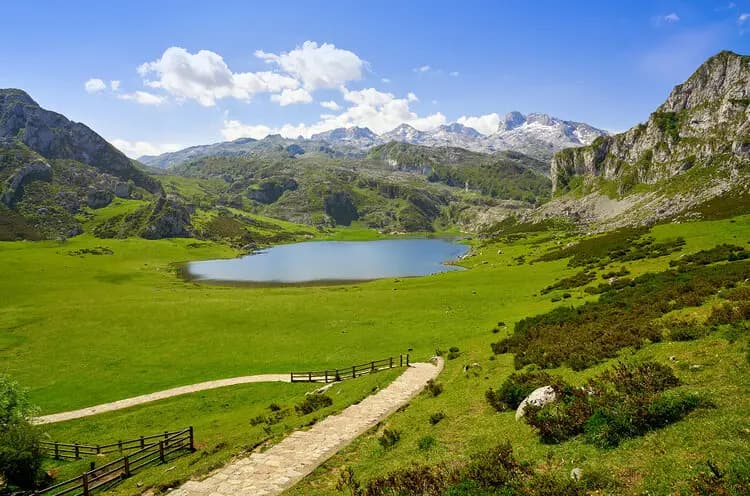
The western massif and its most famous postcard: the Covadonga Lakes, Enol and Ercina, over a thousand metres up, with cows grazing and the peaks reflected in the water. Note: during high season, access by private vehicle is usually restricted and you go up by bus from a car park; check the conditions on the official Picos de Europa National Park page before you go. On the way, the Covadonga Sanctuary is worth the stop.
Head down to spend the night in Cangas de Onís, with its Roman bridge, cider houses and lively atmosphere. Refuel here, stock up the pantry and sleep at one of the area's service areas or campsites.
Day 5: Cabrales and Fuente Dé
Cross east, stopping in Arenas de Cabrales to buy cheese from its cave (Cabrales blue cheese is unlike anything else) and carry on to Fuente Dé, now in Cantabria. There, a cable car whisks you up almost 800 metres in one go to a vertigo-inducing viewpoint over the whole central massif. It's the perfect finishing touch: you say goodbye to the Picos from above.
From Fuente Dé, the drive back to Madrid or the link to the Cantabrian coast are both within easy reach, depending on how you want to wrap things up.
Where to sleep and refuel
Overnight stays are heavily restricted inside the National Park and camping is banned, so sleep in the service areas and campsites of the villages: Cangas de Onís, Potes, Posada de Valdeón, Arenas de Cabrales. There's plenty on offer. Fill up on fuel in the larger villages (Riaño, Cangas, Potes) and don't let the tank run low in the mountains, where petrol stations are scarce. And remember the golden rule: spend the night sensibly and follow the signage; we cover it in full in where it's legal to sleep in a campervan.
Your route through the Picos starts in Madrid
This is our version, but the campervan is yours to stretch or change as you like: add the Asturian coast, head down through Liébana, stay an extra day in Valdeón. We set off from Madrid with the campervan checked over and spotless, and we'll sort out any route queries over WhatsApp before you leave.
Check out the available Winkles and choose your dates and book. A campervan trip through the Picos stays with you for a long time.
Which campervan to choose
For the Picos, with short stages and the odd narrow mountain track, the Winkle Caribe is practical and more than enough for a trip of this length.
Related routes
- Basque Coast and Landes by campervan: 7 days
- Algarve and Portugal's Atlantic coast by campervan: 9 days
- From the Pyrenees to Cabo de Gata (12 days)
Before you book
Check the requirements, price and how booking works in the guide to renting a campervan in Spain.
Ready for this route? Choose your dates and book →
Frequently asked questions
How many days do you need to see the Picos de Europa by campervan?
With 5 days you'll enjoy it without rushing: enough time for all three massifs, the Cares route, the Covadonga Lakes and Fuente Dé, with plenty of room to stop wherever you fancy. Over a 3 or 4-day long weekend you can see the highlights at a brisker pace; with a week, you'll do it justice.
How long does it take to get to the Picos from Madrid?
The first stop on the route, Riaño, is about 350 km from Madrid, roughly 4 hours. It's best to set off in the afternoon, spend the night halfway there or already in Riaño, and start the route fresh the next day. The campervan sets off from Madrid, so the north is just a day's drive away.
Can you spend the night in the campervan inside the National Park?
Overnight stays are heavily restricted inside the National Park and camping is banned, so it's best to sleep in the service areas and campsites of the surrounding villages (Cangas de Onís, Potes, Posada de Valdeón, Arenas de Cabrales). There's a good range on offer. Always spend the night sensibly and follow the signage.
Are the roads in the Picos difficult for a campervan?
They're mountain roads: winding and with some narrow stretches, but perfectly manageable in a campervan if you take it easy. The road up to the Covadonga Lakes usually has access restrictions during high season (you go up by bus from a car park); check the conditions beforehand. The rest is fine if you drive calmly and keep an eye on your mirrors.
What's the best time of year for this route?
From late spring to early autumn. June and September are ideal: good weather, lush greenery and fewer people than in the middle of August. In winter the area is beautiful but there's a snow line and closed access roads, so only go if you're properly prepared.