
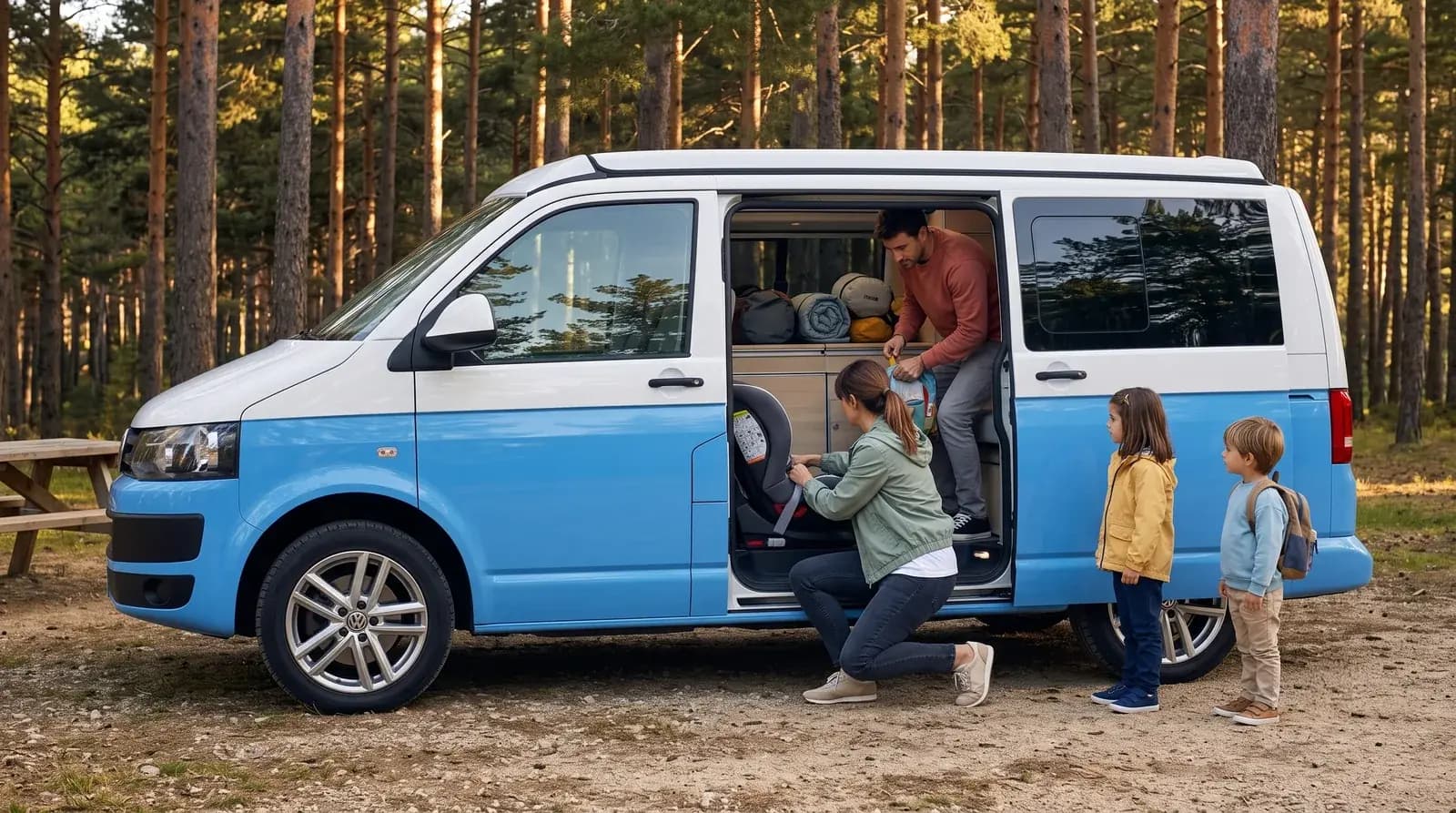
Travelling by campervan with children: safety, beds and tips to actually enjoy it
Learn how to travel by campervan with children: car seats, approved seating positions, beds, luggage, meals, hygiene and which Winkle to choose for your family.
Travelling by campervan with children isn't about squeezing your at-home routine into a van. It's about simplifying it: less luggage, shorter stages, and a layout you've sorted out before you set off. When the seats, car seats and beds all fit properly, the campervan stops feeling small and becomes a house that changes its garden every morning.
This guide answers the questions that actually come up before booking: where each child should travel, how to check a car seat is compatible, who sleeps where, what to pack, and which of the Winkles suits your family best.
The most important check: a seat to travel in and a bed to sleep in are not the same thing. Before booking, confirm separately how many people can travel with a proper seatbelt and appropriate child restraint, and how the beds will be shared out.
Is it a good idea to travel by campervan with children?
Yes, as long as the vehicle has enough approved seating positions, the child restraint systems can be fitted correctly, and the sleeping arrangement is realistic for the children's ages. The advantage of a family campervan isn't covering more miles: it's being able to stop when you need to and carrying food, clothes, a bed and shelter all in the same vehicle.
For a family, a campervan works especially well when:
- the stages leave time for playing and walking;
- each person has an assigned spot to travel in and sleep in;
- the luggage fits without blocking aisles or seats;
- simple nights are alternated with campsites or service areas;
- the itinerary allows for changes due to tiredness, rain or hunger.
It also demands accepting one reality: the space is shared. If you try to bring the same amount of clothes, toys and gear you'd take to a flat, you'll spend more time shifting bags around than enjoying the trip.
Child safety in a campervan: car seats, seatbelts and approved seating positions
While driving, a campervan is a vehicle. The beds, furniture and pop-top roof don't turn the living area into a place where children can move about freely. All occupants must travel seated in an approved position and with the appropriate restraint system.
In Spain, minors measuring 135 centimetres or less must use an approved child restraint system suited to their size. In vehicles with up to nine seats, they must normally sit in the rear seats. The regulations include specific exceptions, but these shouldn't be used as a routine way of organising the trip.
The DGT (Spain's traffic authority) recommends choosing the system according to current approval standards and the child's height. The current reference is the ECE R129 standard, which classifies systems mainly by height.
An approved seating position doesn't guarantee any car seat will be compatible
Before booking, counting seatbelts isn't enough. You need to check:
- whether the car seat uses ISOFIX or a three-point seatbelt;
- whether the campervan's seat has the necessary anchor points;
- whether the car seat manufacturer authorises fitting it to that type of seat;
- whether the seat fits properly without interfering with another one;
- whether the seatbelt runs through the guides without twisting;
- whether the recommended orientation for the child's size can be maintained.
The Winkle Báltico and Índico have ISOFIX anchor points on the rear seats. On the other models it may be possible to use approved seatbelt-fitted systems, but compatibility needs to be checked against the specific car seat model. Send beWinkle the brand, model, approval standard and fitting type before confirming your booking.
Children don't travel on the bed
While the vehicle is moving, nobody should travel lying down, sitting on a piece of furniture, or inside the pop-top roof. The beds are for use once the campervan is parked. Before setting off, pack away the night-time set-up and secure anything that could move around.
Anything loose can become a problem
Bottles, toys, tablets, crockery and rucksacks must travel closed or secured. Use the storage compartments and avoid leaving heavy items on beds or surfaces. The rule is simple: if a sudden brake could move it, it needs to be stowed.
Seats to travel in and beds to sleep in: don't confuse the capacity
"Five seats" can refer to travelling, sleeping, or both. Before choosing a campervan, sketch out your layout with names attached: who travels in which seat, where each child restraint is fitted, and who sleeps where.
| Winkle | Approved seats for travelling | Recommended sleeping capacity | Rough family fit |
|---|---|---|---|
| Báltico | 5 | Up to 5 depending on configuration published | Large families or those needing more autonomy |
| Índico | 4 | Up to 4 with lower bed and pop-top roof | Two adults and one or two children |
| Caribe | 4 | Ideally 2, according to the help centre | Not the first choice for sleeping a family of four |
| Adriático | 3 | Ideally 2; published capacity of up to 3 | A couple with one child, subject to checking bed and car seat |
Age and size matter. Two young children may share a bed very differently to two teenagers. So even though the spec sheet states a maximum capacity, it's worth confirming the bed dimensions and settling the exact layout before paying.
How to organise the beds
In a campervan with a pop-top roof, a common set-up is for the adults to sleep below and older children above. It isn't a universal rule. Weigh up age, the ability to climb up and down, protection against falls, and whether anyone might need attention during the night.
With young children, it may be more practical for an adult to sleep close to them. Don't improvise on the first night: try setting up each bed at pick-up and confirm that everyone can settle in without luggage blocking the way.
Which Winkle to choose for travelling with children
Báltico: the option with the most capacity
The Winkle Báltico has five approved seats, two sleeping areas — a central one measuring 130 × 200 cm and another in the pop-top roof measuring 150 × 200 cm — stationary heating, 57 litres of hot water, a 50-litre fridge and solar panels.
It's the most logical choice when there are four or five of you travelling, you need two separate sleeping areas, or you want greater autonomy. Even so, confirm the exact layout if there are five of you, especially once the children are taller.
Índico: balance for a family of up to four
The Winkle Índico allows up to four people to travel and sleep, and also has a pop-top roof, heating, kitchen, fridge, outdoor shower and rear ISOFIX anchor points. It's a good choice for two adults with one or two children when you don't need Báltico's maximum capacity.
Adriático and Caribe: check the sleeping layout first
Adriático has three approved seats and can suit a couple with one child if the bed and child restraint system are compatible with your situation. Caribe offers four seats for travelling, but the help centre considers it ideal for two people when it comes to sleeping. Don't choose based on the number of seatbelts alone.
You can compare all the Winkles and check with the team about the combination of passengers, ages and child restraint systems before booking.
How to organise luggage, meals and hygiene without filling up the campervan
Luggage: one soft bag per person
Rigid suitcases take up space even when empty. Soft bags or organisers that can be stored inside a compartment work much better. Pack clothes in layers and limit the "just in case" items. If the route lasts a week, it's usually more practical to do some washing halfway through than to carry seven complete outfits per person.
For the children, set aside a small accessible bag for stops containing:
- a complete change of clothes;
- a coat or raincoat;
- water and a snack;
- wet wipes or hygiene items;
- a toy or quiet activity;
- prescribed personal medication, if applicable.
While driving, this bag must also be stowed and secured.
Meals: easy cooking, not a restaurant menu
Plan dishes with few steps: pasta, rice, omelettes, sandwiches, salads, ready-washed vegetables and simple breakfasts. The fridge helps, but its space is limited. Shop for two or three days at a time and restock along the way.
Avoid cooking while the vehicle is moving, and always ventilate according to the team's instructions. Never leave a flame unattended, and don't let children play near the cooker.
Water and hygiene: alternate self-sufficiency with facilities
The campervan's water supply is limited. Báltico and Índico offer up to 57 litres and an outdoor shower; Adriático has a 20-litre tank and Caribe a portable shower. With a family, that volume gets used up much faster than when travelling as a couple.
A good strategy is to alternate self-sufficient nights with campsites or service areas that let you refill water and use showers. For the toilet, beWinkle offers a portable chemical toilet as an extra. Confirm how it works and only empty it at authorised points.
Temperature and ventilation
Never leave a child alone inside a closed campervan, even for a short stop. The interior temperature can change quickly. Look for shade where possible, ventilate safely, and adjust sleeping bags or bedding to the overnight forecast.
In colder months, Báltico and Índico have stationary heating. Ask for it to be explained at pick-up, and don't cover the vents with clothes or luggage.
How to plan your stages when travelling with children
A family route doesn't improve by adding more destinations. It improves when everyone arrives keen to get out of the campervan. As a practical guide, alternate stretches of driving with stops and avoid stringing together several long days in a row.
Plan by time, not just by distance
Two hundred kilometres of motorway is nothing like two hundred kilometres of mountain roads. Check the real driving time, the bends, and any possible access restrictions. For a first trip, choose a nearby destination and stay two nights in the same area.
Turn the stops into part of the trip
Look for spots with room to walk, eat or use the toilet. A useful stop doesn't have to be a monument. Sometimes a park, a safe viewpoint or a village with a bakery does more for the trip than another hour straight on the road.
Leave part of the route open
Book what's essential in high season, but keep some margin to change a night around. If someone sleeps badly, it rains, or a road turns out slower than expected, cutting a stage short is usually better than sticking to the itinerary at any cost.
Recommended campervan routes for families
Sierra de Madrid and Gredos
It's a good first getaway: few kilometres, nature, and the option of coming back without a long drive. In summer, swimming spots can be a good plan, always checking access and conditions first.
Check out the getaway through the Sierra de Madrid and Gredos.
Picos de Europa in five days
This works with children used to the road and to walking, but requires planning around access, mountain terrain and overnight stops. Don't try to see everything. Pick two or three areas and leave time for trails suited to their age.
Use the Picos de Europa campervan route as a base.
Asturias in four days
This combines villages, coastline and outdoor activities. It's a particularly flexible option, as it allows you to swap a mountain plan for a coastal one depending on the weather.
Check out the four-day route through Asturias.
Nine mistakes when travelling by campervan with children
- Choosing based on the number of seats without checking the beds.
- Assuming any car seat will fit any seat.
- Letting someone travel lying down or outside an approved seating position.
- Leaving toys, bottles or luggage loose while driving.
- Planning too many kilometres and too many stops.
- Bringing rigid suitcases that can't be stored afterwards.
- Relying solely on the campervan's water and shower for the whole route.
- Improvising the sleeping arrangement on arrival when everyone's tired.
- Leaving a child alone inside the vehicle.
Checklist before booking a family campervan
- Is there an approved seating position for each person?
- Is each child restraint system compatible with the seat and its anchor points?
- Do you know where each person will sleep?
- Are the beds suitable for the children's height and age?
- Does the luggage fit without blocking aisles or seats?
- Does the route include rest breaks and short days?
- Have you identified service areas or campsites to restock water and facilities?
- Have you checked the temperature forecast?
- Has beWinkle confirmed your combination of passengers and car seats?
Which Winkle suits your family?
Tell us how many of you are travelling, the children's ages, and which restraint systems you use. We'll help you check seats, beds and equipment before you book.
Discover the Winkle Báltico · Check availability
Keep reading: Which campervan to choose depending on who you're travelling with
Frequently asked questions
Is it safe to travel by campervan with children?
It can be, provided each child travels in an approved seating position, uses a compatible restraint system, and all luggage is stowed away. While driving, nobody should travel on a bed, on furniture, or in any space without a seatbelt.
Can a car seat be fitted in a campervan?
Yes, as long as the seat, the anchor type and the car seat itself are compatible. Báltico and Índico have ISOFIX on the rear seats. For seatbelt-fitted systems or other models, check the manufacturer's instructions and consult beWinkle before booking.
Where should children measuring 135 cm or less travel?
In Spain, they must use an approved child restraint system suited to their size. In vehicles with up to nine seats, they must normally travel in the rear seats, except for the exceptions provided for in the regulations.
Which is the best Winkle for a family of four?
Índico and Báltico are the clearest options, as they offer four or more seats, a pop-top roof, heating and two sleeping areas. The decision depends on the beds, the autonomy you need, and the child restraint systems you use.
Which is the best Winkle for five people?
Báltico is the only Winkle with five approved seats and a published capacity to sleep up to five. Before booking, confirm the exact layout according to each traveller's age and height.
Can children sleep in the pop-top roof?
It depends on their age, independence, size and the safety measures available. Check the access, ventilation and risk of falling. With young children, it may be preferable for them to sleep below or next to an adult.