
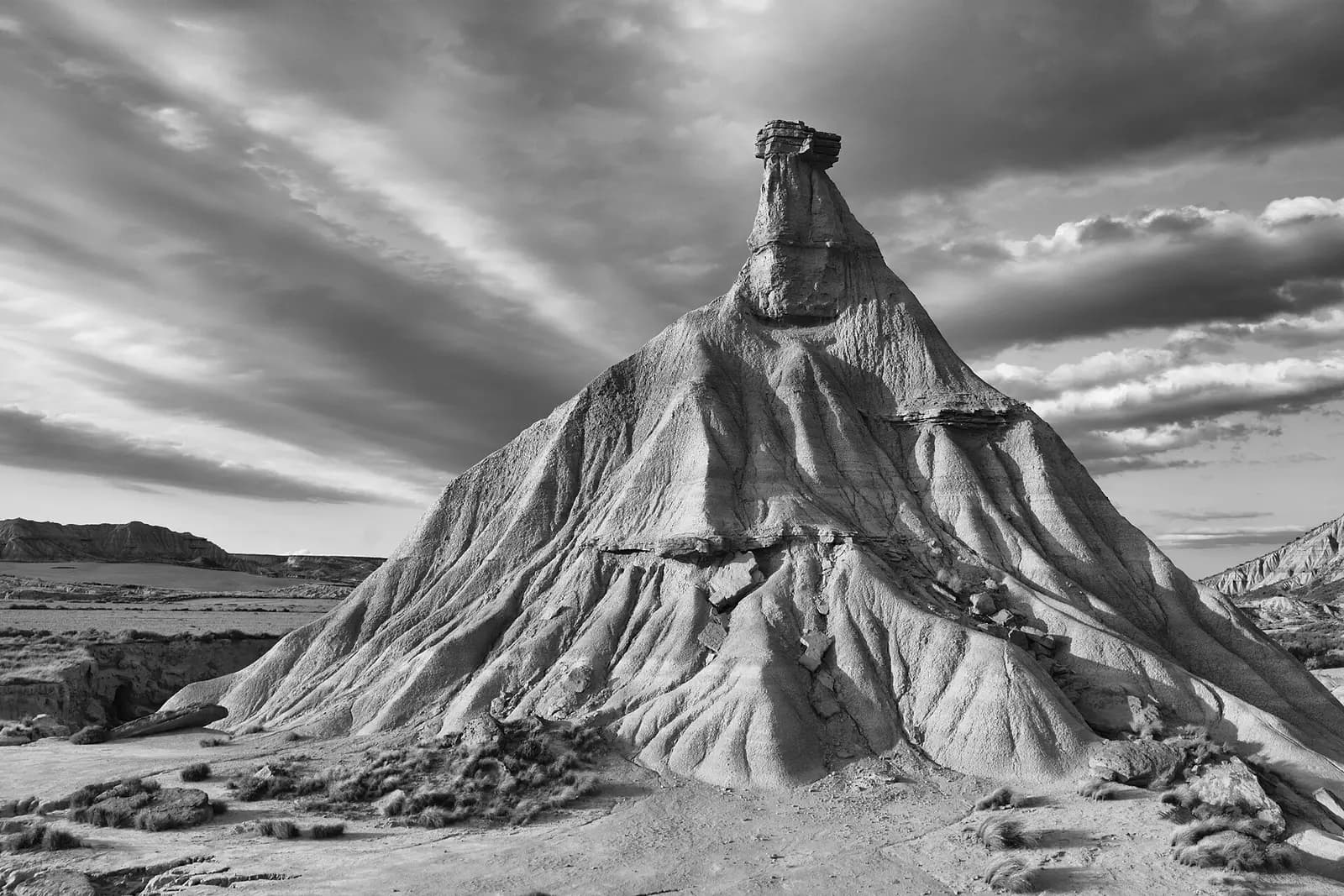
Bardenas Reales by campervan
A desert four hours from Madrid, with a rule that catches almost everyone out: you cannot sleep inside the park. How to plan the campervan route without breaking it.
Less than four hours from Plaza de Castilla there's a desert. The Bardenas Reales are a semi-desert of clay, gypsum and sandstone in the south of Navarre, with gullies and buttes that look like another planet. Lots of people discover it in a photo, picture themselves sleeping out there in the van under the stars and get a nasty surprise when they arrive: you can't spend the night inside the park.
So the plan is a different one, and it works out better. You sleep in Tudela or Arguedas, go into the park by day and use the van for what it's good at: moving around on your own schedule between the desert, a village perched on a hill and two Cistercian monasteries. Four days of short stages. Below you have the map with the real route, the kilometres for each day and what you see between one stop and the next.
- Days
- 4Ribera de Navarra · Bardenas Reales
- Route in the area
- 200 km+ 600 km there and back from Plaza de Castilla
- Behind the wheel
- ≈ 4 h 10 minapprox., without stops
- Best time
- Spring and autumnMay, June and September. In July and August the midday sun is brutal.
Roads: Motorway and main roads to Tudela. Inside the park, signposted dirt tracks with a 40 km/h limit.
Best Winkle: Adriático · the nimblest one, for two or three on a long weekend
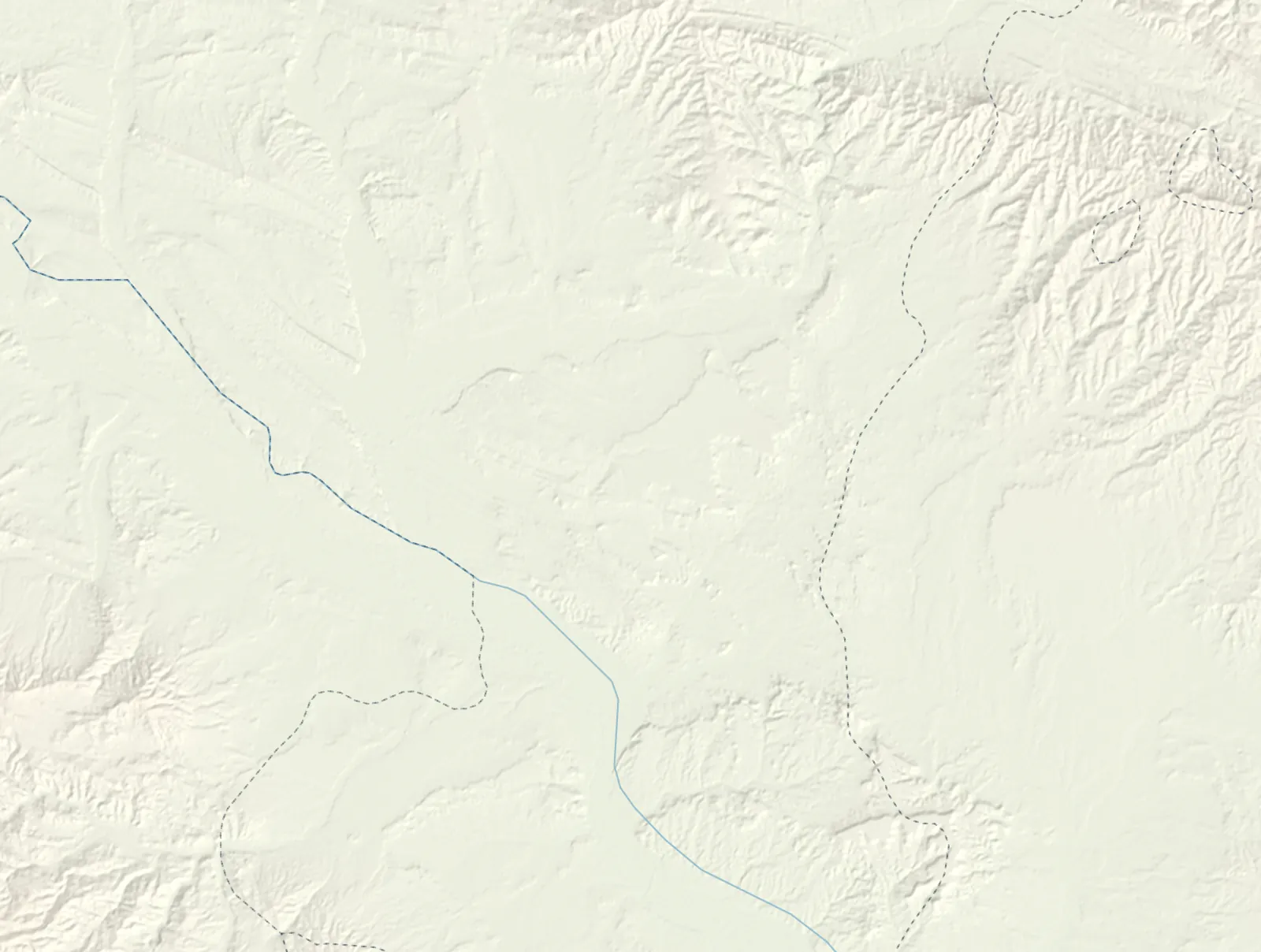 NAVARREARAGONLA RIOJABardenas Reales1Tudela2Visitor centre3Castildetierra4Arguedas5Ujué6La Oliva Monastery7Fitero
- 1 Tudela
- 2 Visitor centre
- 3 Castildetierra
- 4 Arguedas
- 5 Ujué
- 6 La Oliva Monastery
- 7 Fitero
From Plaza de Castilla: 305 km · ≈ 3 h 50 min Back to Plaza de Castilla: 295 km · ≈ 3 h 45 min
© OpenStreetMap contributors (trazado: OSRM) · Natural Earth · relieve: AWS Terrain TilesDay by day
From Madrid to Tudela
Madrid (Plaza de Castilla)1Tudela 305 km ≈ 3 h 50 min
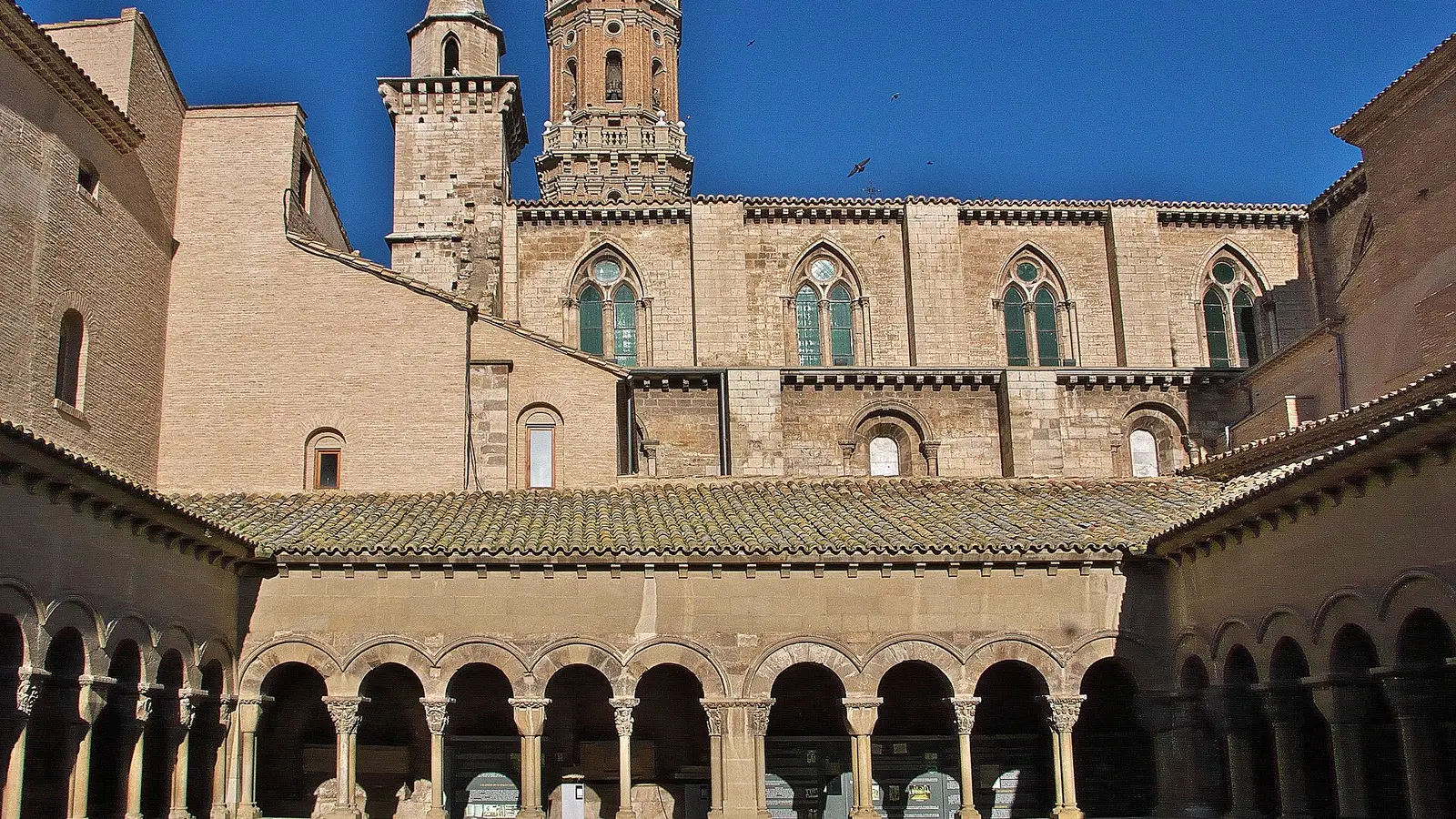
Tudela cathedral, from its cloister.Photo: Jl FilpoC · CC BY-SA 4.0 A driving day, but a short one. You leave Plaza de Castilla on the A-2 and, past Medinaceli, the route leaves the Zaragoza motorway and climbs through Soria country, via Almazán and Ágreda, to Tarazona. From there Tudela is a stone's throw. It's about 305 km, almost four hours without stops.
Tudela is Navarre's second city and sits on the banks of the Ebro. Its main church, Santa María, has been a cathedral since Charles III gave Tudela the title of city in 1390, and it has a Romanesque cloister well worth a visit. The bridge over the Ebro dates from the 12th century. The Plaza de los Fueros is the centre of everything: tapas, terraces and people.
Use the afternoon to stroll the old town and have a Ribera vegetable dinner. Tomorrow is an early start, because the park opens at 8:00 and the best light is first thing.
What to see
- The Plaza de los Fueros
- The cathedral and its Romanesque cloister
- The 12th-century bridge over the Ebro
Where to sleepTudela, in a motorhome area or a car park where it is allowed. Sleeping, not camping.
Heads upIf you leave Madrid late, no problem: you arrive in time for dinner and still get into the park just as early.
A day inside the Bardenas
1Tudela4Arguedasvia Visitor centre, Castildetierra 36 km ≈ 1 h 10 min
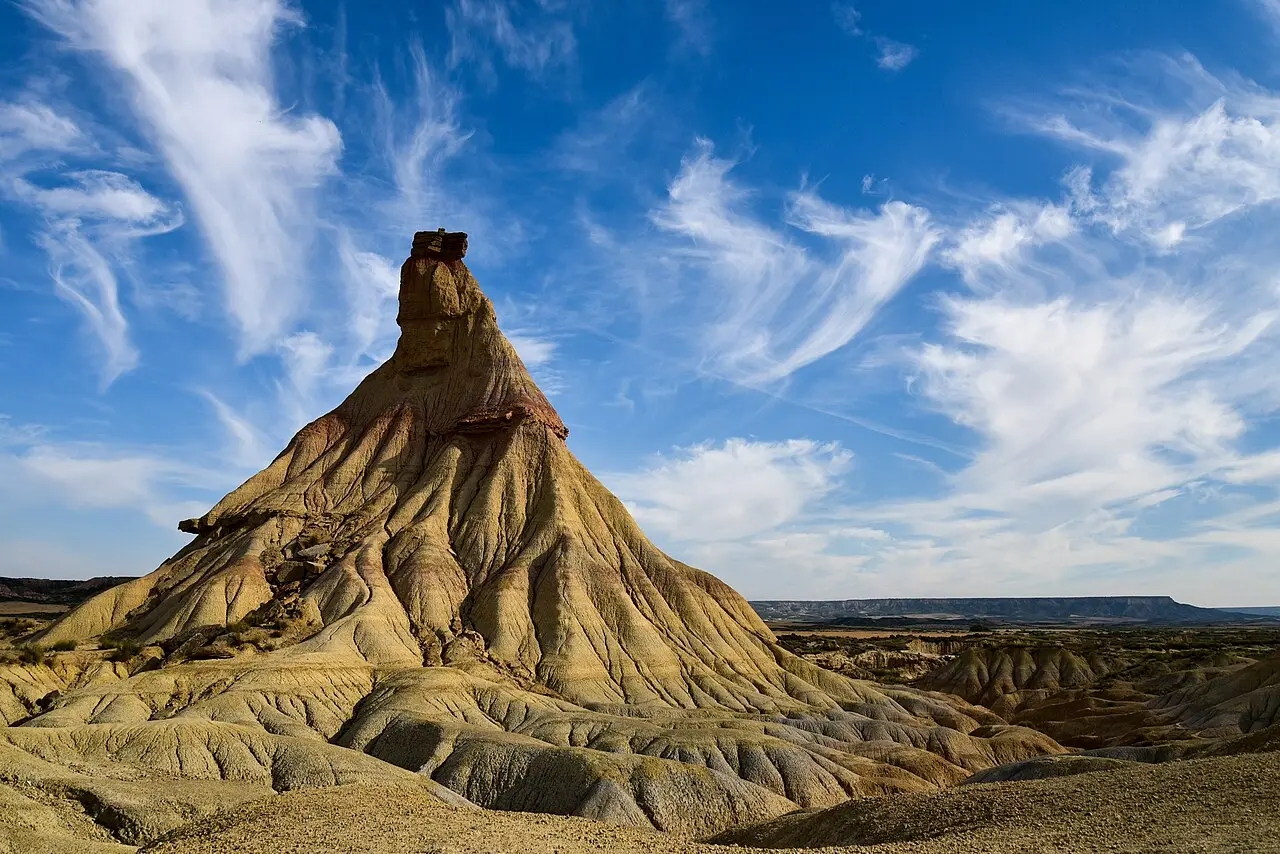
Castildetierra, in the Bardena Blanca.Photo: Ant°AM · CC BY-SA 4.0 The Bardenas Reales cover 41,845 hectares. They have been a Natural Park since 1999 and a Unesco Biosphere Reserve since 2000. They split into three zones: El Plano, to the north, farmland; the Bardena Blanca, in the middle, gypsum and clay, the most eroded and the one in every photo; and the Bardena Negra, to the south, with Aleppo pine and scrub. That lunar look has taken it to the screen: it was the Dothraki Sea in season six of Game of Thrones.
First stop, the Information Centre, at the Los Aguilares estate, about 7 km from Arguedas. They give you a free map and tell you which way to go that day. Always ask: inside the park there's the Spanish Air Force firing range, 2,244 hectares in use since 1951, and driving through the military zone is forbidden.
Then Castildetierra, the Bardena Blanca butte topped by a rock everyone recognises. It's fragile: under normal conditions it's reckoned to have about forty years left. From there, the track that skirts the Bardena Blanca (about 25 km more) gives the best views in the park, and the Barranco de las Cortinas gully is a walk of just over a kilometre, with no climbing.
What to see
- The Los Aguilares Information Centre
- Castildetierra, in the Bardena Blanca
- The track around the Bardena Blanca
- The Barranco de las Cortinas, on foot
Where to sleepArguedas, outside the park. Spending the night inside is forbidden.
Heads upYou can only be inside from 8:00 until an hour before dusk, at 40 km/h at most, on signposted tracks and never in a convoy of five or more vehicles.
Ujué and La Oliva Monastery
4Arguedas1Tudelavia Ujué, La Oliva Monastery 139 km ≈ 2 h 30 min
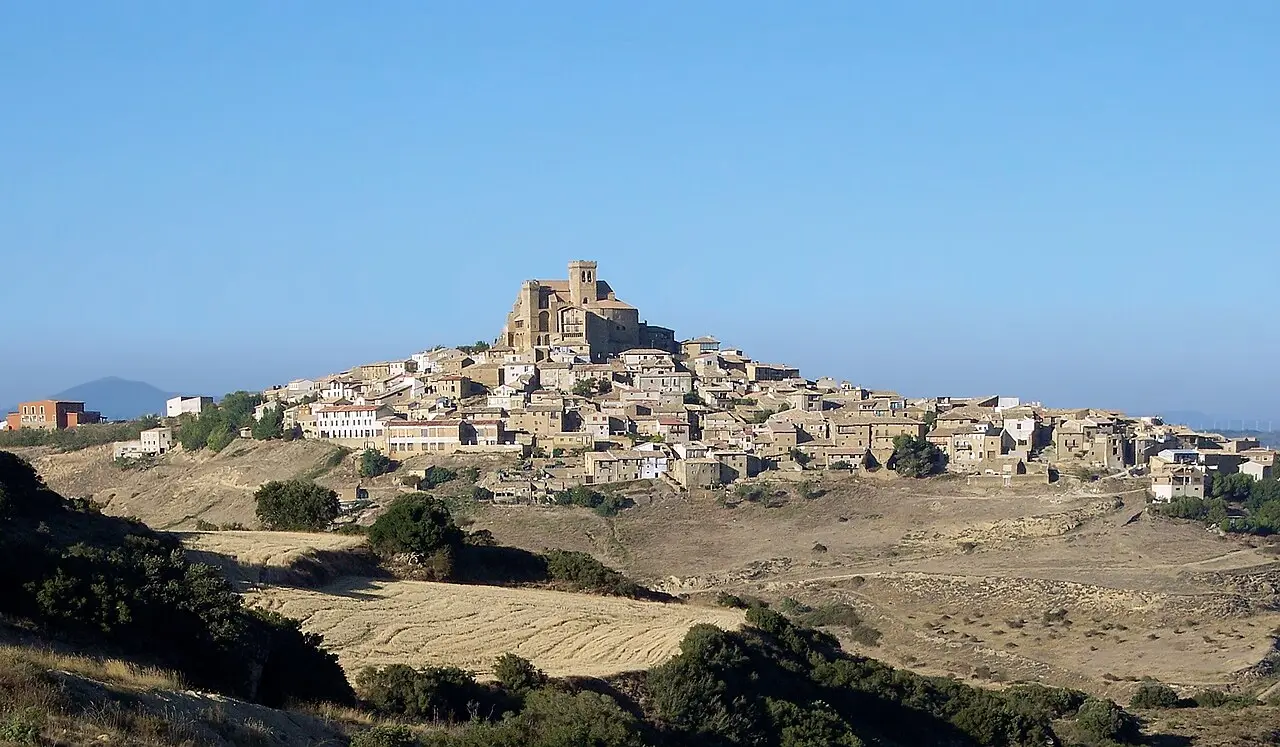
Ujué, perched on its hill.Photo: Adbar · CC BY-SA 3.0 Today you leave the desert and head up into the Navarre almost nobody visits. Ujué sits at 815 metres, on top of a hill, and from the village you look out over the Pyrenees, the Zona Media and the Ribera. Up top is Santa María, a Romanesque fortress church from the 11th century, remodelled with Gothic touches in the 14th. Inside it keeps the heart of Charles II the Bad, who left it to the Virgin. Before you head down, try the shepherd's migas and the candied almonds the village is famous for.
On the way down towards Carcastillo is the Monastery of La Oliva, Cistercian, founded around 1145-1150 by García Ramírez of Pamplona. The church went up between 1164 and 1198, in the shift from Romanesque to Gothic, and the cloister is Gothic, from the 14th to the 16th centuries. It isn't a museum: Trappist monks have lived there since 1927, and they make wine too.
It's the day with the most driving on the trip, about two and a half hours in total, but split between stops. In the evening you head back to Tudela to sleep.
What to see
- Santa María de Ujué and its south-facing viewpoint
- The views towards the Pyrenees
- The church and cloister of La Oliva
Where to sleepBack in Tudela, which leaves you close to Fitero for tomorrow.
Heads upLa Oliva has a community of monks: check visiting hours before you go so you don't find the door shut.
Fitero and home
1Tudela7Fitero 25 km ≈ 30 min
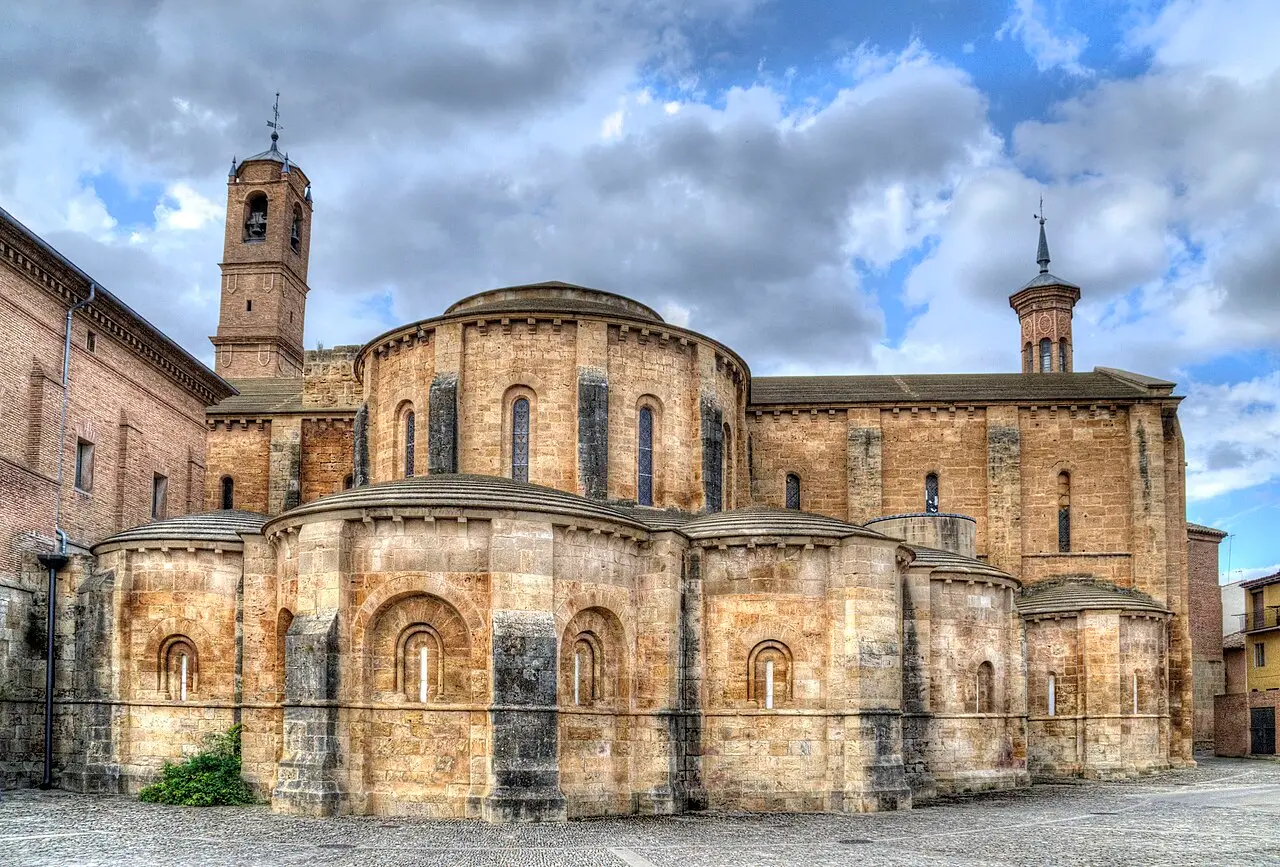
Fitero monastery.Photo: Ángel M. Felicísimo · CC BY 2.0 Last day, and a short one. Half an hour west of Tudela, on the banks of the river Alhama, is Fitero. Its monastery of Santa María la Real began with a donation from Alfonso VII in 1140, and its founder, San Raimundo, created the Cistercian militia that would go on to become the Order of Calatrava. The church was built between 1179 and 1247, in the Cistercian take on the move from Romanesque to Gothic.
About 3 km from the village are the Baños de Fitero, the spa. If it fits, it's the best way to end the trip: a long soak before the almost four hours home.
From Fitero to Plaza de Castilla it's about 295 km, through Soria country again. Leave with time to spare so you can return the van without rushing.
What to see
- The monastery of Santa María la Real
- The Baños de Fitero
- The Alhama valley
Where to sleepAt home. You drive back the same day.
Heads upIf you want the spa, check opening hours and book before you leave Tudela.
Back to Plaza de Castilla: Fitero → Plaza de Castilla · 295 km · ≈ 3 h 45 min · the same day 4, after Fitero
Before you set off
- Read the Bardenas tourist use rules: opening hours, speed limit and the ban on overnight stays.
- Plenty of water, a cap and sun cream. It's a semi-desert and in July highs go above 35 degrees.
- Stop at the Information Centre before you head onto the tracks: they tell you what is open that day.
- If it has rained hard, ask there before driving on dirt tracks.
- Always sleep outside the park. We explain it in where it's legal to sleep in a campervan.
- Work out the kilometres calmly: we tell you how in kilometres when renting a campervan.
When to go
The Bardenas are a semi-desert, with a steppe climate of between 300 and 450 mm of rain a year. In July highs go above 35 degrees and in winter it freezes on 40 to 50 days. So the answer is easy: spring and autumn. Pleasant temperatures, fewer people and the same light for photos. If summer is your only option, go in at 8:00, as soon as the park opens, and at midday head off for lunch in the shade in Tudela.
There's another reason, and it comes from our own numbers. Summer is when most bookings come in: July is our peak month and August the second, while May, June and September are quieter. In mid-season you choose your van instead of taking whatever is left. We go into it in the best times to rent a campervan.
Where to sleep and refuel
The rule, plainly: the Bardenas regulations ban camping, in a tent or a motorhome, and sleeping outdoors anywhere in the park. On top of that, you can only park in the signposted spots. With the van you sleep outside, in Arguedas or Tudela, which have motorhome areas and car parks where you can spend the night.
Don't confuse an overnight stay with camping. An overnight stay is sleeping inside the van, closed up, where parking is allowed. Camping is putting out chairs, an awning or levelling blocks and taking up more space than the vehicle. The first is allowed in lots of places; the second is regulated almost everywhere. The full guide is in where it's legal to sleep in a campervan in Spain.
For fuel, water and emptying, use Tudela, the big town on the route. There's nothing inside the park: go in with a full tank and water in the fridge.
What to eat along the way
You're in the Ribera del Ebro, and people come here to eat vegetables. La Mejana in Tudela is famous for its artichokes, asparagus and lettuce hearts: order them at any bar on the Plaza de los Fueros. In Ujué, shepherd's migas, made with pan cabezón bread, and candied almonds for the road. And at La Oliva the monks make wine: a bottle for dinner on your last night in the van.
If you have more days
This is our four-day version. If you have one more:
- Olite: between Ujué and Tudela, with the Royal Palace that Charles III the Noble enlarged, in a French-inspired Gothic style.
- The Bardena Negra: the El Fraile walk, about 5 km, among Aleppo pines and flat-topped relief. Another side of the park.
- Sanchicorrota: the butte where the bandit Sancho Rota had his cave in the 15th century. They say he shod his horses backwards to throw people off his trail.
And if you only have three days, drop Ujué and La Oliva: Tudela, a full day in the Bardenas and home via Fitero.
What the campervan costs
All the Winkles are Volkswagen Transporters, and each has its own starting price:
| Winkle | Seats | From (€/day) |
|---|---|---|
| Adriático | 3 | 70 |
| Caribe | 4 | 80 |
| Índico | 4 | 90 |
| Báltico | 5 | 100 |
For four days, a couple in the Adriático or the Caribe pays 280-320 € base; a family of four in the Índico, about 360 €. Fully comprehensive insurance and 24/7 assistance are included, and so are 100 km per rental day. Fuel and extras are not. Watch the sums: the whole route, there and back from Plaza de Castilla, adds up to about 800 km, and four days give you 400 km included. You'll fall short, so upgrade the pack when you book; see how kilometres are calculated to pick the one that works best for you.
If it's your first time, read how to drive a campervan for the first few kilometres first. It handles like a big car and within the first hour on the motorway you've got the hang of it. Vans checked over and spotless, and we'll answer any route questions on WhatsApp before you leave.
Related routes
- La Rioja and its wineries by campervan: a weekend
- Teruel and Albarracín by campervan: 3 or 4 days
- Basque Coast and Landes by campervan: 7 days
Before you book
Check the requirements, price and how booking works in the guide to renting a campervan in Spain, or have a look at the Winkles and their equipment.
Ready for this route? Choose your dates and book →
Frequently asked questions
Can you sleep inside the Bardenas Reales in a campervan?
No. The official Bardenas Reales rules ban camping and sleeping outdoors anywhere in the park, and you can only be inside between 8:00 and an hour before dusk. With the campervan you sleep outside, in a motorhome area or a permitted car park in Arguedas or Tudela, and go into the park by day.
How many days do I need to see the Bardenas from Madrid?
You can see the Bardenas Reales well in three or four days from Madrid. The first day is mostly driving (about 305 km, almost four hours, from Plaza de Castilla to Tudela), one is for the park, another for the villages and monasteries of southern Navarre, and the last for Fitero and an unhurried drive home. It's a long-weekend trip, not a full week.
Will any campervan do for the Bardenas, or do you need a 4x4?
A normal campervan is fine. The Bardenas Reales tracks are dirt and signposted, and you drive them slowly: the limit inside the park is 40 km/h. The firm rules are not to leave the authorised tracks, to park only where signposted and not to drive in a convoy of five or more vehicles. If it has rained hard, ask at the Information Centre before going in.
When is the best time to visit the Bardenas by campervan?
Spring and autumn are the best time for the Bardenas Reales: it's a semi-desert and in July and August the midday heat really bites. At beWinkle summer is when most bookings come in, so going in May, June or September pays off twice: gentler temperatures and more vans to choose from.
Which campervan should I choose for this route if it is my first time?
For a couple, the Adriático (3 seats) or the Caribe (4 seats, sleeps 2) are more than enough for this route. If there are four or five of you, the Índico or the Báltico. They're all the same base, a Volkswagen Transporter that drives like a big car, so for a first trip through Navarre the size depends on how many of you there are, not on how hard the roads are.