

Teruel and Albarracín by campervan: pink rock four hours from Madrid
Albarracín clinging to the rock, the chilly mountains of the Montes Universales and the Mudéjar towers of Teruel. A 3 or 4-day campervan route from Madrid: what to see, when to go and where to park and sleep without a fine.
Albarracín appears all at once, tucked into a bend of the Guadalaviar, with houses the reddish colour of rodeno sandstone and walls climbing up the hillside. Hardly anyone puts it on their list of van trips: people think of the Picos, Galicia, the Basque coast. That's a mistake, because Teruel is one of the places where a campervan makes the most sense. Small villages, quiet mountains and stops half an hour apart.
The route fits into four days: one to get there, one for Albarracín and its rodeno pine forests, one to drive up to the source of the Tagus and the last for the Mudéjar of Teruel before heading home. It isn't about clocking up kilometres, it's about parking, getting out and walking. Below you have the map with the real route, the kilometres for each day and what you see between one stop and the next.
- Days
- 4Sierra de Albarracín · Teruel
- Route in the area
- 138 km+ 604 km there and back from Plaza de Castilla
- Behind the wheel
- ≈ 2 h 55 minapprox., without stops
- Best time
- May, June and SeptemberSpring and early autumn. In summer, bring a sleeping bag for the night.
Roads: Motorway and main roads to the sierra; then quiet mountain roads. You cannot drive the van into old Albarracín.
Best Winkle: Índico · it has a parking heater, and above 1,100 metres you will be glad of it
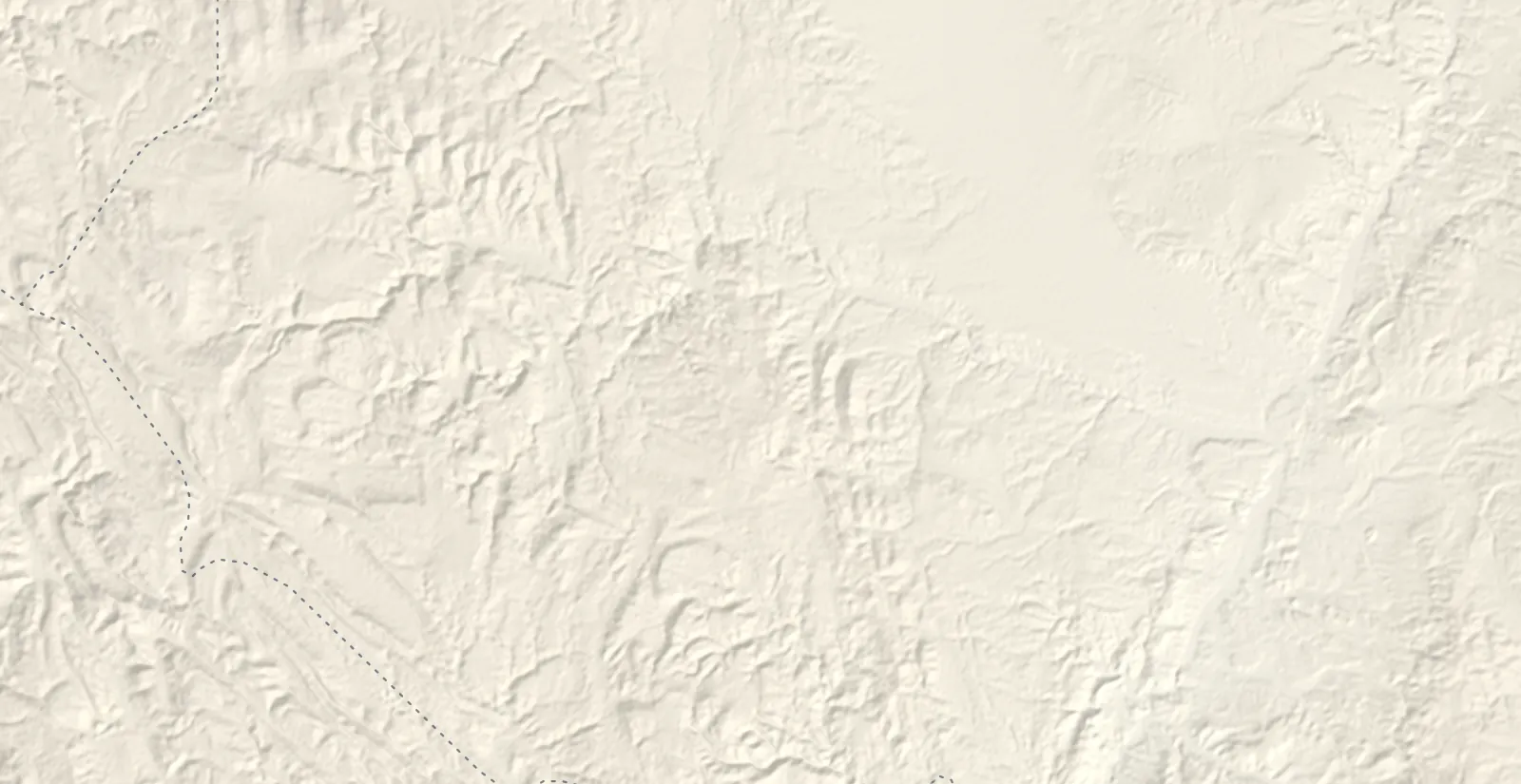 TERUELCUENCASierra de AlbarracínMontes UniversalesGUADALAJARA1Albarracín2Rodeno pine forest3Source of the Tagus4Teruel5Dinópolis
- 1 Albarracín
- 2 Rodeno pine forest
- 3 Source of the Tagus
- 4 Teruel
- 5 Dinópolis
From Plaza de Castilla: 286 km · ≈ 3 h 55 min Back to Plaza de Castilla: 318 km · ≈ 3 h 50 min
© OpenStreetMap contributors (trazado: OSRM) · Natural Earth · relieve: AWS Terrain TilesDay by day
From Madrid to Albarracín
Madrid (Plaza de Castilla)1Albarracín 286 km ≈ 3 h 55 min
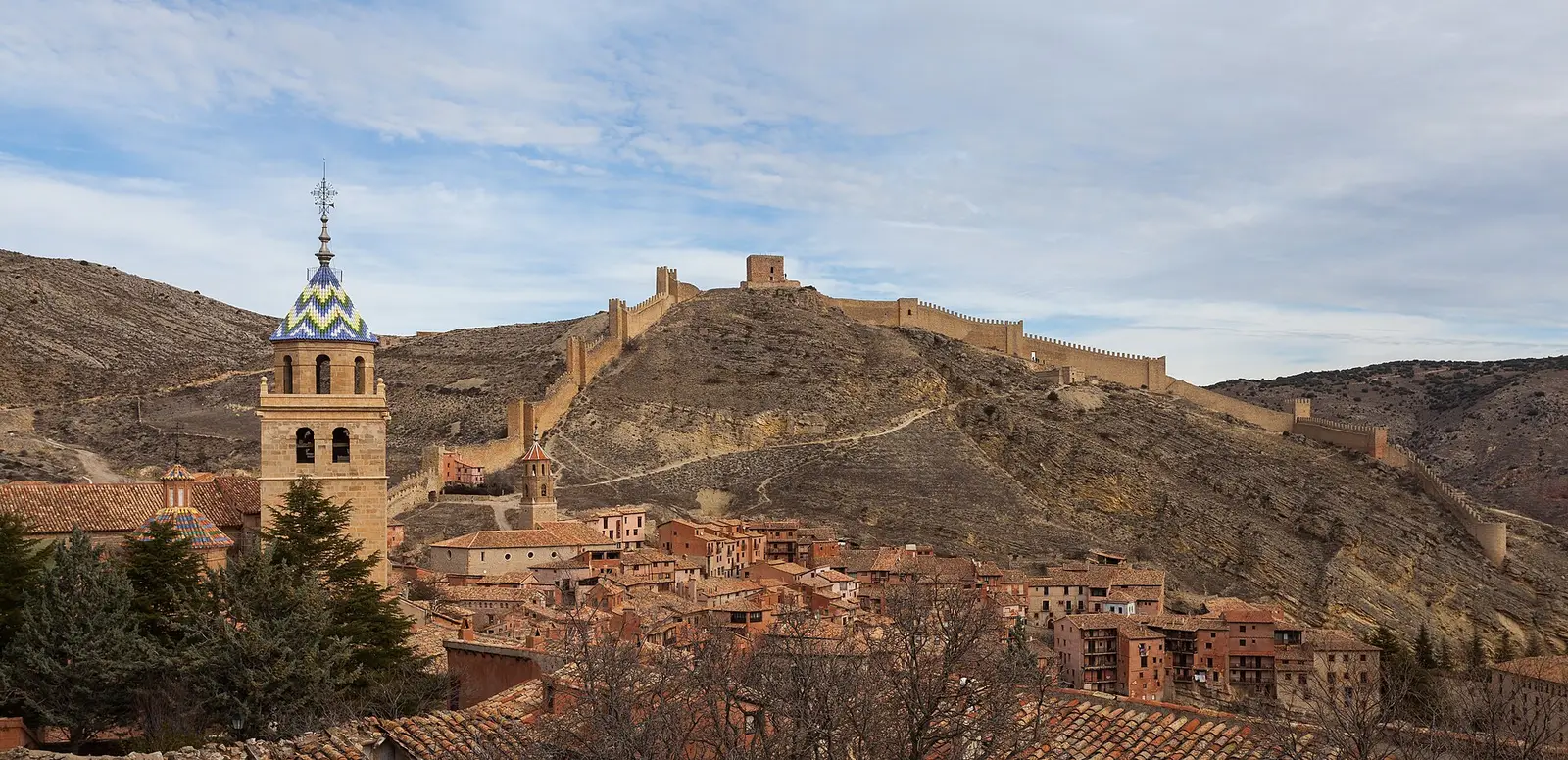
Albarracín, in its meander.Photo: Diego Delso · CC BY-SA 3.0 You leave Plaza de Castilla on the A-2 as far as Alcolea del Pinar and from there head down via Molina de Aragón towards the sierra. It's about 286 km and almost four hours behind the wheel, so the easy option is to leave after lunch and arrive with the last of the light. The way in is worth it: the village appears hanging above the river, and you take the first photo without getting out.
Albarracín sits at about 1,170 metres and has fewer than a thousand residents. It became a National Monument in 1961 and is now a protected historic site. Almost the whole old town is wrapped by the river Guadalaviar, which closes it into a meander, and that's where its perched silhouette comes from, unlike any other village.
Tonight you don't need to see anything else. Park in the area at the entrance, take a short walk at dusk and leave the old town for tomorrow, with daylight and fresh legs.
What to see
- Arriving in Albarracín above the Guadalaviar
- A first stroll at sunset
Where to sleepThe motorhome area at the entrance to Albarracín. You sleep here three nights.
Heads upDon't try to drive the van into the old town: the streets are narrow and steep. Leave it below and walk up.
Albarracín on foot and the Pinares de Rodeno
1AlbarracínRodeno pine forest and back 28 km ≈ 45 min
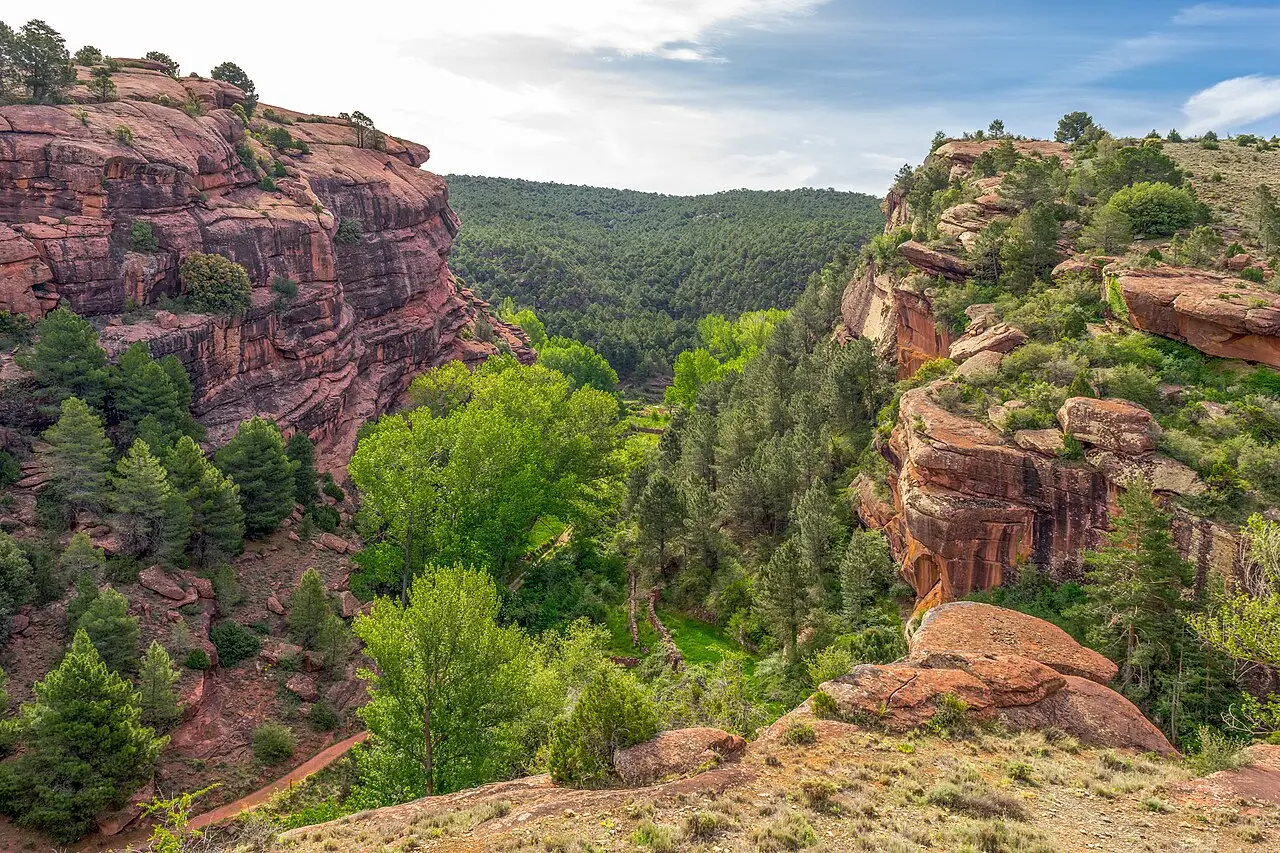
Red sandstone and pines in the Rodeno.Photo: Jose Rumí · CC BY-SA 4.0 The morning is for the village, and you do it on foot. Walk up along the walls, 14th-century and Christian-built, to the Torre del Andador, which is older: Muslim masonry from the 10th and 11th centuries, at the top of the enclosure. Below, the cathedral of El Salvador, from the 16th century, next to the castle that was the citadel of the Banu Razin, the family that ruled its own taifa kingdom here in the 11th century. Later, the Azagra family kept Albarracín effectively independent of Castile and Aragón from 1170. Small, but with the history of a kingdom.
In the afternoon, back in the van and about 20 minutes to the Pinares de Rodeno. It has been a Protected Landscape since 1995, the first in the province, with 6,829 hectares between Albarracín, Bezas and Gea. The ground is red sandstone, the rodeno, and on top grows the maritime pine. Among the rocks there are shelters with Levantine rock art, such as the Toros del Prado del Navazo, the cave of Doña Clotilde or the Cocinilla del Obispo.
Those shelters are part of the rock art of the Mediterranean Basin, a World Heritage Site since 1998. You've got paintings thousands of years old a short walk from the van.
What to see
- The walk along the walls and the Torre del Andador
- The cathedral of El Salvador and the castle
- The Toros del Prado del Navazo and the rodeno shelters
- The Dornaque interpretation centre
Where to sleepAlbarracín again.
Heads upIt's all slopes and stone: comfortable shoes for the village and for the rodeno trails.
Montes Universales and the source of the Tagus
1AlbarracínSource of the Tagus and back 69 km ≈ 1 h 20 min
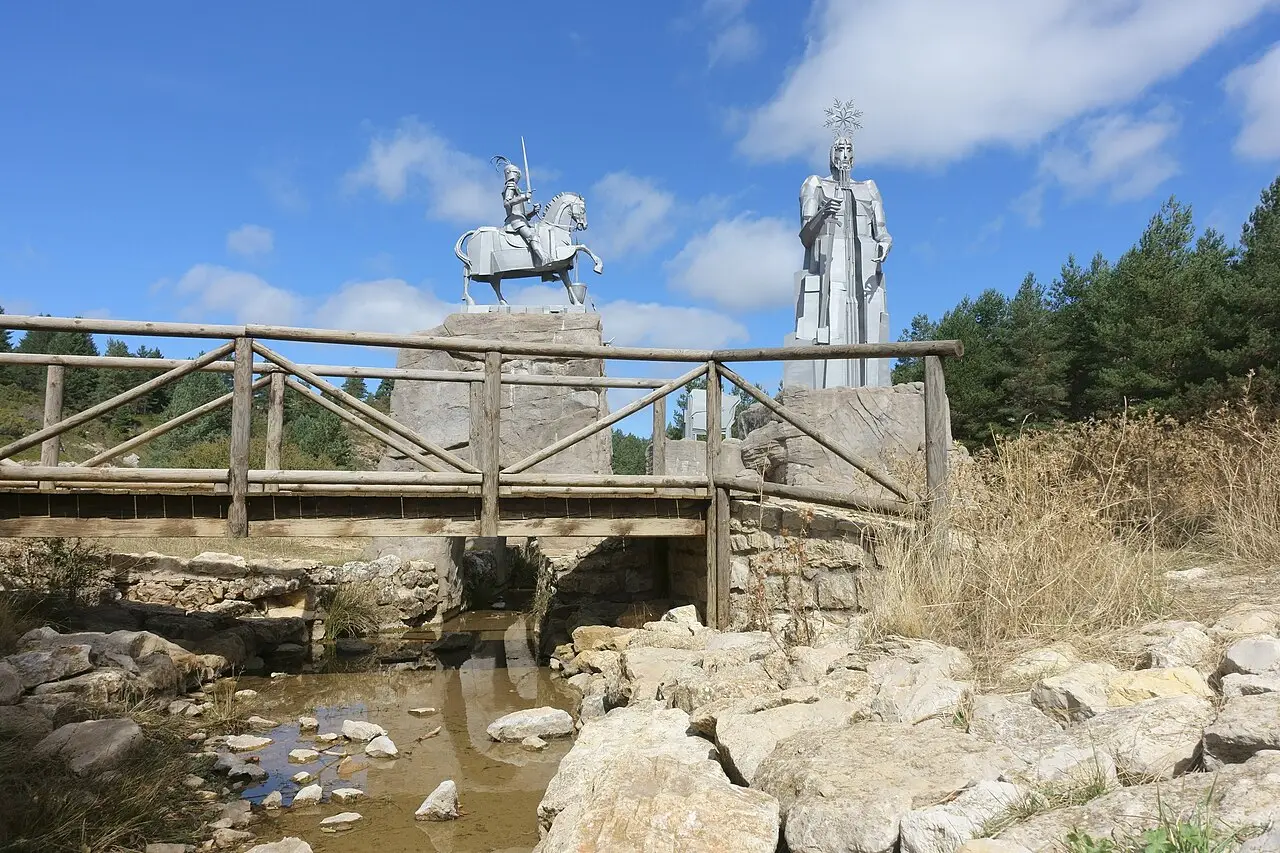
The monument to the source of the Tagus.Photo: Rodelar · CC BY-SA 4.0 Today you head up into the mountains. The Montes Universales are the roof of the area: the highest peak, Caimodorro, reaches 1,936 metres. These mountains are the source of the Tagus, the Turia (called the Guadalaviar here, the same river that wraps around Albarracín), the Cabriel and the Júcar. Half the peninsula starts here.
The Tagus rises at 1,593 metres, at the spot called Fuente García, in the municipality of Frías de Albarracín. From there it runs 1,007 km to Lisbon. A little below the spring is the monument to the source, from 1974, by the sculptor José Gonzalvo Vives, with figures of the river and of the three provinces that meet in the area: Teruel, Cuenca and Guadalajara.
It's about 70 km there and back, an hour and twenty minutes of driving, so take your time: stop at the viewpoints, have lunch in the countryside and get back to Albarracín with time for one last loop around the old town.
What to see
- The monument to the source of the Tagus
- The Fuente García spring
- The pine forests and meadows of the Montes Universales
Where to sleepAlbarracín, third and last night.
Heads upThere are few services in the mountains: set off with water, food and fuel to spare.
Teruel, the Mudéjar and Dinópolis
1Albarracín5Dinópolisvia Teruel 41 km ≈ 50 min
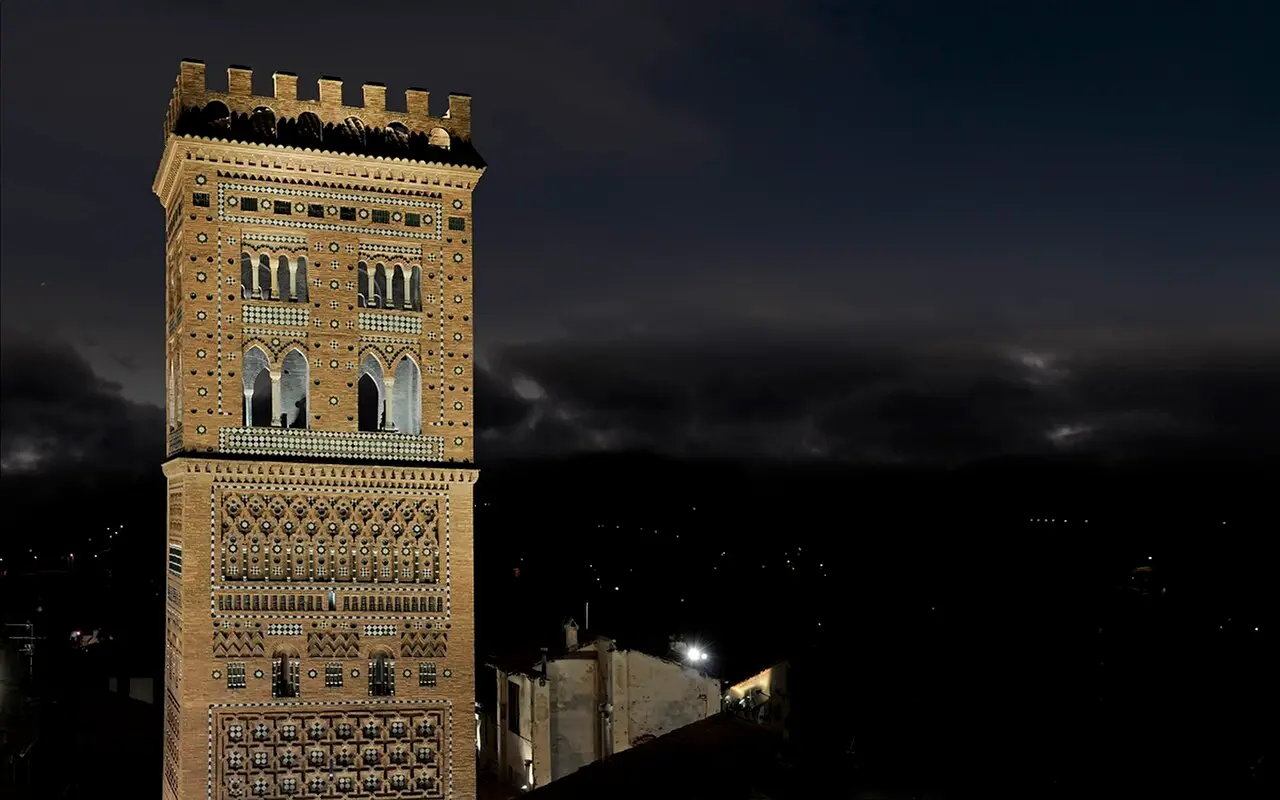
The tower of El Salvador, in Teruel.Photo: Tagarino · CC BY-SA 3.0 You drive down to Teruel, less than an hour away. It's Spain's least populated provincial capital and sits at about 915 metres. Its Mudéjar architecture has been a World Heritage Site since 1986: the towers of El Salvador, San Martín and San Pedro, in brick and ceramic, and the cathedral of Santa María de Mediavilla, whose wooden ceiling is said to be the most important medieval ceiling in the world.
You can see it on foot in a morning. The Plaza del Torico, with its 1858 fountain that is the city's emblem; the mausoleum of the Lovers; the neo-Mudéjar Escalinata staircase; and the 1929 viaduct over the San Julián ravine. Before you leave, ham: Teruel ham was Spain's first ham with a designation of origin, since 1984.
If you're travelling with children, Dinópolis is on the outskirts: a palaeontology theme park opened in 2001, half a day of dinosaurs. The drive home starts from there, about 318 km and almost four hours, heading down via Cuenca.
What to see
- The Mudéjar towers of El Salvador and San Martín
- The cathedral of Santa María de Mediavilla
- The Plaza del Torico and the Escalinata
- Dinópolis, if you have children
Where to sleepAt home. You drive back the same day.
Heads upDinópolis changes its hours with the season: check its website before you go.
Back to Plaza de Castilla: Dinópolis → Plaza de Castilla · 318 km · ≈ 3 h 50 min · the same day 4, heading down via Cuenca
Before you set off
- A warm sleeping bag even in summer: you'll be sleeping above 1,100 metres.
- Comfortable shoes. Albarracín is all slopes and stone, and you reach the rodeno shelters on foot.
- Check the car park sign before staying the night and, if in doubt, go to the Albarracín motorhome area.
- Overnight stays yes, camping no. We explain it in where it's legal to sleep in a campervan.
- Download the GPX: you can lose signal in the mountains.
- If you have children, check Dinópolis opening hours the day before.
When to go
You're in high mountains: Albarracín at about 1,170 metres, the source of the Tagus at almost 1,600. In a campervan that's almost an advantage, because you sleep cool. But it's worth knowing, and packing a good sleeping bag even in August.
May, June and September are the sweet spot: mild days for walking, green mountains and fewer people in the streets of Albarracín. We see it in our bookings too. Summer accounts for most departures, with July and August at the top, so that's when you have the least room to choose your van and dates. We break it down by season in when it's best to book. If August is your only option, no problem: look at dates early, you can see availability in the search.
And if winter tempts you, the mountains are beautiful in the cold, but read how to sleep warm in a campervan first.
Where to park and sleep
This is the question that really holds people back, and it's worth answering before you leave rather than at nine at night hunting for a spot. You can't drive the van into old Albarracín: the streets are narrow and steep, made for walking. You leave the campervan in the car parks at the entrance and walk up.
To sleep, Albarracín has an area for motorhomes and campervans at the entrance, set up for spending the night. With it as your base you save yourself moving the van three nights in a row: the rodeno pine forests and the source of the Tagus are out-and-back trips.
The rule that applies all over Spain: an overnight stay (sleeping inside the van, parked in a legal space, with nothing put out) is allowed; camping (chairs, awning, levelling legs, anything that takes up ground) is not. The whole difference is in sleeping in a campervan without a fine. In a small village, check the car park sign when you arrive and, if it bans motorhomes or sets hours, go to the area.
What to eat along the way
Pork rules here. Teruel ham was Spain's first ham with a designation of origin, and its regulatory council is based in the city itself. Buy some in Teruel on the last day and take one home, or at least a few slices for dinner on the last night. In the mountains, fill the fridge in Albarracín before heading up to the Montes Universales: up there there are few places to stop and shop.
If you have more days
This is our four-day version. With a few more:
- Griegos: in the Montes Universales, the second-highest village in Spain. To keep climbing through the mountains.
- Mar Nummus: in Albarracín itself, one of the Dinópolis sites spread around the province. A good afternoon plan with children.
- Cuenca: the drive home already passes close by. If you want to stretch the trip, we cover it in the route through Cuenca and the Serranía.
And if you only have three days, drop the source of the Tagus and go down to Teruel on the third.
Which Winkle to choose
Any Winkle can do the route, so the choice comes down to how many of you there are. The Adriático, from 70 € a day, is the couples' van, for up to 3 people. The Caribe, from 80 €, has an awning, fridge and kitchen unit, but no heating. The Índico, from 90 €, for four. And the Báltico, from 100 €, the most complete, for five. They are all Volkswagen Transporters, with fully comprehensive insurance and 24/7 assistance across Europe. If you're not sure, see which campervan to choose for how many of you are travelling.
Watch the kilometres. The price includes 100 km per rental day, so four days give you 400. The whole route, there and back from Plaza de Castilla, adds up to about 740 km. You'll fall short: upgrade the pack when you book, and have a look first at how to calculate the kilometres.
If you've never driven a van, the first half hour behind the wheel goes by fast, we tell you about it in driving a campervan for the first time. By the time you reach Molina de Aragón you're driving it like your own car. Vans checked over and spotless, and we'll answer any route questions on WhatsApp before you leave.
Related routes
- Cuenca and the Serranía by campervan: a weekend
- Bardenas Reales and southern Navarre by campervan: 3 or 4 days
- 8 campervan routes from Madrid for 3, 5 and 7 days
Before you book
Check the requirements, price and how booking works in the guide to renting a campervan in Spain, or have a look at the Winkles one by one.
Ready for this route? Choose your dates and book →
Frequently asked questions
How many days do I need to see Teruel and Albarracín by campervan?
With three days you see Albarracín without rushing and get a taste of the mountains; with four you add the city of Teruel and the source of the Tagus without racing around. Teruel and Albarracín are best enjoyed slowly, strolling and stopping, so a long weekend is just right for a first visit to the area.
Can you drive a car or campervan into old Albarracín?
The medieval old town of Albarracín has narrow, steep streets, it's no place for a campervan. You leave the van in the car parks at the entrance to the village and walk up, which is also the way to see it. You don't need the vehicle to get around the old town: you can cover it on foot in an afternoon.
Where can you stay overnight in a campervan in Albarracín?
Albarracín has an area for motorhomes and campervans at the entrance to the village, designed for spending the night parked. The general rule in Spain is that an overnight stay parked in a legal space is allowed; camping (putting out chairs, an awning or levelling legs) is not. Always check the car park signs before staying.
What is the best time of year for the Sierra de Albarracín by campervan?
Albarracín sits at about 1,170 metres and the sierra climbs above 1,500, so nights are cool even in summer: bring a warm sleeping bag. Spring and early autumn give mild days for walking and green mountains; summer works well but it's when the fleet goes fastest. If you can choose your dates, May, June and September are comfortable.
Which Winkle should I choose for this route?
For a couple, the Adriático or the Caribe are more than enough; for a family or a group of four or five, the Índico or the Báltico. They are all Volkswagen Transporters with 100 km a day included, fully comprehensive insurance and 24/7 assistance across Europe. The Báltico and the Índico have heating, which you'll appreciate in the mountains. Choose by how many of you are travelling, not by the name, even if the sea names are catchy.