
Cuenca and the Serranía: by campervan from Madrid
Two hours from Madrid there's sculpted rock, waterfalls and dizzying gorges, and hardly anyone thinks of it for a campervan break. A long weekend through Cuenca and its Serranía: what to see, what it costs and where to sleep without getting fined.
Two hours from Madrid there's a city hanging between two gorges, a forest of stone that was once the seabed and a river that pours out of the mountain in mossy waterfalls. And hardly anyone thinks of Cuenca when planning a campervan break. Big mistake. It's one of the closest routes to home with proper mountains, and you can do it in a long weekend without rushing.
The route is simple: you reach Cuenca by motorway, climb into the Serranía past the Ciudad Encantada and the Ventano del Diablo, and finish at the source of the Río Cuervo, up in the high part. Three days, stages of under an hour once you're there, and almost everything is free except the Ciudad Encantada. Below you have the map with the real route, the kilometres for each day and what you'll see between one stop and the next.
- Days
- 3Cuenca · Serranía de Cuenca
- Route in the area
- 93 km+ 420 km there and back from Plaza de Castilla
- Behind the wheel
- ≈ 1 h 55 minapprox., without stops
- Best time
- May, June and SeptemberSpring and early autumn
Roads: Motorway to Cuenca. In the Serranía, quiet, well-surfaced mountain roads.
Best Winkle: Adriático · the most nimble, made for couples and for first-timers
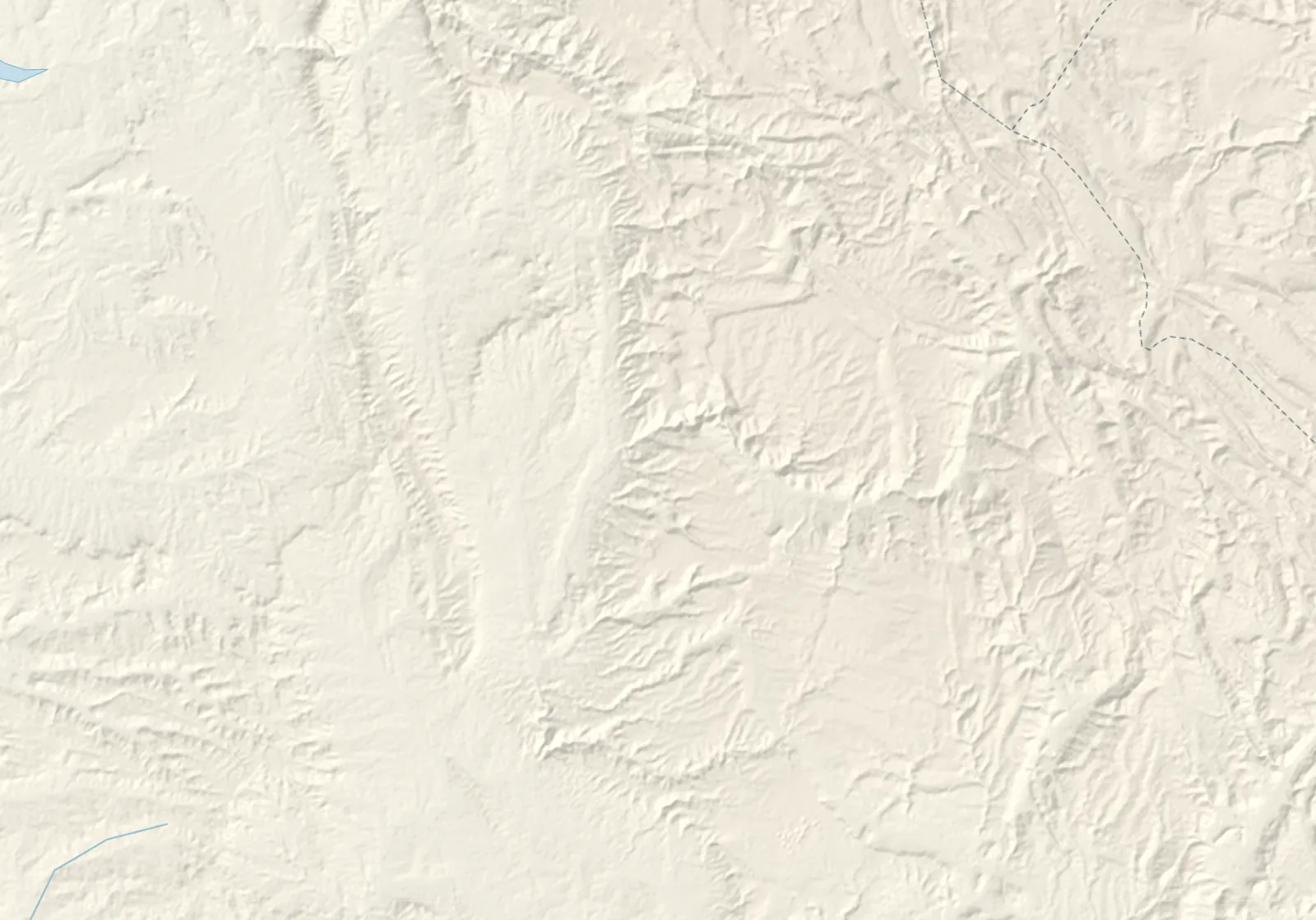 Serranía de CuencaJúcar gorgeCUENCAGUADALAJARATorcas de los Palancares1Cuenca2Ciudad Encantada3Ventano del Diablo4Uña5Tragacete6Source of the Cuervo River
- 1 Cuenca
- 2 Ciudad Encantada
- 3 Ventano del Diablo
- 4 Uña
- 5 Tragacete
- 6 Source of the Cuervo River
- Torcas de los Palancares
From Plaza de Castilla: 172 km · ≈ 2 h 5 min Back to Plaza de Castilla: 248 km · ≈ 3 h 25 min
© OpenStreetMap contributors (trazado: OSRM) · Natural Earth · relieve: AWS Terrain TilesDay by day
From Madrid to Cuenca, the city between gorges
Madrid (Plaza de Castilla)1Cuenca 172 km ≈ 2 h 5 min
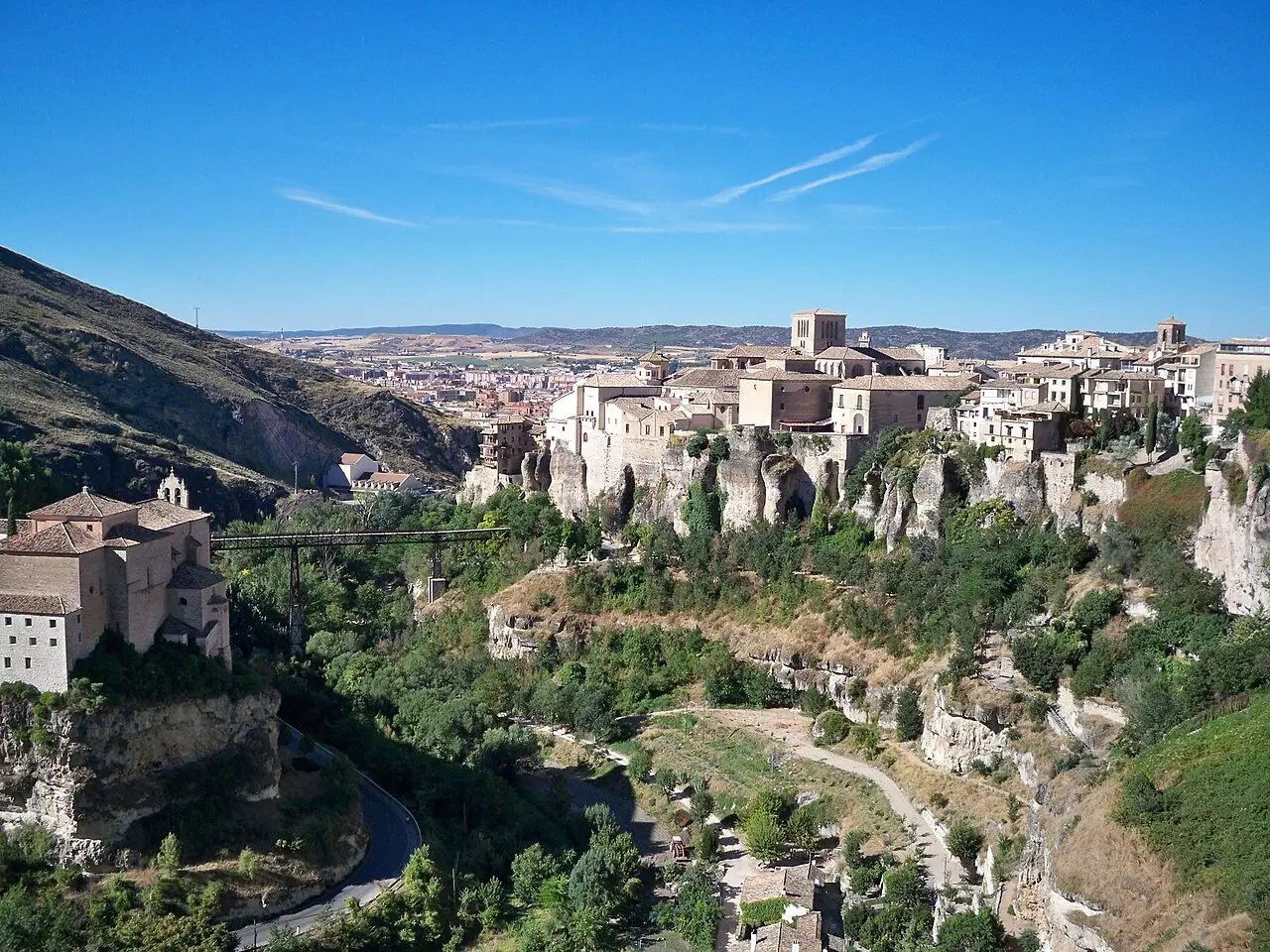
The Huécar gorge, below the old town.Photo: Siempremolinicos · CC BY-SA 3.0 You leave Plaza de Castilla and in just over two hours you're in Cuenca, almost all of it on the A-3 and A-40, with no tolls. You arrive with half the morning ahead of you or, if you leave after lunch, with the whole afternoon for the city.
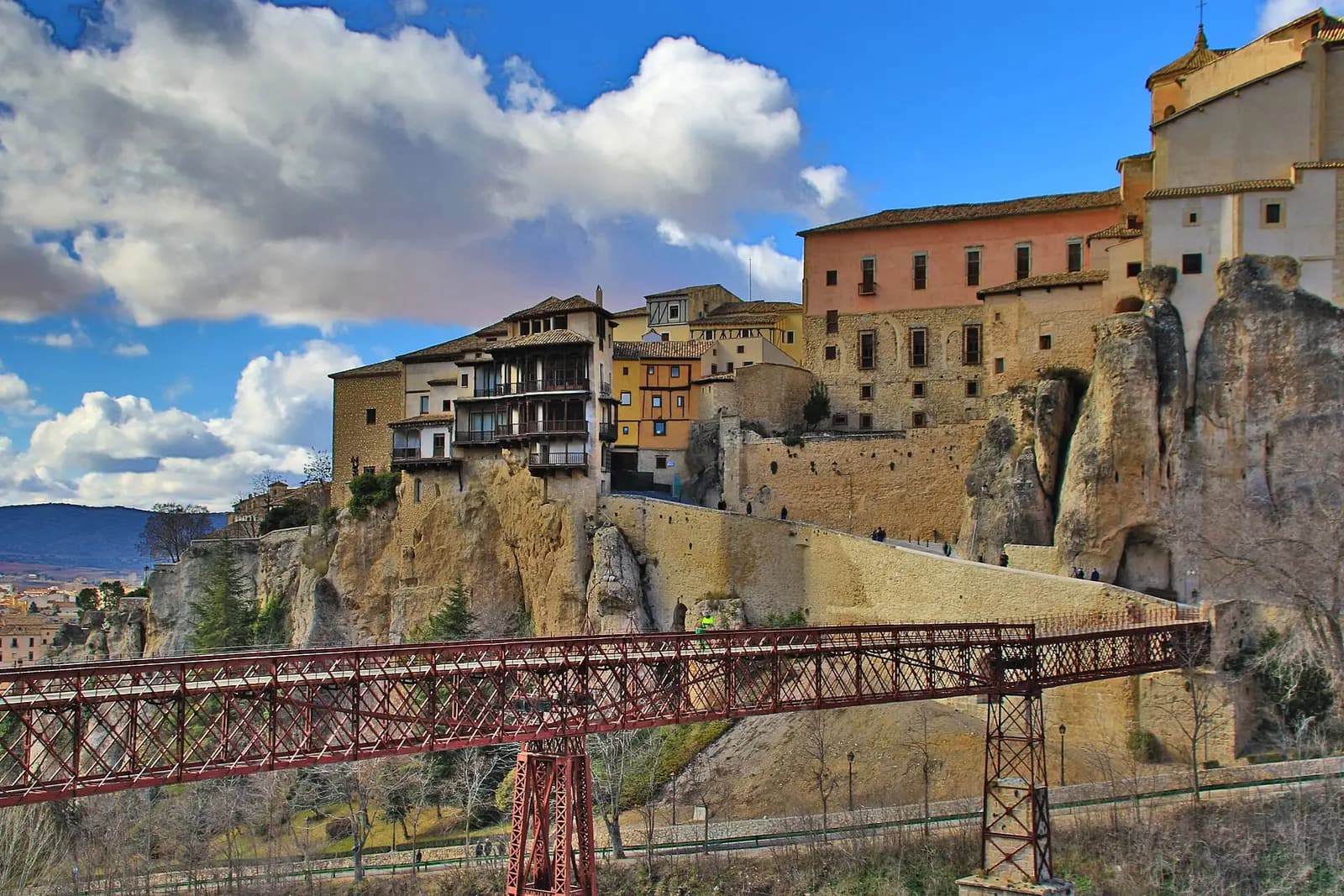
The old town is perched on a rocky hill between two gorges: the Júcar gorge to the north and the Huécar gorge to the south. The walled historic city, with its outlying quarters and the two gorges, has been a World Heritage Site since December 1996. Leaning out over the Huécar are the Casas Colgadas, the Hanging Houses, built since at least the 15th century straight onto the cliff edge. Two of them house the Museum of Spanish Abstract Art, opened in 1966. Opposite, the San Pablo bridge, made of iron and wood and dating from 1902, gives you the classic photo of the houses.
The cathedral was begun in the 12th century on the site of the old mosque and consecrated in 1208. Its current façade is neo-Gothic: the Giraldillo tower collapsed in 1902 and had to be rebuilt. Wander it with no plan. Cuenca is a city you walk slowly, and uphill.
What to see
- The Casas Colgadas above the Huécar gorge
- The San Pablo bridge and the view of the houses from it
- The cathedral and the Plaza Mayor
- The viewpoints over the Júcar gorge
Where to sleepAt the campsites and private areas around the city. As of 2025, Cuenca itself didn't have a public municipal motorhome area.
Heads upLeave the van down in the new part of town and walk up. The old town is narrow and isn't designed for a large vehicle.
Ciudad Encantada, Ventano del Diablo and Uña
1Cuenca4Uñavia Ciudad Encantada, Ventano del Diablo 49 km ≈ 1 h

The Mar de Piedra, at the Ciudad Encantada.Photo: Rafa Esteve · CC BY-SA 4.0 The big day, although at the wheel it's less than an hour. Head off early towards Valdecabras, because the Ciudad Encantada, the Enchanted City, is the busiest stop in the area and by mid-morning the car park fills up. It's Cretaceous limestone, around 90 million years old, from when all of this was seabed. Water dissolved the rock, the land rose and wind, ice and rain did the rest. The hardest blocks were left standing, in shapes that have names: the Tormo Alto at the entrance, the Mar de Piedra (Sea of Stone), the Tobogán (the Slide), the Barcos (the Boats). It has been a Natural Site of National Interest since 1929.
The trail is a 3 km loop and takes an hour and a half with photo stops. Adult entry is 7 €, under-7s go free and tickets are only sold at the ticket office: there's no online sale. Bring cash, because the site's own website warns that card payment isn't guaranteed due to poor signal.
From there you drop down to Villalba de la Sierra and stop at the Ventano del Diablo, the Devil's Window, a hollow, vaulted rock looking out over the Júcar cliffs, some two hundred metres above the river. Tradition says the devil held his witchcraft sessions here. You follow the Júcar upstream and finish in Uña, a village of 90 people beside its lake. The lake formed behind a natural dam on the Rincón stream and was raised with concrete: today it covers around 15 hectares and has been a Wildlife Refuge since 1988.
What to see
- The Ciudad Encantada: the Tormo Alto and the Mar de Piedra
- The Júcar cliffs from the Ventano del Diablo
- Uña lake and its lakeside walk
- Griffon vultures over the gorges, if you look up
Where to sleepAt campsites and designated areas in the villages of the Serranía. Wild camping is banned inside the Natural Park.
Heads upBring cash for the Ciudad Encantada and get there early. In summer there are already queues by mid-morning.
Tragacete and the source of the Río Cuervo
4Uña6Source of the Cuervo Rivervia Tragacete 44 km ≈ 55 min
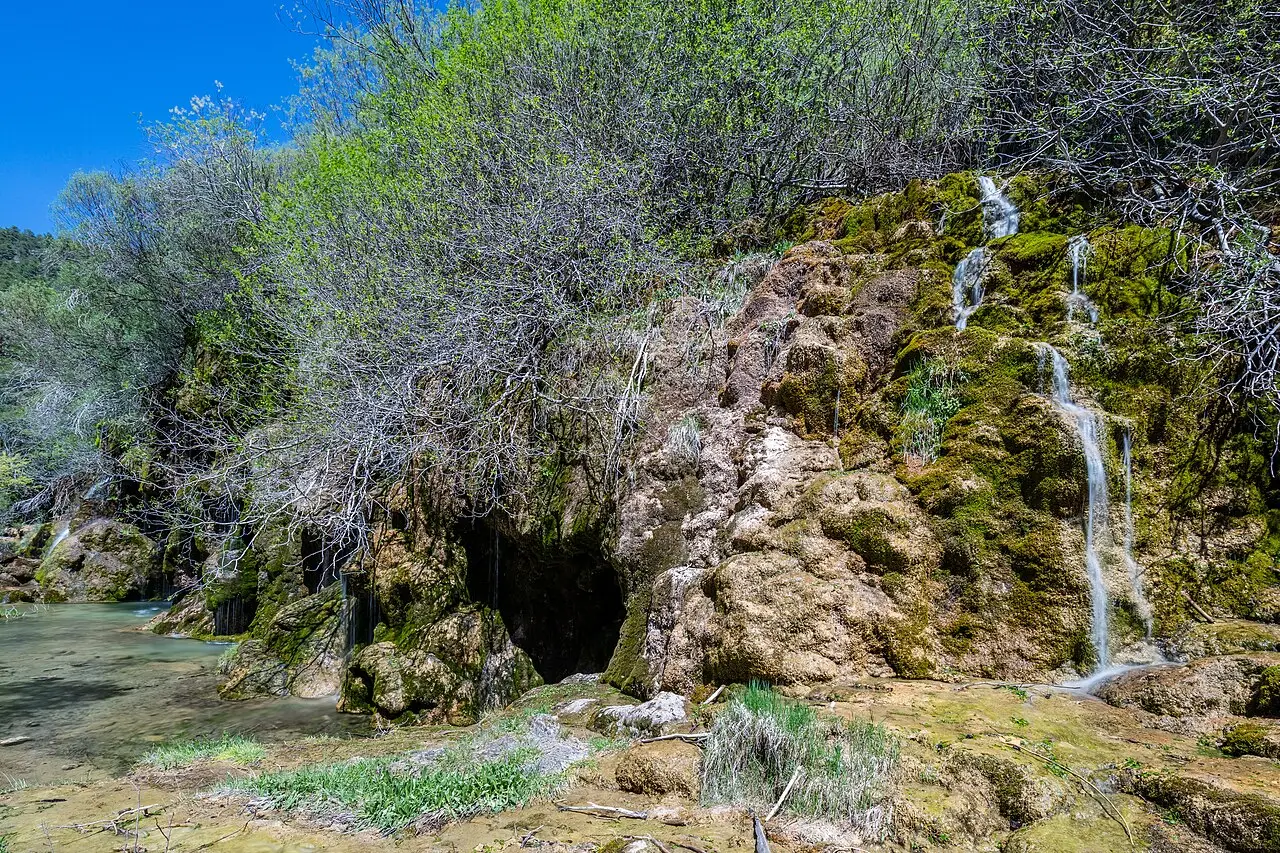
The falls at the source of the Río Cuervo.Photo: Diego Delso · CC BY-SA 4.0 The last day, and the greenest. From Uña you climb to Tragacete, now in the high Serranía, at almost 1,300 metres and with the Júcar running through it. It's a good place to stop, stretch your legs and stock up the larder before the finale.
The finale is the Nacimiento del Río Cuervo, the source of the Cuervo river, next to Vega del Codorno, at around 1,470 metres. The water springs from the ground and tumbles down moss-covered steps of tufa, in falls that freeze in winter. It has been a Natural Monument since 1999 and, although it's at the far end of the Serranía, it still belongs to the municipality of Cuenca. The Cuervo doesn't join the Júcar: it ends up in the Guadiela and, with it, in the Tagus basin.
The visit is a short loop of about two kilometres, easy, free and with no booking needed. The waterfall flows much harder in spring and after rain; in a dry midsummer it can shrink to a trickle. After lunch, back to Madrid: you come down again through the Júcar gorges and Cuenca, so the scenery stays with you all the way to the motorway.
What to see
- The tufa and moss falls at the source of the Cuervo
- The pine forest and meadows of the high Serranía
- The Júcar gorges again, on the way back
Where to sleepYou're heading home. If you stretch it to four days, sleep at the campsites around Tragacete.
Heads upThe Cuervo car park fills up early at weekends and on public holidays. Get there early and you will have it to yourself.
Back to Plaza de Castilla: Source of the Cuervo River → Plaza de Castilla · 248 km · ≈ 3 h 25 min · through the Júcar gorges and Cuenca
Before you set off
- Bring cash for the Ciudad Encantada ticket office: there's no online sale and cards don't always work because of the signal.
- Check the weather and the season: in spring the Cuervo waterfall is at its best.
- Find a campsite or area for each night before you set off. Wild camping is banned in the Natural Park; read up on where it is legal to sleep in a campervan.
- Download the GPX: in the high Serranía the signal comes and goes.
- Fill the tank in Cuenca. Up there the villages are small.
When to go
Spring and early autumn. May, June and September give you the Serranía at a good temperature for walking and with far fewer people than in August. In spring, on top of that, the Cuervo is in full flow and the waterfall is at its best. Early autumn brings the colours of the pine and oak woods.
August is the busiest month, and you notice it at the Ciudad Encantada ticket office and in the Cuervo car park. In our own bookings, more than half fall between June and August. If you can choose, pick another date.
It's an inland route, so you don't depend on beach weather. A grey day in the gorges has its charm, and rock in the mist is a sight of its own. In winter the Cuervo freezes and it's beautiful, but up there it gets properly cold and it can snow: give yourself some leeway.
Where to sleep and refuel
Much of the Serranía de Cuenca is a Natural Park, declared under Law 5/2007, covering more than 73,000 hectares across ten municipalities, including Cuenca, Villalba de la Sierra, Uña and Tragacete. Inside it, wild camping is banned: no getting out the table, chairs and awning by the lake, however tempting it is.
Sleeping inside the van without setting anything up is a different matter, and it depends on each municipality's bylaws and the signs at each spot. We cover the general rules in where it is legal to sleep in a campervan in Spain. To be on the safe side, use campsites and designated areas, which also have water and waste disposal.
An honest note: as of 2025, Cuenca itself didn't have a public municipal motorhome area, although the council had taken steps to revive the project (OCU). There are private options near the city and in the Serranía. Better to know that when you plan than on the night you arrive looking for a spot.
Refuel in Cuenca before heading up. The villages up there are small and it's not worth running the tank low.
What to eat along the way
Cuenca has mountain and game cooking. Morteruelo is the house dish: a game pâté, with partridge as the star. Zarajos are made from lamb, and ajoarriero with salt cod and garlic. For dessert, alajú, a sweet of Arab origin made with honey, almonds and breadcrumbs. Buy one for the van and have dinner looking out over the gorge.
If you have more days
This is our three-day version. With one more, you have plenty to choose from within the same Natural Park:
- Torcas de los Palancares: about 20 km from Cuenca, some thirty circular sinkholes in the pine forest, dolines that can be more than 90 metres deep.
- Callejones de Las Majadas: another rock landscape in the Natural Park, next to the village of Las Majadas, at 1,400 metres.
- Hoz de Beteta: in the north of the province, a canyon carved by the Guadiela with about six kilometres of walls over 80 metres high. A Natural Monument since 2004.
We set off from Madrid with the van checked over and spotless, and we'll answer your questions about the route on WhatsApp before you leave. For your first kilometres at the wheel, there are our tips for driving a campervan for the first time.
Related routes
- Teruel and Albarracín by campervan: 3 or 4 days from Madrid
- Sierra de Madrid and Gredos by campervan: a weekend
- 8 campervan routes from Madrid for 3, 5 and 7 days
Before you book
The Winkles are vans named after seas. For a couple on a short break, Adriático is the most nimble and the cheapest way to try this, from 70 € a day. If you're travelling as a group or a family, there are models with up to five seats: see them in the Winkles. Requirements, price and how booking works, in the guide to renting a campervan in Spain.
Ready for this route? Choose your dates and book →
Frequently asked questions
How long does it take to drive from Madrid to Cuenca in a campervan?
From Plaza de Castilla to Cuenca it's about 172 km on the A-3 and A-40, all motorway and toll-free. That's just over two hours of easy driving, so you arrive with the whole morning or afternoon ahead of you to start the route. It's one of the closest breaks to Madrid with proper mountains.
How much does it cost to visit the Ciudad Encantada?
General adult entry to the Ciudad Encantada is 7 €, and under-7s go free. Tickets are only sold at the ticket office, with no online sale or advance booking, and it opens every day. Bring cash: card payment isn't guaranteed because of the signal. It's on the Valdecabras road, in the southern part of the Serranía.
Can you sleep in a campervan in the Serranía de Cuenca?
To sleep in the van you need to use campsites and designated areas: wild camping is banned inside the Serranía de Cuenca Natural Park, so you can't set up camp wherever you like. Always follow each municipality's signs. As of 2025, Cuenca itself still doesn't have a public municipal motorhome area.
How many days do I need to see Cuenca and the Serranía by campervan?
Three days lets you see the essentials without stress: the city of Cuenca and its gorges, the Ciudad Encantada, the Ventano del Diablo, Uña lake and the source of the Río Cuervo. With four, add the Torcas de los Palancares or the Hoz de Beteta. If you only have a normal weekend, focus on Cuenca itself and the Ciudad Encantada, which are a stone's throw apart.
When is the best time for this route?
Spring and early autumn are best: the Río Cuervo is in full flow, it's a good temperature for walking and there are shorter queues at the Ciudad Encantada ticket office. August is the busiest month and the hottest on the plateau, so if you can choose, May, June or September give you a quieter Serranía.
Do I need experience to drive this route in a campervan?
No. Almost the whole way from Madrid is motorway, and the Serranía roads are mountain roads but quiet and well surfaced, with no tricky passes. It's a short route close to home, one of the best for a first trip: you get the feel of the van without taking on a long journey on day one.