
Monfragüe, Trujillo and Cáceres: by campervan from Madrid
Three hours from Madrid there's a national park full of vultures, two cities of stone and hardly anyone about. Four days by campervan through Monfragüe, Trujillo and Cáceres: what to see, when to go and where to sleep without getting fined.
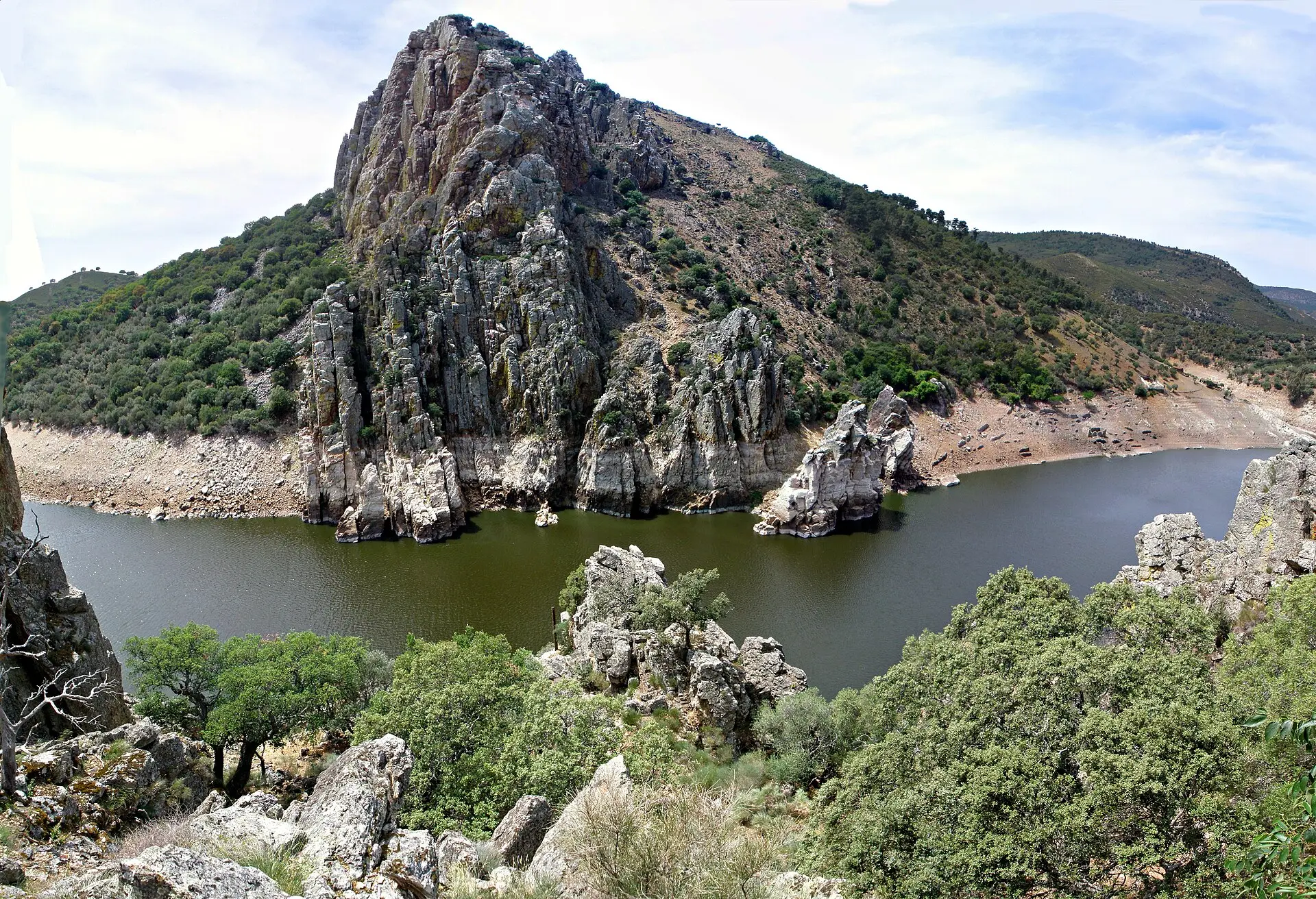
Three hours from Madrid there's a place where the vultures pass at head height, two cities that are almost a stage set in stone and, nearly always, the road to yourself. Extremadura is one of the destinations that pays off most by campervan and one of the last people think of when planning a break. You travel calmly, you eat superbly, and what really counts, the mountain of light, the nests on the cliffs, the empty squares at dusk, nobody charges for.
The route is a clean line heading west: you come in through Plasencia, drop into Monfragüe National Park to watch big birds, and finish in Trujillo and Cáceres, two historic old towns a step apart. Four days, short stages once you're there and almost everything free except what you order. Below you have the map with the real route, the kilometres for each day and what you'll see between one stop and the next.
- Days
- 4Cáceres · Monfragüe · Extremadura
- Route in the area
- 145 km+ 575 km there and back from Plaza de Castilla
- Behind the wheel
- ≈ 2 h 25 minapprox., without stops
- Best time
- March to May and OctoberSpring and autumn, for the heat and the birds
Roads: Motorway to Plasencia and the A-5. Inside, comfortable, well-surfaced roads; the EX-208 crosses Monfragüe without tough bends.
Best Winkle: Índico · with a heater, it's great for the cool spring and autumn nights
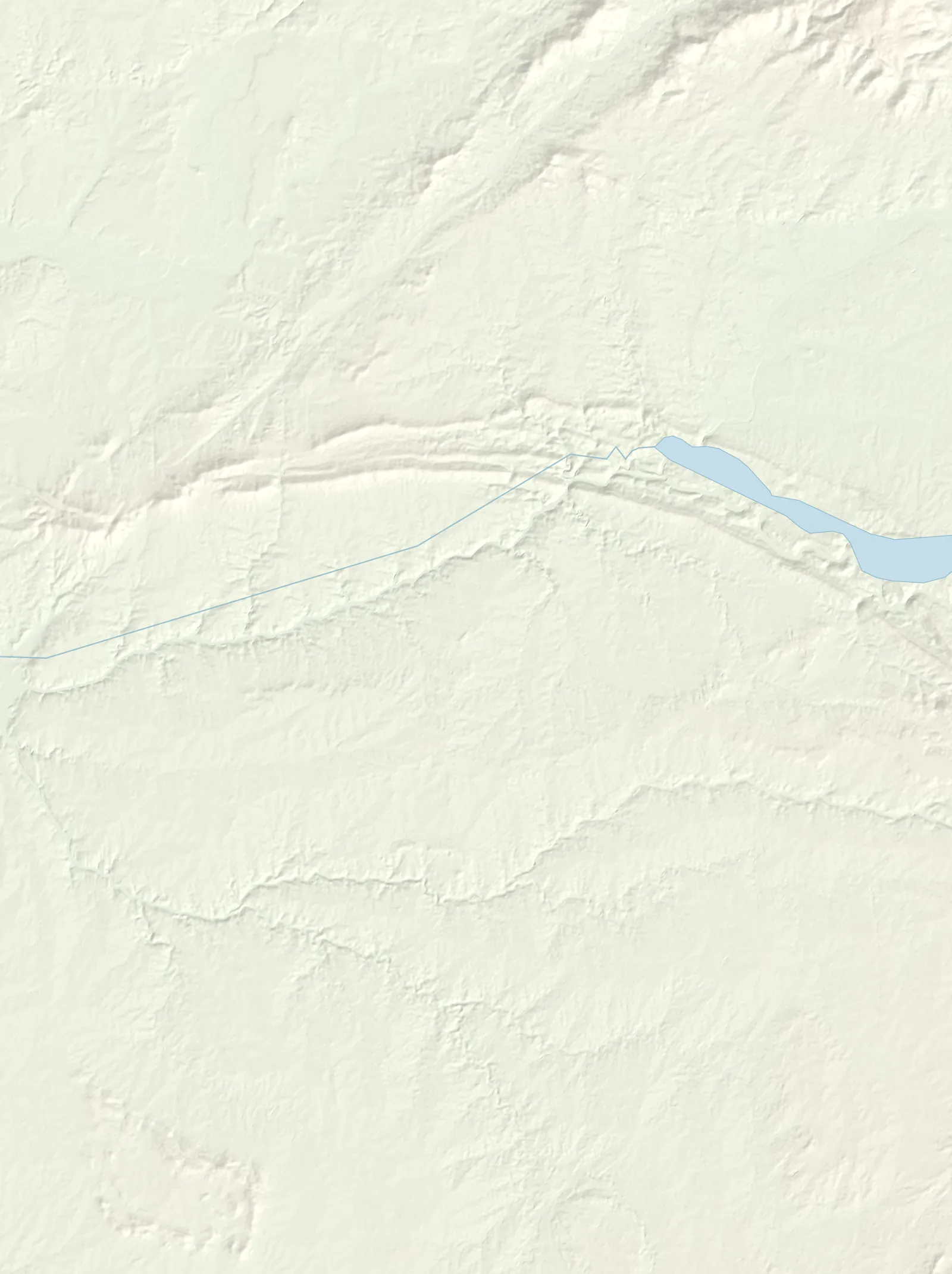 EXTREMADURAMONFRAGÜEJERTE VALLEYMonfragüe Castle1Plasencia2Monfragüe (Villarreal de San Carlos)3Trujillo4Cáceres
- 1 Plasencia
- 2 Monfragüe (Villarreal de San Carlos)
- 3 Trujillo
- 4 Cáceres
- Monfragüe Castle
From Plaza de Castilla: 263 km · ≈ 3 h 5 min Back to Plaza de Castilla: 312 km · ≈ 3 h 30 min
© OpenStreetMap contributors (trazado: OSRM) · Natural Earth · relieve: AWS Terrain TilesDay by day
From Madrid to Plasencia, the northern gateway
Madrid (Plaza de Castilla)1Plasencia 263 km ≈ 3 h 5 min
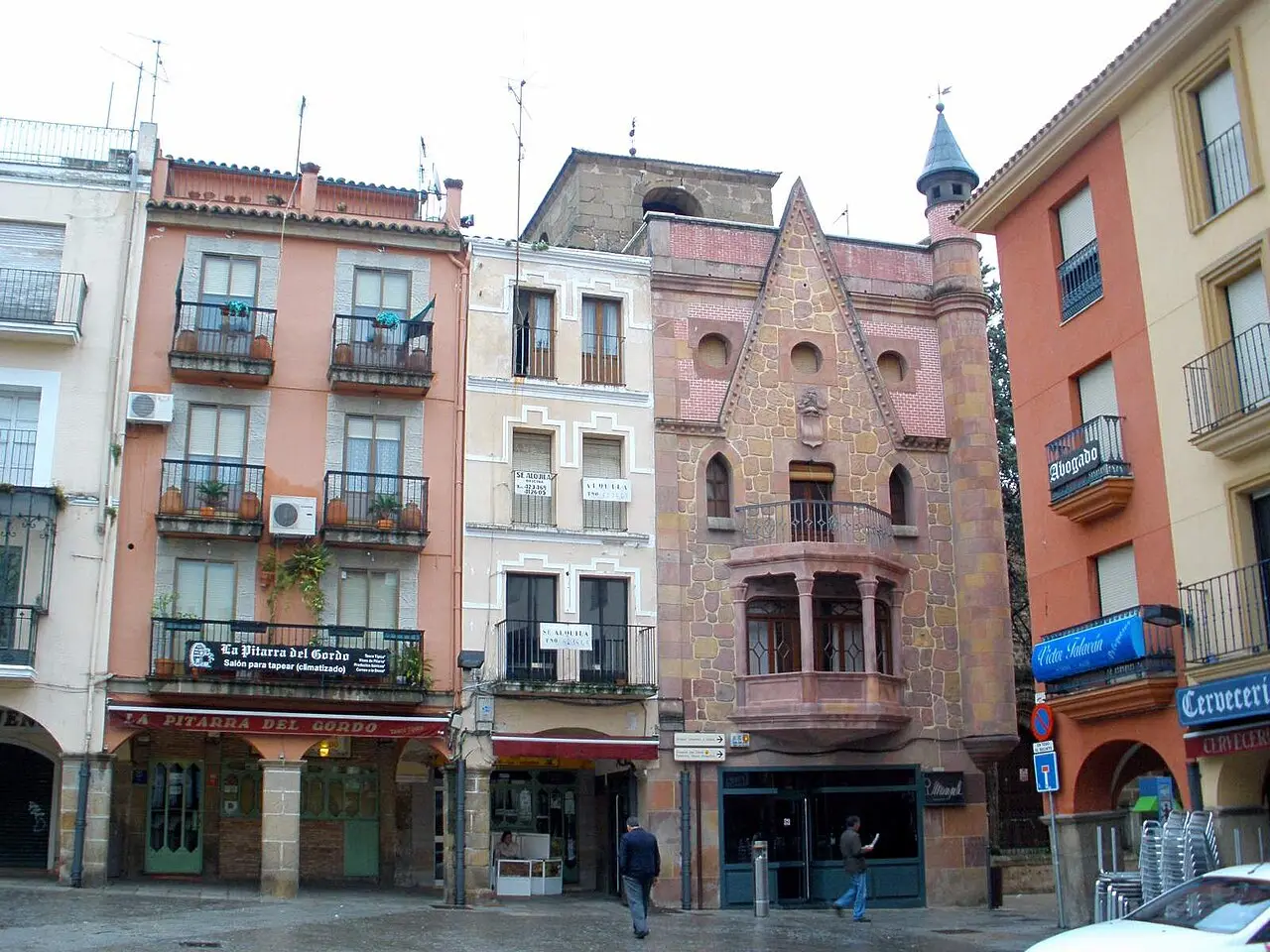
The Plaza Mayor of Plasencia, the heart of the city.Photo: Zarateman · CC0 You set off from Plaza de Castilla and head west, almost all on the motorway and toll-free, to Plasencia. It's the natural gateway to northern Extremadura, perched above the River Jerte, and a good place to sleep the first night and get the feel of the van without rushing.
Plasencia was founded by King Alfonso VIII of Castile in 1186, in the thick of the Reconquista, out of pure strategy: it sat within reach of the borders with León and with the Muslims. Even its name comes from the king, from the motto he gave it on its coat of arms, "Ut placeat Deo et hominibus", to please God and men (so says Wikipedia). Wander the Plaza Mayor, where there's been a market every Tuesday for centuries, and the two cathedrals stuck together, the old and the new, left half-joined.
Don't rush. Plasencia is best taken slowly, with a beer on a terrace in the square and the van parked down below, in the new part. Tomorrow is the big one.
What to see
- The Plaza Mayor and its Tuesday market
- The two cathedrals, old and new
- The walls and the walk above the Jerte
Where to sleepIn the campsites and private areas around Plasencia. Leave the van in the lower town and walk up to the old quarter.
Heads upIf you leave Madrid after lunch, you'll arrive in the dark: better to set off early and keep the afternoon for the city.
Monfragüe: the day of the vultures
1Plasencia2Monfragüe (Villarreal de San Carlos) 32 km ≈ 35 min
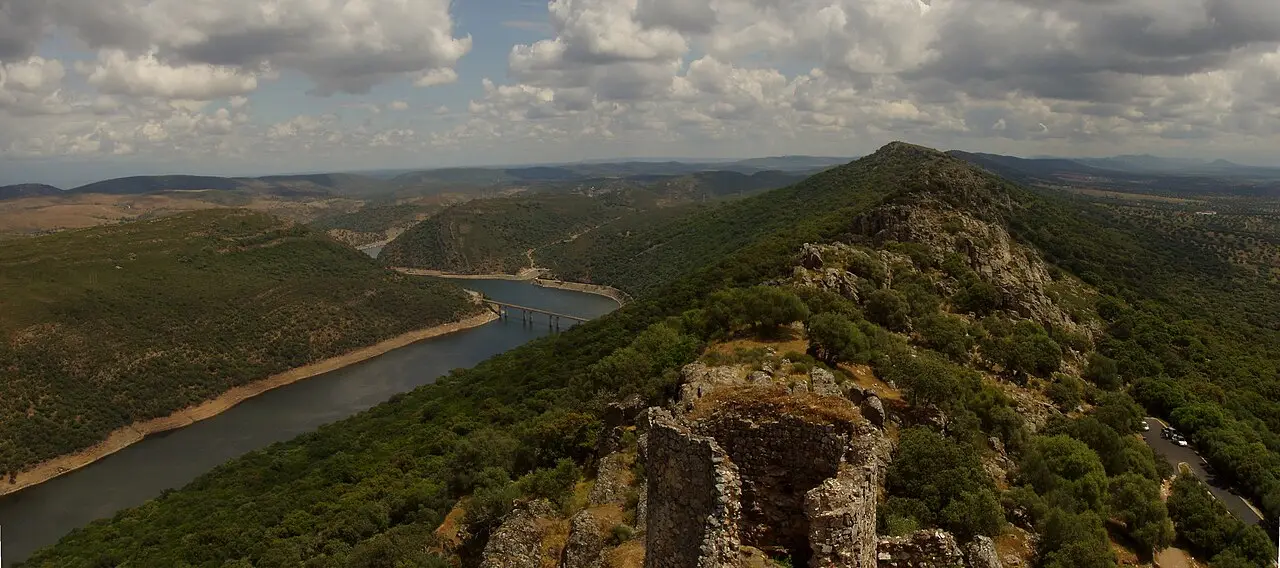
Monfragüe from the castle, with the Tajo carving its way through.Photo: Malopez 21 · CC BY-SA 4.0 The big day, though there's little driving. From Plasencia you drop into Monfragüe National Park on the EX-208, which crosses it end to end. It's been a national park since 2007, after being a nature park from 1979 and a UNESCO biosphere reserve from 2003, and what makes it unique is two rivers, the Tajo and the Tiétar, and the rock faces where the birds nest (MITECO).
The hub of it all is Villarreal de San Carlos, a tiny village in the middle of the park with the information point and the start of the trails. From there you have to go to the Salto del Gitano, a huge wall of rock over the Tajo where one of the largest colonies of black vulture around breeds, and alongside it griffon vultures, Egyptian vultures, black storks and, with luck and binoculars, the Spanish imperial eagle. You see them from the viewpoint, with the naked eye, passing at your own height. It's more impressive than it sounds.
If your legs are up to it, climb to Monfragüe Castle, a Moorish fortress up top with the whole park at its feet. It's a short but steep climb, and the view of the two valleys from the top is the photo you take home.
What to see
- The Salto del Gitano and its vultures from the viewpoint
- Monfragüe Castle and the view of the two valleys
- The Tajo and Tiétar rivers from the viewpoints
- Birds up close: bring binoculars
Where to sleepIn the campsites and areas of Malpartida de Plasencia or Torrejón el Rubio, at the gates of the park. There's no camping inside the national park.
Heads upGet up early for the birds: there's more activity and fewer cars at the viewpoints first thing. And bring water, it gets hot in summer.
Trujillo, the square of the conquistadors
2Monfragüe (Villarreal de San Carlos)3Trujillo 67 km ≈ 1 h 10 min
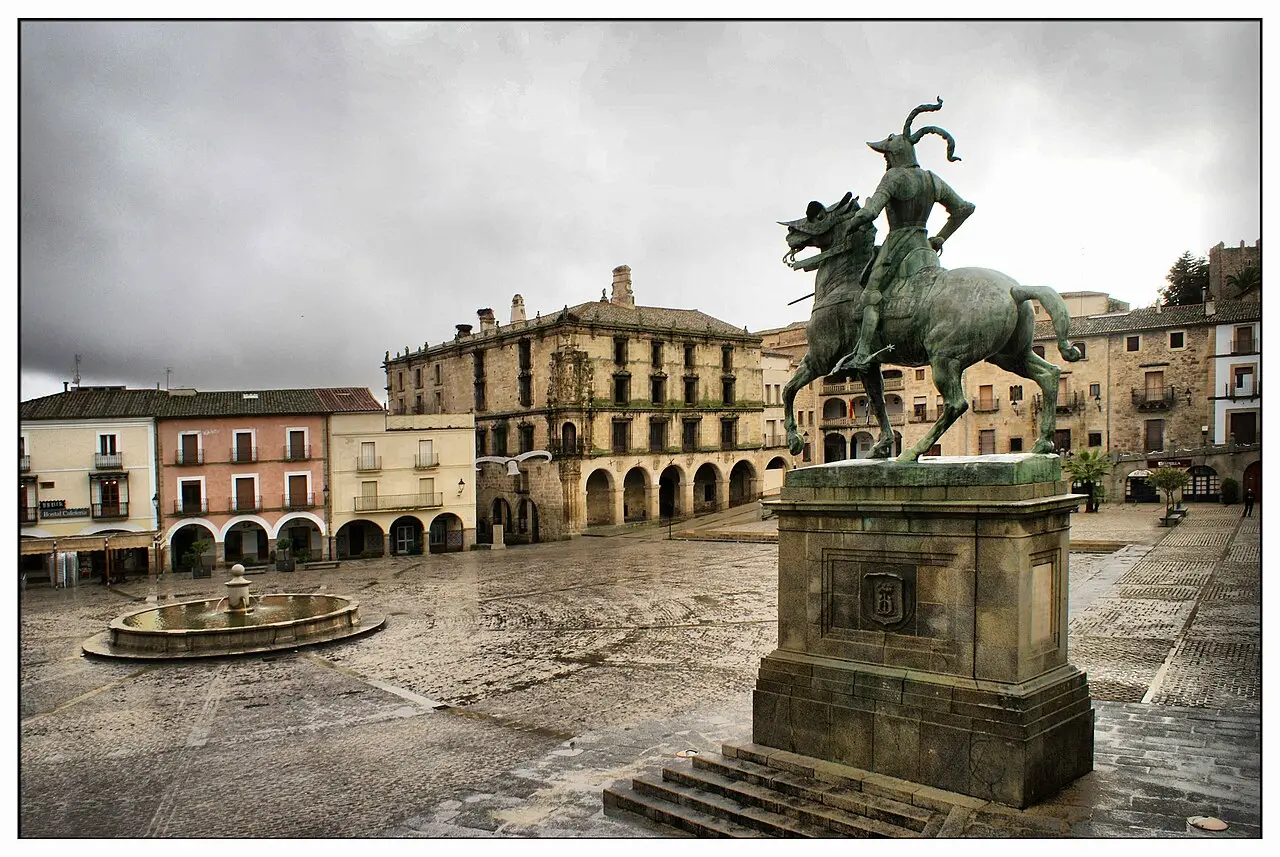
The Plaza Mayor of Trujillo, with Pizarro on horseback.Photo: Rafa G. Recuero · CC BY-SA 3.0 es From Monfragüe you drop south, to Trujillo. The picture is its Plaza Mayor, on a slope, presided over by the equestrian statue of Francisco Pizarro, who was born here before going off to conquer Peru (as Wikipedia records). Several of the men who crossed the Atlantic came from Trujillo, and the money that came back built the palaces around the square.
Climb up to the castle, Moorish in origin, from where you can see the dehesa stretch as far as the eye reaches. Then come down through the alleys of the upper town, which have barely changed, and take the place in slowly. It's small and you can do it in an afternoon, which is exactly what the route wants.
Trujillo has something you don't expect, too: in spring, the towers and rooftops fill with storks. Look up and count them.
What to see
- The Plaza Mayor and the equestrian statue of Pizarro
- The Moorish castle and the view over the dehesa
- The palaces and alleys of the upper town
- The storks on the towers, in spring
Where to sleepIn the areas and campsites around Trujillo. As with the whole trip, the van down below and the old town on foot.
Heads upThe streets of the upper town are narrow and steep: don't take the van up there. Park in the lower part and walk up.
Cáceres, the old town that looks like a film set
3Trujillo4Cáceres 46 km ≈ 40 min
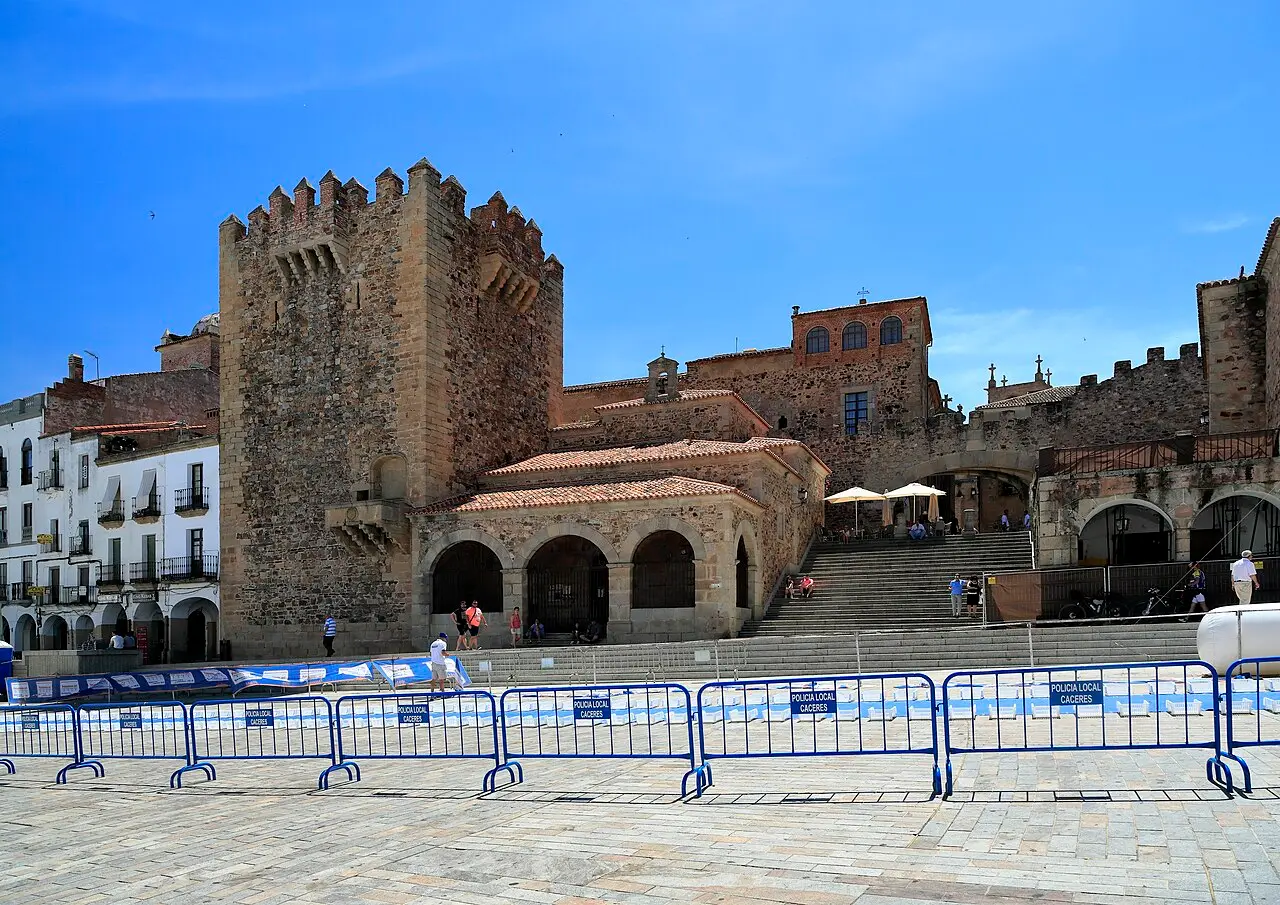
The Plaza Mayor of Cáceres, with the Torre de Bujaco.Photo: Falk2 · CC BY-SA 4.0 Last day and the most monumental. From Trujillo you drop to Cáceres on the motorway. Its old quarter, the Ciudad Vieja, has been a UNESCO World Heritage Site since 1986 (UNESCO): a maze of palaces, towers and walls so well preserved that now and then the film crews take it over to shoot series. You come in through the Plaza Mayor, with the Torre de Bujaco and the Arco de la Estrella, and from there up it's all golden stone.
Lose yourself with no plan around the Plaza de San Jorge, the Plaza de Santa María with its co-cathedral, and the old Jewish quarter. Go up to a viewpoint or a tower at dusk, when the stone turns honey-coloured and the crowds leave. It's probably the best possible finish to the route.
After lunch, back to Madrid: you've got the A-5 almost all the way home. Or, if you stretch it a day, you stay another night and give Cáceres the whole morning, which it deserves.
What to see
- The Plaza Mayor, the Torre de Bujaco and the Arco de la Estrella
- The Plaza de San Jorge and the Plaza de Santa María
- The co-cathedral and the Jewish quarter
- The Ciudad Vieja at dusk, when it empties
Where to sleepYou head home. If you stretch to five days, sleep in the areas and campsites around Cáceres and give it the next morning.
Heads upLeave the van outside the walls: you can't drive into the Ciudad Vieja, and besides, it's better on foot.
Back to Plaza de Castilla: Cáceres → Plaza de Castilla · 312 km · ≈ 3 h 30 min · on the A-5, or stretching one more night in Cáceres
Before you set off
- Choose spring or autumn. In Monfragüe the birds are more active, and in Trujillo and Cáceres the heat of the meseta eases off.
- Bring binoculars. In Monfragüe they're the difference between seeing a dot far off and watching a vulture pass at your height.
- Find a campsite or area for each night before you leave. Inside the national park camping is banned; check where it's legal to sleep in a van.
- Download the map offline: inside Monfragüe the signal comes and goes.
- Fill up in Plasencia or Trujillo. The villages inside the park are very small and you don't want to run the tank low.
When to go
Spring and autumn, by a mile. From March to May and in October you get Monfragüe at its best, the birds active, the nests occupied, and the cities walkable without the heat the Extremadura meseta hands out without mercy in July and August, when topping 35 degrees is normal. In spring, on top of that, the storks take over the towers of Trujillo and Cáceres, and that costs no entry fee.
Here's a note from us, in case it helps you pick dates. Most of our trips bunch up in July and August, which is when everyone's on holiday; spring and early autumn run much quieter. For this route in particular, that works in your favour twice over: you get better weather and it's easier to find the van you want. If you can choose, don't go in the middle of August.
Winter has its charm, Monfragüe still has its birds and the old towns are all but empty, but the days are short and it gets properly cold at night. If you go then, take a van with a heater and leave yourself a margin of daylight.
Where to sleep and refuel
The golden rule of the trip is set by Monfragüe National Park: no camping inside. It's been a national park since 2007 (MITECO), with its own rules, and wild camping is banned. No setting out a table and chairs at a viewpoint, however much the sunset over the Tajo tempts you.
Sleeping inside the van, without putting anything out, is another matter, and it depends on each town's bylaws and the signs at each spot. The general picture is in where it's legal to sleep in a van in Spain. To play it safe, use campsites and set-up areas: Plasencia, Malpartida de Plasencia and Torrejón el Rubio at the gates of Monfragüe, and the Trujillo and Cáceres area for the last nights. They've got water and waste disposal too, which helps.
Fill up in Plasencia when you arrive and top up again in Trujillo. The villages inside the park are tiny and you don't want to run the tank low hunting for a petrol station that might not be there.
What to eat along the way
Extremadura has some of the most serious food in Spain and hardly anyone says so. The acorn-fed Iberian ham from the dehesa is king, but don't stop there. Try the Torta del Casar, a sheep's cheese so creamy you eat it with a spoon; Extremaduran migas; lamb and caldereta stew; and, in Monfragüe, game dishes. For pudding, técula mécula or some perrunillas. Buy from a village grocer, have dinner in the van with the Trujillo square in front of you, and you'll thank me.
If you have more days
This is our four-day version, which is about how long the typical trip with us tends to run. With one or two more, you've plenty to do without going far:
- Mérida: under an hour from Cáceres, the finest Roman complex in Spain, theatre, amphitheatre and aqueduct, also a World Heritage Site.
- The Jerte Valley and La Vera: north of Plasencia, water gorges, cherry trees and mountain villages; in spring, the whole valley in blossom.
- Guadalupe: to the east, with its Royal Monastery, another World Heritage Site, along lovely dehesa roads.
We set off from Plaza de Castilla with the van gone over and spotless, and we sort out your route questions on WhatsApp before you leave. If it's your first time at the wheel of a campervan, have a look at the tips for driving a campervan for the first time; and if you're still weighing up dates, here are the best times to hire a campervan.
Related routes
- Sierra de Madrid and Gredos by campervan: a weekend getaway
- Teruel and Albarracín by campervan: 3 or 4 days from Madrid
- 8 campervan routes from Madrid for 3, 5 and 7 days
Before you book
The Winkles are campervans with sea names, four of them, each with its own character. For this spring or autumn route, Índico is good company: it carries a heater for the cool Monfragüe nights and plenty of room, from €90 a day. If there are two of you and you want the nimblest, cheapest option, Adriático starts at €70. The price you see in the booking engine is the price you pay, with insurance and 24/7 assistance across Europe included; see them all at the Winkles. And if it's your first time, how the booking works and the requirements are in the guide to hiring a campervan in Spain.
Fancy Extremadura? Pick your dates and book →
Frequently asked questions
How long does it take from Madrid to Extremadura by campervan?
From Plaza de Castilla to Plasencia it's about 260 km, almost all on the motorway and toll-free, around three hours of easy driving. To Cáceres it's about 310 km, roughly three and a half hours. It's one of the closest breaks to Madrid with a national park and World Heritage cities, and you arrive with the afternoon ahead of you if you set off in the morning.
How many days do I need to see Monfragüe, Trujillo and Cáceres?
Four days lets you see the essentials without rushing: Plasencia, a full day in Monfragüe National Park, Trujillo and Cáceres. At a push you can do it in three, and with five you've got spare time to stay another night in Cáceres or drop down to Mérida. The stages once you're there are short, under an hour, so most of your time is for wandering, not driving.
When is the best time for this Extremadura route?
Spring and autumn, no question. In Monfragüe the birds are more active and the storks fill the towers of Trujillo; on top of that, Cáceres and Trujillo are a pleasure to walk without the heat of the meseta, which in high summer comfortably tops 35 degrees. March, April, May and October are the most comfortable months for this Extremadura route.
Can you sleep with the campervan in Monfragüe National Park?
To sleep in the van you have to use campsites and set-up areas in the surrounding villages, like Malpartida de Plasencia or Torrejón el Rubio: wild camping is banned inside Monfragüe National Park, so you can't spend the night wherever you fancy. Always respect the signs and each town's bylaws.
Do I need experience to drive this route in a campervan?
No. Almost the whole trip from Madrid is motorway, and once in Extremadura the roads are comfortable and well-surfaced, including the EX-208 that crosses Monfragüe, with no tricky sections. It's a route of short stages close to home, one of the best for first-timers: you get the feel of the van without taking on a long haul the first day.
What can you see in Monfragüe National Park?
Monfragüe is above all a bird sanctuary: from the Salto del Gitano viewpoint you see black and griffon vultures, Egyptian vultures, black storks and, with luck, the Spanish imperial eagle, often right at eye level. It's also worth climbing Monfragüe Castle for the view over the Tajo and Tiétar rivers. Bring binoculars and get up early.