
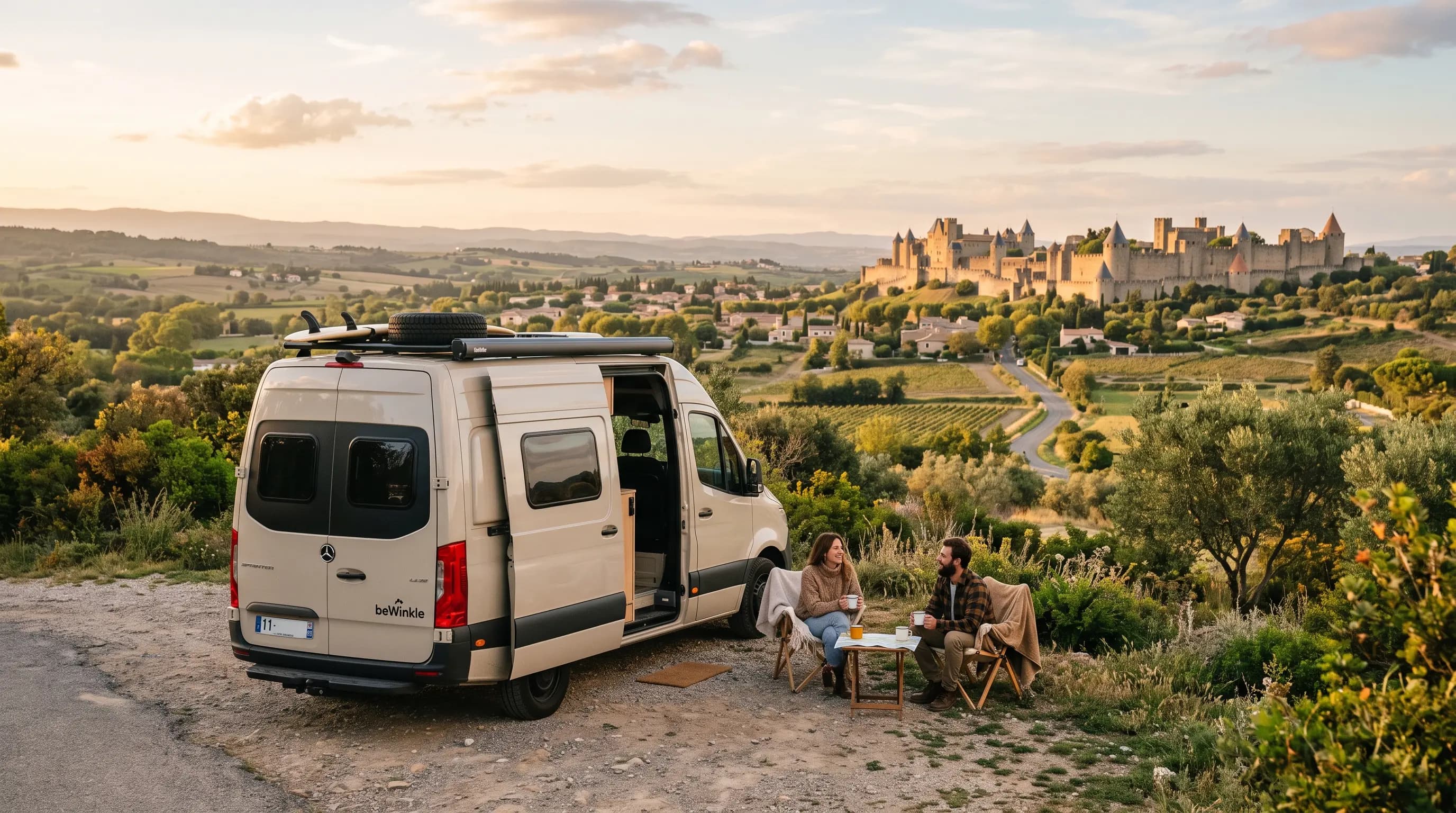
South of France by campervan from Madrid: a 7-day route through Occitania, Toulouse and Carcassonne
Explore the south of France by campervan from Madrid: a 7-day route through the Pyrenees, Toulouse, Carcassonne and the coast, with tolls, Crit'Air and overnight stops.
A week is enough to cover the south of France by campervan from Madrid, provided you stick to a single travel arc. This route connects the French Basque Country, the Pyrenees, Toulouse, Carcassonne and the Occitania coast before heading back through Catalonia and Zaragoza. It comes to roughly 1,900–2,100 kilometres — an intense route, but manageable if you respect the two long connecting days.
The itinerary combines fast roads with short stages and avoids the mistake of squeezing Provence, the Côte d'Azur or Bordeaux into the same week. It also covers what you need to check before crossing the border: rental authorisation, insurance, Crit'Air, low-emission zones (ZFE), tolls and legal places to spend the night.
Route summary: Madrid → Bayonne → Saint-Jean-Pied-de-Port and Pau → Toulouse → Carcassonne → Narbonne and Collioure → Zaragoza → Madrid.
South of France campervan route: quick reference
| Duration | 7 days |
| Departure and return | Madrid |
| Estimated distance | 1,900–2,100 km depending on service areas, detours and access |
| Driving time | Approximately 24–28 hours |
| Countries | Spain and France |
| Road type | Motorways and dual carriageways, national roads and local routes |
| Difficulty | Medium-high, due to distance, tolls, cities and mountain sections |
| Recommended season | May, June, September and early October |
| Recommended campervan | Índico for 2–4 travellers; Báltico for up to 5 and greater range |
Distances are approximate. Before booking, map out the stages with the service areas where you'll spend the night, and check current roadworks, weather, restrictions and tolls.
Seven-day itinerary through Occitania
| Day | Stage | Approximate kilometres | Driving time |
|---|---|---|---|
| 1 | Madrid–Bayonne | 500–530 km | 5 h 30–6 h 30 |
| 2 | Bayonne–Saint-Jean-Pied-de-Port–Pau | 150–190 km | 3–4 h |
| 3 | Pau–Toulouse | 195–230 km | 2 h 30–3 h 30 |
| 4 | Toulouse–Carcassonne | 95–120 km | 1 h 15–2 h |
| 5 | Carcassonne–Narbonne–Collioure | 160–200 km | 2 h 30–3 h 30 |
| 6 | Collioure–Zaragoza | 430–480 km | 5–6 h |
| 7 | Zaragoza–Madrid | 315–330 km | 3 h 15–4 h |
The route keeps Toulouse and Carcassonne as its central stops and uses Bayonne, Pau and Collioure to build a circular journey. If you'd rather cover fewer kilometres, drop Collioure and head back from Carcassonne through the Pyrenees.
Day 1: Madrid to Bayonne
Set off early from Madrid and head towards Burgos, Vitoria-Gasteiz and the Irún border crossing. The stage runs to around 500 kilometres and is the first real test of your travel pace. Take a break at least every two hours and swap drivers whenever both of you are authorised to drive.
Bayonne works well as a gateway city, since it lets you start the following morning without doubling back. Look for an authorised campsite or service area outside the centre and use public transport or a bike to explore the town.
Don't try to fit Biarritz, Saint-Jean-de-Luz and Bayonne into the same afternoon straight after picking up the campervan. If you set off late, focus on arriving, settling in and reviewing the next day's route.
Day 2: French Basque Country, Saint-Jean-Pied-de-Port and Pau
From Bayonne, head inland through the French Basque Country. Saint-Jean-Pied-de-Port makes for a manageable stop to walk around its historic centre and get a sense of the area's ties to the Camino de Santiago.
Continue towards Pau without forcing mountain passes. Your sat nav might suggest shorter local roads, but with a campervan it's better to stick to signposted, paved roads with room to pass.
In Pau, leave the vehicle outside the central streets and spend the afternoon along the Boulevard des Pyrénées and the old town. On a clear day, the views towards the mountain range give you a taste of the scenery ahead, without needing to add a full alpine stage.
Day 3: Pau to Toulouse
The Pau–Toulouse leg can be done via motorway to save time, or via alternative roads to cut down on tolls. The first option leaves more hours for Toulouse; the second adds villages and driving time.
Before entering the metropolitan area, check the ZFE and the Crit'Air classification for the campervan. Don't drive through the centre out of habit. Choose an authorised campsite, service area or car park connected to public transport and explore the city without moving the Winkle.
With an afternoon and a night, prioritise Place du Capitole, the banks of the Garonne and a stroll through the historic centre. The Cité de l'Espace needs more time and should replace, not sit alongside, the rest of the city programme.
Day 4: Toulouse and the medieval city of Carcassonne
Enjoy a relaxed morning in Toulouse, then drive on to Carcassonne. It's under 100 kilometres by the direct route, so this day makes up for the longer stages.
The Cité de Carcassonne is explored on foot. Park in a space suited to the campervan's dimensions and don't try to get close to the historic gates through narrow streets. In peak season, arrive with plenty of time and book accommodation or a service area in advance.
Spend the afternoon at the walls and the medieval city. For an indoor visit with opening times, check the monument's official information before you arrive.
Day 5: Narbonne, the Occitania coast and Collioure
Leave Carcassonne for Narbonne. Decide whether you want an urban stop or a coastal day: trying to see the town centre, several beaches and Collioure all in one day can turn the stage into a constant hunt for parking.
From Narbonne, head towards the Mediterranean and on to Collioure. Coastal roads and car parks come under heavy pressure in summer. Avoid taking the campervan into the historic centre and use peripheral areas or shuttle services where available.
The point of the day isn't to cover the whole coastline, but to swap the Atlantic and Pyrenean scenery for one last Mediterranean afternoon. Check for fire and wind restrictions before heading into any natural areas.
Day 6: Collioure to Zaragoza
The route heads back into Spain through Catalonia and continues to Zaragoza. It's a stage of over 400 kilometres, with possible tolls, city traffic and crosswinds in the Ebro valley.
Set off early and avoid planning long visits. If you want to stop, choose a point that doesn't require a detour. On arrival in Zaragoza, use an authorised car park or service area and get the campervan ready for drop-off the following day.
If the pick-up and drop-off times make this stage too tight, shorten day five and spend the night south of Perpignan, or already in Spain. Don't turn the return leg into a race against the clock.
Day 7: Zaragoza to Madrid
The final stage runs to around 320 kilometres. Allow extra time for traffic, refuelling, cleaning and checking over the vehicle. Let the contractual drop-off time guide your departure.
Check the fuel level, pack away the equipment and keep hold of your toll receipts. If you used electronic toll lanes or number-plate-linked systems, confirm how any charges will be settled afterwards.
Documents and insurance for driving to France with a rental campervan
beWinkle authorises travel within the European Union with no border surcharge, under its published terms. Even so, let them know your itinerary and confirm that the documentation you're given covers all the territories and drivers involved.
Bring:
- valid ID or passport for each traveller;
- a valid driving licence for each driver;
- rental agreement;
- vehicle documentation;
- proof or certificate of insurance;
- authorisation to take the campervan out of Spain;
- international assistance phone number;
- European accident statement form;
- digital copies accessible offline.
beWinkle requires a valid category B driving licence held for at least two years, and a minimum age of 25. All drivers must be listed on the contract.
The rental includes fully comprehensive insurance with a €600 excess per claim and 24/7 assistance across Europe. The extended cover published for eligible bookings brings the excess down to €200. Always read the policy and its exclusions.
Check the full guide to travelling abroad with a rental campervan before you set off.
Crit'Air and ZFE: check before entering Toulouse
Crit'Air is the French sticker that classifies vehicles according to their emissions. The official portal states it's mandatory for driving in low-emission zones (ZFE-m) and whenever differentiated traffic measures are activated during certain pollution episodes.
Vehicles registered outside France can also apply for one. The classification depends, among other things, on fuel type, Euro standard, vehicle category and date of first registration.
Before travelling:
- ask beWinkle for the necessary details from the vehicle's registration document;
- check the classification on the official portal;
- apply for the sticker in advance if the route enters a ZFE;
- check the current map and restrictions for Toulouse and any other cities on the route;
- keep proof of your application;
- don't buy the sticker from sites that imitate the official one.
Only apply through certificat-air.gouv.fr. Don't assume what category a Winkle will fall into based on its commercial name — it has to be determined using the specific vehicle's details.
Regulations can change by city and date. The fact that a campervan can enter a zone today doesn't guarantee it will be able to when you travel. Check the official map and the relevant metropolitan authority's website right before you set off.
Tolls, motorways and fuel budget
France has both toll motorways and free roads. On some routes you take a ticket on entry and pay on exit; others may use barrier-free systems linked to the number plate. Read the signage and don't enter a lane reserved for a device you don't have.
The charge depends on the route and the class assigned to the vehicle. Don't rely on a fixed total without entering the number plate, dimensions and route into an up-to-date calculator.
To budget:
- map out each stage in the motorway operator's route planner;
- note down tolls for the outbound leg, internal journeys and the return;
- check the campervan's toll class;
- leave a margin for route changes;
- keep your tickets and receipts.
For fuel, use this formula:
Kilometres × consumption in L/100 km ÷ 100 × price per litre.
With the consumption figure published by beWinkle of 7.5–8.5 L/100 km, a 2,000 km route needs roughly 150 to 170 litres. Multiply that range by the current diesel price. Load, speed, wind and terrain can all push consumption higher.
Which mileage package to choose
Over seven days, the base package includes 700 km and the 200 km/day package adds up to 1,400 km. Both fall short of this route's roughly 2,000 km. Unlimited mileage is usually the more sensible choice, but compare its price against your expected overage before booking.
Use the guide to work out your rental mileage and add a margin for service areas, shopping trips and detours.
Where to spend the night in a campervan in France
France has campsites and numerous aires de camping-car (motorhome service areas), but each site has its own conditions. A car park allowing vehicles in doesn't necessarily mean it permits camping or setting up equipment.
Prioritise:
- campsites booked for city or coastal nights;
- official service areas with pitches suited to the campervan;
- municipal spaces expressly set up for this purpose;
- authorised car parks when you're only parking and resting inside the vehicle.
Check maximum height, opening hours, barriers, payment, facilities, permitted length of stay and access for campervans. In Toulouse, Carcassonne and Collioure, it's worth booking ahead or lining up alternatives before you arrive.
Don't set up tables, chairs, awnings or a cooker outside the vehicle unless the site allows it. Don't dump waste water, and use authorised points for filling and emptying.
Basic rules for driving a campervan in France
Winkles weigh under 3,500 kg, but you still need to follow the signage and limits that apply to the specific vehicle. As a general reference for light vehicles, France sets maximum limits that can be reduced by rain, visibility, road type or local decisions.
Bear in mind, in particular:
- speed limits drop in rain and other adverse conditions;
- with visibility below 50 metres, the general maximum limit is reduced;
- local signage takes precedence;
- all occupants must wear a seatbelt;
- children must travel with the appropriate restraint system;
- you must carry the vehicle's mandatory equipment;
- in certain départements and dates, winter equipment may be required;
- don't use a warning triangle on a motorway if getting out of the vehicle is dangerous — follow the emergency protocol instead.
Check the current information from Sécurité Routière before travelling. In a campervan, drive below the maximum whenever wind, load or bends make it advisable.
Which Winkle to choose for this route through France
Índico for two to four travellers
Índico comes with parking heater, pop-top roof, a 57-litre water tank, outdoor shower, solar panel, electrical hook-ups and a 50-litre fridge. Its range suits a long spring or autumn route well.
Check out the Índico Winkle for your route through France.
Báltico for five people or extra comfort
Báltico adds capacity for up to five, two beds, hot water, heating, a solar panel and an external 220V hook-up. It's the best-equipped option for families, groups and weeks with several nights away from Spain.
Check out the Báltico Winkle for travelling through Occitania.
Before choosing, check the specific vehicle's environmental classification and the restrictions in each city on the route. The most comfortable model isn't always the one that can access every city centre — use peripheral car parks when needed.
Checklist before crossing the border
- Destination reported to and authorised by beWinkle.
- All drivers listed on the contract.
- Valid ID or passport and driving licences.
- Campervan and insurance documentation.
- International assistance phone number.
- Crit'Air sticker applied for if the route enters a ZFE.
- Restrictions for Toulouse and other cities checked.
- Tolls calculated for the final route.
- Unlimited mileage or a sufficient package.
- Campsites or service areas planned for the six nights.
- Backup options saved in case a site is full.
- Road conditions and mountain weather checked.
- Winter equipment where required.
- Offline map and emergency phone numbers.
- Margin built in for the drop-off in Madrid.
An international week works better when the map has limits
This route doesn't try to show you the whole of the south of France. It focuses the trip on Occitania, sets aside time for Toulouse and Carcassonne, and leaves room to follow environmental rules, spend the night legally and head home without rushing.
Check availability for your route through the south of France and set your mileage before finalising the booking.
Route, conditions and official sources checked in July 2026. Verify Crit'Air, ZFE, tolls, weather and local regulations right before you travel.
Keep reading: Campervan routes from Madrid · Galicia by campervan
Frequently asked questions
Can you do a route through the south of France in seven days from Madrid?
Yes, provided you limit the trip to Occitania and accept two long connecting days. This route comes to around 2,000 km. Adding Provence, the Côte d'Azur or Bordeaux would make the itinerary too demanding.
Can I travel to France with a rented Winkle?
Yes. France is among the authorised territories published by beWinkle, with no border surcharge. Let them know your itinerary and check the contract, insurance and documentation you've been given.
Do I need Crit'Air with a Spanish-registered campervan?
You need it when driving through a ZFE where the sticker is mandatory, or during temporary restrictions that require it. Vehicles registered abroad can apply for one through the official French portal.
Where can I spend the night in the campervan in France?
Use campsites, official service areas and car parks where regulations permit. Check the conditions in each municipality and don't confuse parking with setting up camping equipment.
Which mileage package should I choose?
The route comes to around 1,900–2,100 km. Over seven days, even the 200 km/day package only adds up to 1,400 km, so you should compare unlimited mileage against the expected overage before booking.
What's the best time of year?
May, June and September offer a good balance of daylight, temperature and tourist crowds. In winter, check for snow and required equipment; in July and August, expect heat, wildfire risk, traffic and limited availability at service areas.