
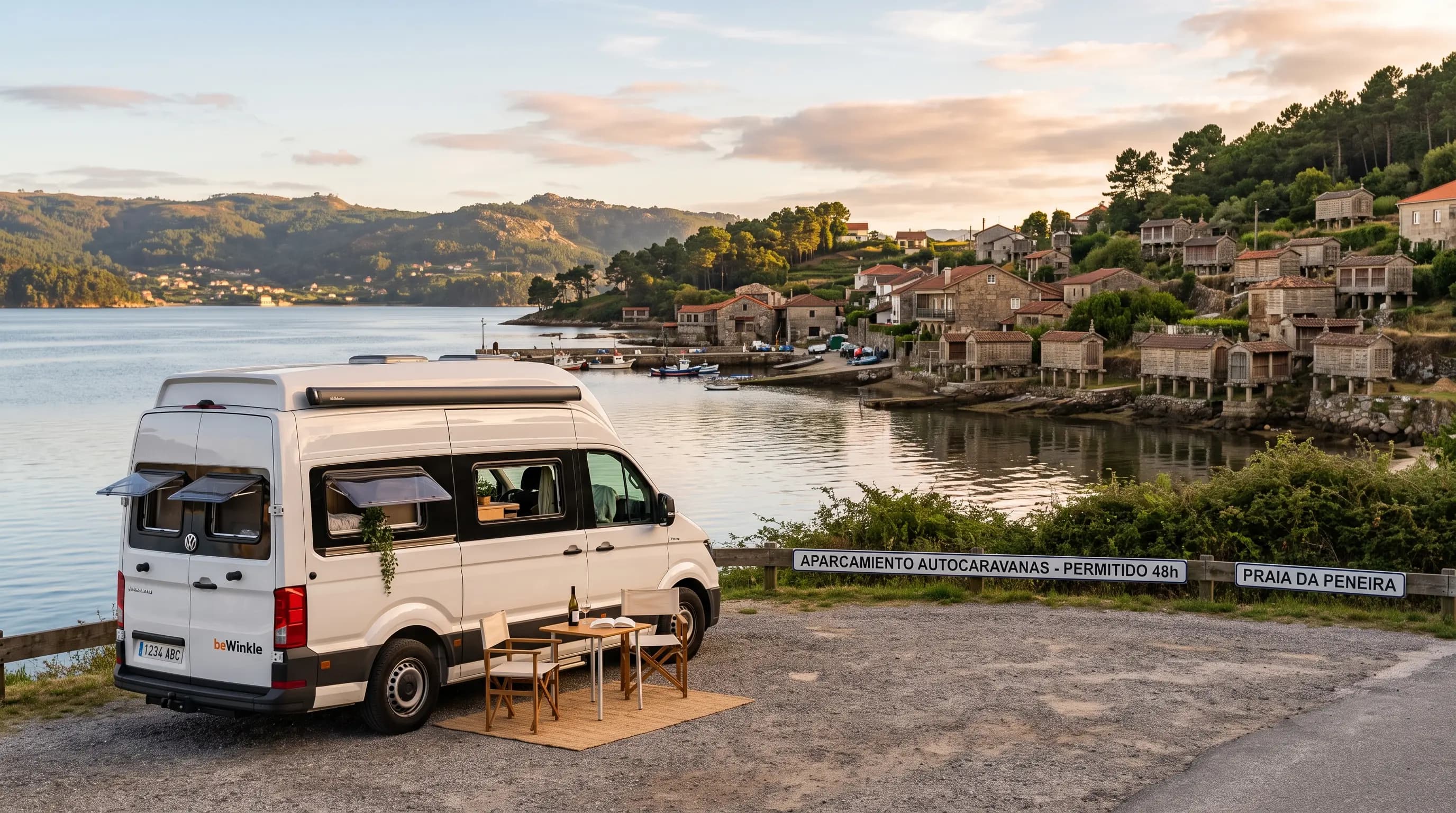
Galicia by campervan from Madrid: a 9-day route through the Rías Baixas, lighthouses and the Costa da Morte
Travel through Galicia by campervan from Madrid with this 9-day route through the Rías Baixas, Fisterra, Muxía and the Costa da Morte, with mileage and overnight stops.
Travelling through Galicia by campervan in nine days isn't about ticking off all four provinces on a map. From Madrid, the most balanced route concentrates the trip on the Rías Baixas (Lower Rías) and the Costa da Morte (Coast of Death): fishing villages, Atlantic beaches, lighthouses and back roads, without turning every day into a race against the clock.
This itinerary adds up to roughly 1,600–1,800 kilometres, depending on detours and the exact overnight spots. It sets aside two long days to connect Madrid with Galicia and seven days of gradual progress along the coast. If you only have a week, further down you'll find a shortened version that cuts stops rather than compressing them artificially.
Route summary: Madrid → Ourense or Ribadavia → Combarro and O Salnés → the Barbanza peninsula → Muros → Fisterra → Muxía → Camariñas → Laxe → A Coruña → Santiago → Madrid.
Galicia by campervan route: quick overview
| Recommended duration | 9 days; adaptable to 7 or 8 |
| Departure and return | Madrid |
| Estimated distance | 1,600–1,800 km, depending on detours and chosen stopovers |
| Total driving time | Roughly 22–26 hours |
| Road type | Motorway on the links to/from Madrid; A-roads, secondary roads and coastal routes in Galicia |
| Difficulty | Medium: long connecting days and narrow coastal stretches |
| Best time of year | May, June, September and early October; July and August require more planning |
| Recommended campervan | Índico for 2–4 people; Báltico for groups of up to 5 or greater range |
The distances given are approximate. The actual mileage will vary depending on your overnight stops, closed roads, permitted access points and any detours you take. Work out the final route just before you travel.
Nine-day itinerary along the Galician coast
| Day | Stage | Approximate distance | Driving time |
|---|---|---|---|
| 1 | Madrid–Ourense or Ribadavia | 500–530 km | 5h 15m–6h |
| 2 | Ourense–Combarro–Cambados–O Grove | 150–190 km | 2h 30m–3h 30m |
| 3 | O Grove–Arousa–Corrubedo–Muros | 140–180 km | 3–4h |
| 4 | Muros–Carnota–Ézaro–Fisterra | 80–110 km | 2–3h |
| 5 | Fisterra–Muxía–Camariñas | 80–110 km | 2–3h |
| 6 | Camariñas–Laxe–Ponteceso–Malpica | 90–130 km | 2h 30m–3h 30m |
| 7 | Malpica–A Coruña | 45–70 km | 1–1h 30m |
| 8 | A Coruña–Santiago de Compostela | 75–90 km | 1–1h 30m |
| 9 | Santiago–Madrid | 590–620 km | 6–7h |
The route runs from south to north to avoid doubling back. It doesn't include the Lugo coast, As Catedrais or the eastern Rías Altas (Upper Rías): adding them would turn a nine-day route into a string of transfers.
Day 1: from Madrid to Ourense or Ribadavia
The first day is about getting closer to the coast without arriving worn out. Set off early from Madrid and cover roughly 500 kilometres to Ourense or Ribadavia. Most of it runs along fast roads, but you should factor in rest stops, refuelling and meals.
Ourense works best if you want to walk around the city and start the trip with good food and an urban atmosphere. Ribadavia offers a quieter first night and a historic centre that lets you quickly swap the pace of the motorway for the pace of the road trip.
Don't try to push on to O Grove after picking up the campervan and putting in more than five hours of driving. This route is designed to get you into Galicia with some slack, get to know the vehicle and rest.
Day 2: Combarro, Cambados and O Grove
From the interior, head down towards the Rías Baixas. Your first stop can be Combarro, known for its granaries (hórreos) right by the sea and its narrow streets. Don't take the campervan into the historic centre: use the designated car parks outside it and walk in.
Carry on to Cambados, where the old town and the albariño wine culture justify a long stop. If you visit a winery, book ahead and leave the driving afterwards to whoever hasn't been drinking.
End the day on the O Grove peninsula or around A Lanzada. In high season, look for a campsite or authorised area before you arrive; coastal car parks can fill up and have specific restrictions.
Priorities for the day: Combarro, a walk around Cambados and sunset on the O Salnés coast. If you're running late, drop a stop rather than driving at night on secondary roads.
Day 3: the Ría de Arousa, Corrubedo and Muros
Skirt the Ría de Arousa at a selective pace. You don't need to go into every village. Pick one harbour, one market or one seafront walk, and save time for the Corrubedo Nature Park and its surroundings.
In natural spaces, only park where it's permitted and respect barriers, signage and any seasonal restrictions. Driving a campervan doesn't give you the right to access tracks, dunes or restricted car parks.
Carry on to Muros. Its old town and seafront make for a good transition between the Rías Baixas and the Costa da Morte. This stage includes roads that run through towns, with bends, traffic and local traffic: the distance looks short, but the actual time usually runs longer than on a motorway.
Day 4: Carnota, Ézaro and Fisterra
This is one of the most visually striking days of the route. Head from Muros towards Carnota, continue to the mouth of the River Xallas at Ézaro and finish at Fisterra.
Pick two or three stops:
- the hórreo (granary) and surroundings at Carnota;
- a coastal walk with permitted access;
- the Ézaro waterfall;
- Fisterra harbour;
- the lighthouse at Cape Fisterra at the end of the day.
Access to the lighthouse can get busy with traffic, coaches and pedestrians. Check the current rules and don't use the car park as an overnight spot. If you want to catch the sunset, sort out your overnight stay beforehand so you're not hunting for a space after dark.
Day 5: Muxía and Cape Vilán
From Fisterra, drive to Muxía. The Sanctuary of A Virxe da Barca and the coastline let you spend the morning walking without racking up more kilometres.
Then carry on to Camariñas and Cape Vilán. The scenery tempts you to follow any track near the sea, but a campervan route needs to stick to authorised access points and road conditions. If the sat nav suggests a shortcut that's narrow or unpaved, stay on the main road.
Cape Vilán lighthouse is one of the essential stops on the Costa da Morte. Check opening times and access before visiting, especially in strong wind or bad weather.
Day 6: Camariñas, Laxe, Ponteceso and Malpica
This leg follows some of the scenery linked to the Camiño dos Faros (Lighthouse Way), though it's not meant to walk that route on foot. Use the campervan to link the villages and pick one short walk you can safely complete.
Camariñas, Laxe, Ponteceso and Malpica offer more stops than will fit in a single day. A balanced combination would be:
- a relaxed morning in Camariñas;
- a walk and lunch in Laxe;
- a scenic stop around Ponteceso;
- arriving in Malpica while there's still light.
Don't try to reach every lighthouse with the campervan by the shortest route. Check the width, surface, gradients and whether you can actually turn around. On the coast, the last kilometre usually demands more attention than the previous hundred.
Day 7: A Coruña without moving the campervan around the centre
Drive to A Coruña and leave the campervan somewhere authorised from which you can use public transport or walk. Moving a campervan through narrow city-centre streets and hunting for parking next to every monument wastes time and increases the risk of a knock or scrape.
Spend the day at the Tower of Hercules and its surroundings, the seafront promenade, the Cidade Vella (old town) and an unhurried meal. If you want to go inside the Tower of Hercules or visit any museums, check opening times and book where needed.
This day cuts down on driving and lets you rest before Santiago and the long drive back to Madrid.
Day 8: Santiago de Compostela
Head to Santiago and use a campsite, motorhome service area or authorised car park outside the historic centre. The centre is best enjoyed on foot: Praza do Obradoiro, the market, the streets of the monumental quarter and the nearby parks.
Don't plan around the cathedral alone. Set aside time for lunch and for wandering the city without packing the day full of sightseeing. In the afternoon, get the campervan ready for the journey home: fuel, water, luggage, a basic clean and checking the next day's route.
If you'd rather avoid such a long final leg, you can cover part of the journey south-east in advance and spend the night at an authorised area. In that case, adjust the mileage for day nine too, and don't drive tired.
Day 9: the return from Santiago to Madrid
The final day runs to around 600 kilometres. Set off early and take a break at least every two hours, or sooner if you feel tired. Share the driving between whoever is named as an authorised driver on the contract.
Leave time to refuel and return the campervan within the agreed slot. A traffic jam, a long lunch or an extra stop can turn a tight schedule into a late return with a surcharge.
If the drop-off time won't let you complete the leg safely, drop Santiago from the plan or spend the previous night closer to Madrid. The route needs to fit the contract, not the other way round.
How to adapt the Galicia route to 7 or 8 days
The eight-day version
Combine A Coruña and Santiago into a single day, or visit only one of the two cities. The coastal route stays untouched:
Madrid → Ourense → Rías Baixas → Muros → Fisterra → Muxía and Camariñas → Laxe and A Coruña → Santiago and Madrid.
The seven-day version
For seven days, cut destinations, not rest. The most sensible option is:
- Madrid–Ourense or Ribadavia;
- Combarro–Cambados–O Grove;
- Corrubedo–Muros;
- Carnota–Ézaro–Fisterra;
- Muxía–Camariñas–Laxe;
- Laxe–Santiago;
- Santiago–Madrid.
In a week, drop A Coruña and Malpica. Don't try to squeeze in the Ribeira Sacra, the Lugo coast and As Catedrais too — those areas deserve a route of their own.
Where to spend the night in a campervan in Galicia
There's no blanket permit to spend the night in any random viewpoint or coastal car park. The DGT (Spain's traffic authority) states that, generally speaking, motorhomes can stop and park under the same conditions as other vehicles, but must comply with local by-laws and signage. What's more, parking is not the same as camping.
For each night, prioritise:
- campsites open and suited to the season;
- public or private motorhome and campervan service areas;
- car parks where local rules allow the vehicle and an overnight stay;
- alternatives located before or after the sightseeing spot if the town is full.
Turismo de Galicia (Galicia's tourist board) maintains an official locator of tourist resources where you can check motorhome areas. Confirm directly with whoever manages the site:
- whether campervans are allowed;
- whether it's open on your dates;
- opening hours and maximum stay;
- booking or fees;
- water, waste disposal and electricity;
- restrictions due to works, local festivals or the season.
Once properly parked, avoid putting out awnings, tables, chairs or chocks beyond the vehicle's footprint; pouring out liquids; making noise; or taking up extra space. When you want to set up anything outdoors, use a campsite or a space that expressly allows camping.
Also see our guide on the differences between parking, staying overnight and camping.
What the roads on this route are like
The Madrid–Galicia and Santiago–Madrid links run mainly along motorways. On the coast you'll find A-roads, regional roads and local routes with bends, town crossings, changes in gradient and narrow verges.
Drive by these rules:
- don't take a shortcut unless the signage confirms it's suitable;
- check height and width restrictions before entering a historic town centre;
- slow down in rain, fog or crosswinds;
- anticipate meeting coaches and farm vehicles;
- park outside villages with narrow streets;
- avoid arriving at night at viewpoints or areas you don't know;
- don't park in front of entrances, private land or emergency exits.
The weather forecast can change fast on the Atlantic coast. Check AEMET (the Spanish met office) warnings and traffic conditions before each stage, not just when you leave Madrid.
How much mileage to book and how to estimate fuel
The full route requires roughly 1,600–1,800 kilometres. On a nine-day booking, beWinkle's base package includes 900 kilometres, and the 200 km/day package adds up to 1,800. For this itinerary, the second option fits better if your final route stays within that range.
If you choose seven days, 200 km a day comes to 1,400 kilometres, which may fall short for a route from Madrid. Work out the exact route and compare the cost of the package, unlimited mileage and any possible excess.
To estimate fuel, use this formula:
Total kilometres × consumption in litres/100 km ÷ 100 × diesel price per litre.
With the consumption range published by beWinkle — 7.5 to 8.5 L/100 km — a 1,700 km route would use roughly 128–145 litres. Multiply that figure by the current fuel price before you travel. Wind, load, speed, gradients and traffic can all push consumption up.
The guide on working out your rental mileage will help you pick the right package without overpaying.
Which Winkle to choose for Galicia
Índico: the balanced choice for 2–4 travellers
The Índico comes with stationary heating, a pop-top roof, a 57-litre water tank, an outdoor shower, a solar panel, electrical hook-ups and a 50-litre fridge. It's a well-balanced choice for a long week in Galicia, where rain can mean spending more time indoors than planned.
Check availability for the Winkle Índico.
Báltico: for five people or maximum range
The Báltico adds capacity for up to five travellers, hot water, two beds, heating, a solar panel and a 220V outdoor hook-up. It makes sense for families, groups and routes where range matters more than the daily rate.
Check availability for the Winkle Báltico.
If there are two of you travelling in summer, the Adriático or Caribe can also handle the route. Even so, for nine days it's worth weighing up water capacity, heating, storage and interior comfort before choosing on price alone.
Checklist before setting off for Galicia
- Route saved, with alternatives in case of rain or wind.
- 1,600–1,800 km planned, plus a margin for detours.
- The right mileage package chosen.
- First and last legs compatible with your pick-up and drop-off times.
- Areas or campsites checked for every night.
- A backup plan in case a spot is full.
- Raincoat, waterproof footwear and layered clothing.
- Sun protection, even under cloud cover.
- Enough fuel before rural stretches.
- Water topped up and service points identified.
- Food for one extra day, just in case.
- Assistance phone number and contract easy to hand.
- Documentation for all authorised drivers.
- Opening times and access rules for lighthouses and protected areas checked.
Prepare for an Atlantic week without turning it into a race
Galicia rewards routes with breathing room: an unexpected stop, a rainy day and a long lunch are all part of the trip. Keep the two connecting days, choose just a few bases and let the itinerary breathe.
Check which Winkles are available for your Galicia route and set your mileage before finalising your booking.
Route and conditions reviewed in July 2026. Check the weather, local by-laws, access points and area availability before you travel.
Keep reading: Campervan routes from Madrid · Southern France by campervan
Frequently asked questions
How many days do you need to tour Galicia by campervan?
Nine days lets you connect Madrid with the Rías Baixas and Costa da Morte without driving the whole time. In seven days, it's best to narrow the route to south-western Galicia and leave A Coruña, the Rías Altas and the Lugo coast for another trip.
How many kilometres is this route from Madrid?
Roughly 1,600–1,800 kilometres. The final distance depends on your overnight stops, detours and chosen access routes.
Can you sleep inside the campervan in Galicia?
Yes, when the vehicle is parked in line with local rules and there's no local ban in place, but you must respect municipal signage. To set up anything outdoors or use services, choose campsites and areas that expressly allow it.
What's the best time of year for this route?
May, June and September usually strike a good balance between daylight hours and lower tourist numbers. In July and August, book ahead. Whatever month you go, be prepared for rain, wind and changing temperatures.
Which campervan is best for Galicia?
The Índico is a well-balanced choice for two to four people thanks to its heating, water and power set-up. The Báltico adds capacity for five, hot water and extra equipment for longer routes.
Can I add As Catedrais to this route?
It's not advisable in seven or nine days from Madrid if you want to explore the Rías Baixas and Costa da Morte at a relaxed pace. As Catedrais is on the Lugo coast and fits better into a different route through the Rías Altas and the Mariña Lucense.